Gallery · The Republic of Pirates · Room 3 of 6
Was It Really a Republic?
Curator's note
The phrase that brings most people to this subject was coined in 2007. That is worth knowing before the room begins, because the room is an exercise in setting a modern label beside the vocabulary of the people it describes.
"the Name of a Commonwealth" · "In the Commonwealth of Pyrates" · "Treating with the Government upon the Foot of a Commonwealth"
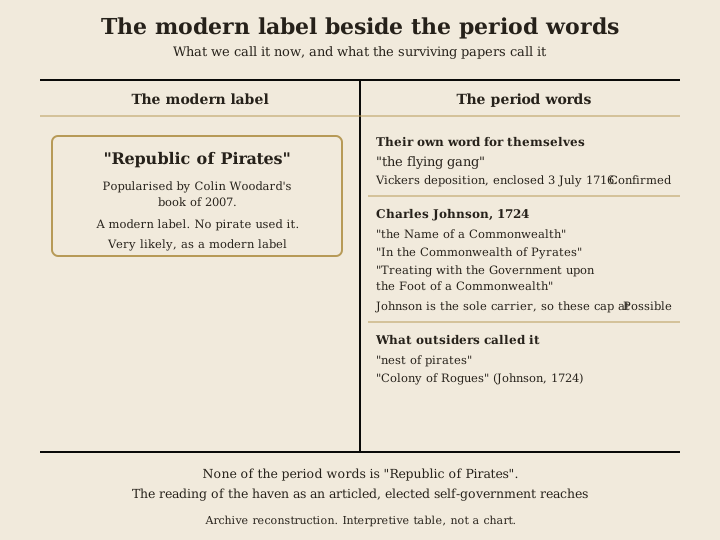
- "Republic of Pirates" was popularised by Colin Woodard's book of 2007. It is a modern label. No pirate used it.
- "flying gang" is what the men called themselves, in the Vickers deposition enclosed 3 July 1716. Confirmed.
- Charles Johnson in 1724 writes of "the Name of a Commonwealth", "In the Commonwealth of Pyrates" and "Treating with the Government upon the Foot of a Commonwealth". Johnson is the sole carrier, so these cap at possible.
- Outsiders wrote of a "nest of pirates" and a "Colony of Rogues".
- The reading of the haven as an articled, elected self-government reaches possible.
The constitutional reading has one strong prop, and it is real enough as far as it goes. Johnson gives the New Providence men republican words at the moment the pardon was coming, and those words carry a political idea. He is the only source that carries them.
Control of a place is the part beyond dispute. From about 1713 the pirates used Nassau harbour freely, refitted there, sold there and were reported there by name in official correspondence for five years. Governors wrote to London about them. Merchants avoided them. Pirate companies governed themselves by articles and by vote, as men swore in courts elsewhere.
The distance between those two statements is the room. A base with a dominant figure, shared customs and articles agreed aboard individual ships is one thing. A polity with a constitution, an electorate and officers of state is another, and for the second there is a handful of phrases in a book printed six years after the haven ended.
The label itself has a date and an author, and they belong on the wall beside the period words: Colin Woodard, The Republic of Pirates, 2007. It is a modern book of narrative history, and the phrase it fixed in the popular mind is a twenty-first-century one.