Gallery · Blackbeard · Room 4 of 7
The Pardon and the Relapse
Curator's note
The instrument that was supposed to end his career survives in print, dated and numbered, and it is the most precisely datable object in this Collection. He accepted it. Then he took another ship.

The reward schedule matters for what comes later in this walk, because it put a public price on the head of a man who did not come in.
He came in. Some time in late June 1718 he took the pardon from Charles Eden, governor of North Carolina, at Bath. No exact day was recorded. He settled there, and for a few weeks lived quietly in a small colonial town.
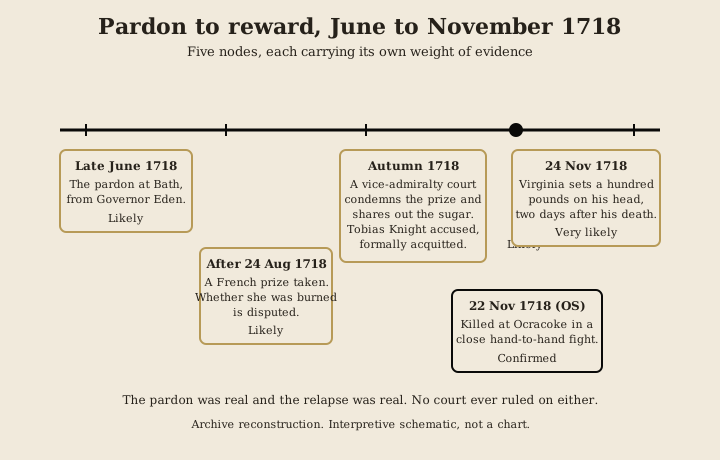
- Late June 1718: the pardon at Bath, from Governor Eden. Probable.
- After 24 August 1718: a French prize taken. Whether she was burned is disputed. Probable.
- Autumn 1718: a vice-admiralty proceeding condemns the prize and shares out her sugar. Tobias Knight is accused and formally acquitted. Probable.
- 22 November 1718, Old Style: killed at Ocracoke. Confirmed.
- 24 November 1718: Virginia sets a hundred pounds on his head, two days after his death. Highly probable.
The prize is the hinge. Some time after 24 August 1718 a French vessel came into his hands, and she was brought in and dealt with through a vice-admiralty proceeding that condemned her and shared out her cargo of sugar. Whether the hull was afterwards burned is disputed in the sources. Tobias Knight, the colony's secretary and customs collector, was accused of taking a share and was formally acquitted. The corruption reading is a modern argument, made principally by Lee and Woodard, not a finding of the period record.
The pardon was real and the relapse was real, and no court ever ruled on either. The instrument itself, and how the Crown used mercy as a weapon across the whole suppression, is held in The King's Pardon.