Gallery · Theme · THM-004
Pirate Pardons
Also recorded as: The Act of Grace; The King's Pardon; the King's Proclamation for Suppressing of Pirates
From: 5 September 1717 To: 1 July 1719
The Crown's proclamations of 1717 and 1718, issued under the prerogative and not by Act of Parliament, offering surrendering pirates a pardon for their lives. The two proclamation texts are Confirmed verbatim; the surrender numbers behind them are graded lower.
Curator's note
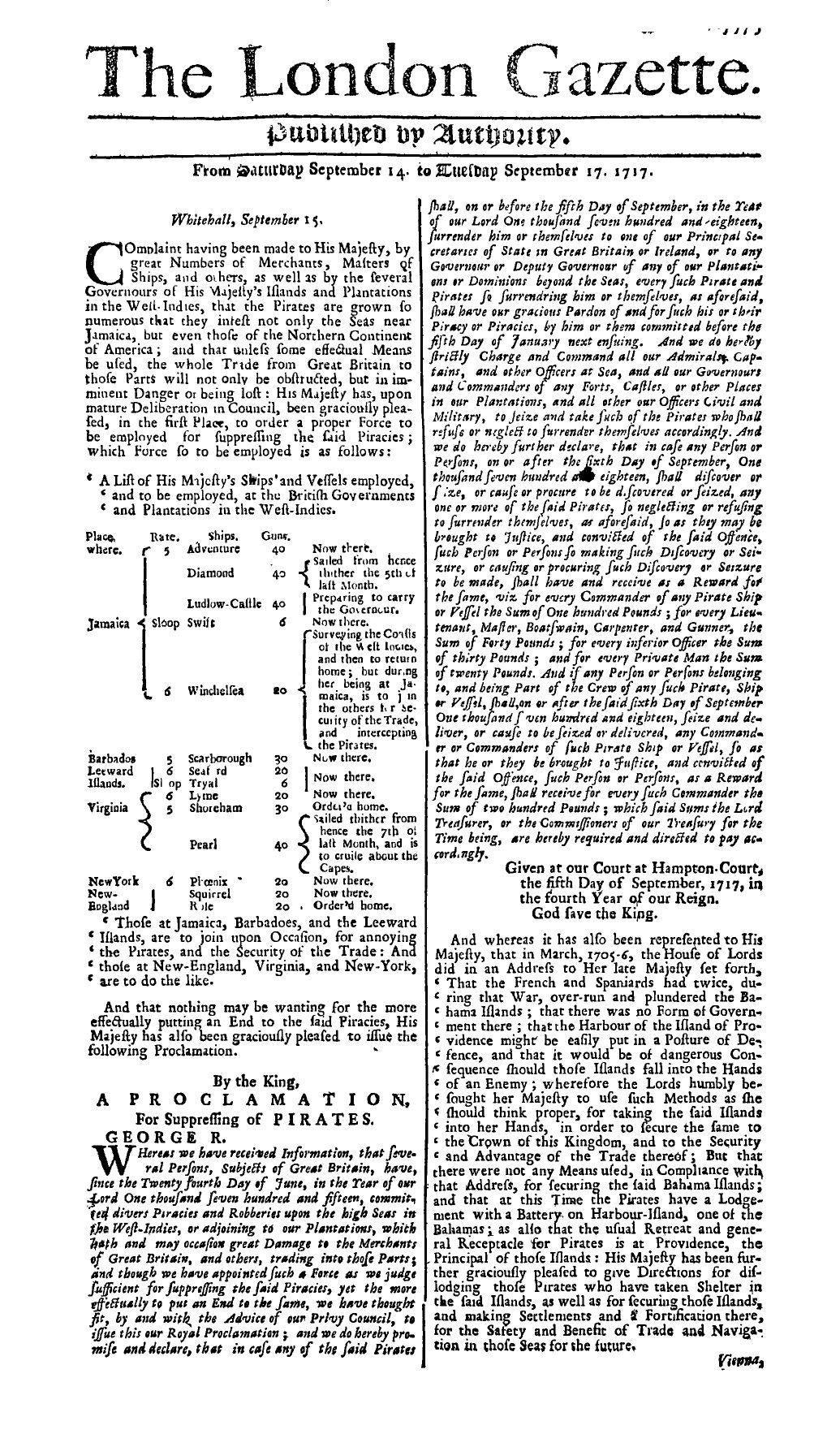
There's no single artefact for the pardon, there are two: the issues of the London Gazette in which the Crown printed its terms. Both are shown here, and both are transcribed to the letter below.
The pardon was the carrot. Set against the navy and the vice-admiralty gallows, it offered a pirate the one thing the gallows took: his life, if he came in by a date and gave up the trade. It was cheaper than a squadron and, for a while, it worked better.
What it was
A pirate pardon was the Crown's remission, by royal proclamation issued under the prerogative of mercy, of the capital penalty for piracy, granted to sea robbers who surrendered themselves to a designated officer within a fixed window and for piracies committed before a fixed cut-off. It was not an Act of Parliament, though contemporaries, Governor Woodes Rogers among them, called it the "Act of Grace." Every documented pardon in the theme shows the same four parts: a voluntary surrender, an administering officer, a written certificate, and a defined span of time and offences.
The two proclamations, read from the Gazette
The first proclamation, "By the King, A Proclamation, For Suppressing of Pirates," was given at Hampton Court on the fifth day of September 1717, in the fourth year of George I. Its recital dates the piracy wave it addresses to "since the twenty fourth Day of June ... One thousand seven hundred and fifteen," which is the start of the problem and not the pardon cut-off. The pardon clause fixes that cut-off exactly:
every such Pirate and Pirates so surrendring him or themselves, as aforesaid, shall have our gracious Pardon of and for such his or their Piracy or Piracies, by him or them committed before the fifth Day of January next ensuing.
Piracies committed before 5 January 1718 were pardonable; the pirate had to surrender "in or before the fifth Day of September ... One thousand seven hundred and eighteen." After that a reward schedule turned pirate against pirate: 100 pounds for taking a commander, down to 20 pounds for a private man, and 200 pounds to any crew member who seized and delivered up his own commander. No pirate is named in the proclamation.
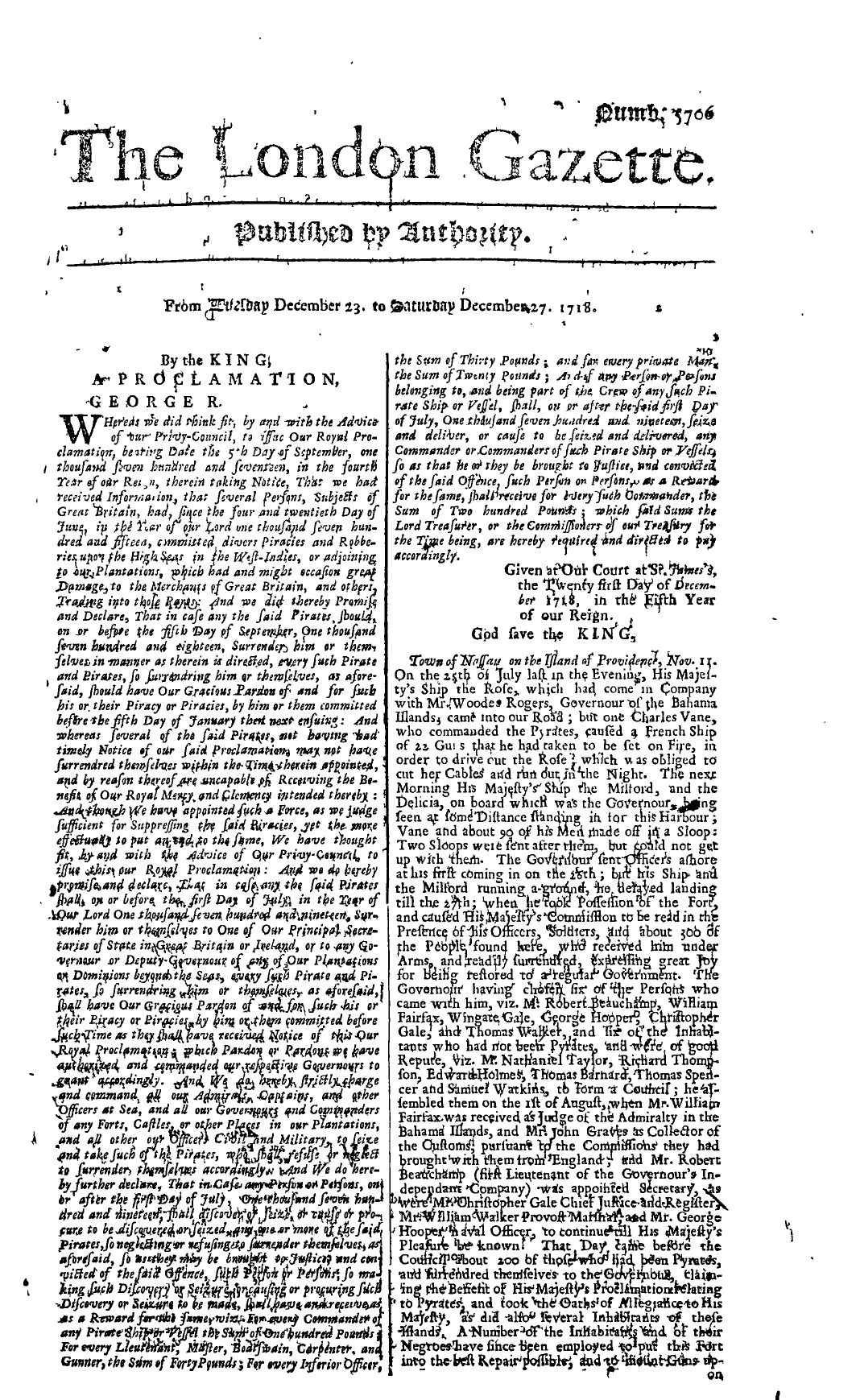
The second proclamation, given at St James's on the twenty-first day of December 1718, in the eighth year of the reign, extended the window. Surrender was now open "on or before the first Day of July ... One thousand seven hundred and nineteen," and the piracies covered were widened forward, to those committed "before such time as they shall have received Notice of this Our Royal Proclamation." Both proclamations are quoted verbatim from the printed Gazette, issues 5573 and 5706, and their terms are Confirmed.
Who administered it
The proclamation named the Secretaries of State and any Governor or Deputy Governor of the plantations. In the field the work fell to Royal Navy captains too. The type case is Captain Vincent Pearse of HMS Phoenix, who reached New Providence in February 1718 "having His Majesty's Proclamation on board, for the pardoning of Pirates," took surrenders and issued certificates; his list is reported to carry about 209 names in ADM 1/2282, a figure resting on report rather than on the manuscript and so held at Probable. When Rogers arrived that July he administered the pardon by the same instrument, writing that "this has been one great reason why I gave them all their certificates in ye manner I did." Blackbeard surrendered to Governor Charles Eden at Bath and took the Act of Grace the same summer, which shows the reach of the thing and, in his case, its limit.
The relapse problem
The weakness was built in. A man could surrender, pocket the certificate, and go back to sea. Charles Vane is the archetype. Pearse deposed that Vane, "about the latter end of March, 1718, being then at Providence ... surrendered himself to him, in order to obtain the benefit of the said Proclamation, which he received, and afterwards turned Pirate." The certificate was a physical thing that could be destroyed: Vane's associate Robert Deal told the Jamaica court he had "the King's Pardon from the Governor of Providence, but that the same had been taken from him, and torn in Pieces by the Pirates." Rogers put a number on the failure in his despatch of 31 October 1718: "above 100 men that accepted H.M. Act of Grace in this place are now out pirating again."
The enforcement moment
When mercy failed, the state showed the other instrument. Rogers tried the recaptured company of John Auger at Nassau on 9 and 10 December 1718. Ten men were tried; John Hipps was acquitted as a forced man; nine were convicted; eight were hanged at Nassau on 12 December 1718, and George Rounsivell, one of the convicted, was reprieved at the gallows. These were relapsed pardon-holders, and hanging them was the answer to the relapse. The count rests on secondary and tertiary carriers and is graded Probable; the primary court record is not in evidence here.
The numbers, honestly graded
Roughly two hundred pirates are reported to have taken the pardon at Nassau in the first days after Rogers landed, and his own letters speak of others going out again, so the census is a moving one and its totals are Probable at best. The individual cases sit at different grades. Vane's surrender and relapse are Confirmed from Pearse's sworn deposition. Benjamin Hornigold's pardon by early 1718 is Probable. Rackham's reported 1719 pardon at Nassau reaches us only through Johnson and is capped at Possible. Anne Bonny and Mary Read were never pardoned; their 1720 cruise fell outside the window. The pardon that began the end of the Golden Age is best understood as one instrument among four, and the least reliable of them on its own.
The letter of the pardon is secure and the arithmetic of it is not: the two proclamations survive word for word, but the surrender lists and the December court record that would fix the numbers are not in evidence here, and the page grades them accordingly.
Connections
- The End of the Golden Age features Pirate Pardons
Evidence behind this record
- A pirate pardon was the Crown's remission, by royal proclamation under the prerogative of mercy and not by Act of Parliament, of the capital penalty for piracy, for pirates who surrendered to a designated officer within a fixed window for piracies committed before a fixed cut-off. Contemporaries, including Governor Woodes Rogers, called it the "Act of Grace". Definition on primary anchors: The two proclamations (London Gazette 5573, 5706); 'Act of Grace' attested by Rogers, CSP Colonial vol 30, 31 October 1718
- The first proclamation, given at Hampton Court on 5 September 1717, pardons piracies "committed before the fifth Day of January next ensuing" (5 January 1718) for pirates who surrender "in or before the fifth Day of September ... One thousand seven hundred and eighteen"; its recital dates the piracy wave to "since the twenty fourth Day of June ... One thousand seven hundred and fifteen" (the start of the problem, not the cut-off), and a reward schedule (100/40/30/20 pounds by rank, 200 for delivering up a commander) follows the deadline. Printed proclamation: The London Gazette, issue 5573, page 1, read verbatim from the issue PDF
- The second proclamation, given at St James's on 21 December 1718, extends the surrender window to "the first Day of July ... One thousand seven hundred and nineteen" (1 July 1719) and widens the piracies covered to those committed "before such time as they shall have received Notice of this Our Royal Proclamation." Printed proclamation: The London Gazette, issue 5706, page 1, read verbatim
- The pardon was administered by Secretaries of State and by any Governor or Deputy Governor, and in the field by Royal Navy captains: Captain Vincent Pearse of HMS Phoenix took surrenders at New Providence in early 1718 "having His Majesty's Proclamation on board" and issued certificates, and Rogers issued certificates at Nassau ("I gave them all their certificates in ye manner I did"). Pearse's reported list of about 209 names (ADM 1/2282) was not read at the manuscript and is Probable. Sworn deposition and state paper: Pearse deposition, 1721 Tryals print; Rogers, CSP Colonial 31 October 1718; the ~209 count from ADM 1/2282 reported, not read
- The pardon's structural weakness was relapse. Pearse deposed that Charles Vane "surrendered himself to him, in order to obtain the benefit of the said Proclamation, which he received, and afterwards turned Pirate"; Robert Deal testified his "King's Pardon from the Governor of Providence" had been "taken from him, and torn in Pieces by the Pirates"; and Rogers reported "above 100 men that accepted H.M. Act of Grace in this place are now out pirating again." Sworn deposition and state paper: Pearse and Deal, 1721 Tryals print; Rogers, CSP Colonial vol 30, 31 October 1718
- The enforcement answer to relapse was the December 1718 Nassau trial of pardon-holders who had returned to piracy: ten tried, John Hipps acquitted as a forced man, nine convicted, eight hanged on 12 December 1718, George Rounsivell reprieved at the gallows. Probable Secondary and tertiary carriers: Carried by the Calendar of State Papers and later accounts; the primary court record (CO 23/13) is not in evidence
- The end of the Golden Age of piracy in roughly 1716 to 1726 was a deliberate, coordinated state project of four instruments working together, the pardon (the Act of Grace), naval force, the reformed piracy law and exemplary public justice at the gallows, and not an organic fading of the trade nor the consequence of any single pirate's death. The pardon was the carrot; the navy, the statutes and the vice-admiralty gallows were the stick. Probable Interpretive synthesis: Editorial synthesis of the two royal proclamations (London Gazette 5573 and 5706), the Piracy Acts of 1698 and 1721, and the executions record from Boston 1717 to Boston 1726
- The pirate pardon of the Golden Age was granted by royal proclamation under the prerogative, not by an Act of Parliament; the first, "By the King, A Proclamation, For Suppressing of Pirates", was given at Hampton Court on 5 September 1717, in the fourth regnal year of George I. Royal proclamation: London Gazette, issue 5573 (proclamation given at Hampton Court, 5 September 1717)
- The first proclamation pardons piracies "committed before the fifth Day of January next ensuing" (5 January 1718); its recital separately notes piracies committed "since the twenty fourth Day of June 1715". A second proclamation, given at St James's on 21 December 1718, extended the surrender window to 1 July 1719. Royal proclamations: London Gazette, issue 5573 (5 September 1717) and issue 5706 (21 December 1718)
- The December 1718 Nassau trial of relapsed pardon-holders (John Auger, Phineas Bunce and company, retaken by Benjamin Hornigold) tried ten, convicted nine, and hanged eight on 12 December 1718; one convicted man, George Rounsivell, was reprieved at the gallows, and John Hipps was acquitted as a forced man, not reprieved. The trial and condemnations are firm from the calendared court copy; the gallows detail rests on consistent independent carriers. Highly Probable Court record (calendared) and independent carriers: Calendar of State Papers, Colonial, volume 31, item 475 (CO 23/1 No. 18); gallows detail from consistent independent carriers
- Charles Vane surrendered to Captain Vincent Pearse at Providence about the latter end of March 1718 to obtain the benefit of the King's proclamation, received the pardon, and afterwards turned pirate again: the recorded pattern of a man taking the certificate and going back to sea. Sworn deposition: Deposition of Captain Vincent Pearse (surrender at Providence, latter end of March 1718)
Open research
The two proclamations (London Gazette 5573 and 5706) were read verbatim and their terms are Confirmed. Pearse's surrender list of about 209 names (ADM 1/2282) was not read at the manuscript and is Probable; the December 1718 Nassau trial of relapsed pardon-holders is graded Probable pending the primary court record (CO 23/13); the surrender totals (about 200 at Nassau, and the numbers 'now out pirating again') are a moving census carried on the governor's despatches. Born/died carry the surrender-window dates rather than being suppressed; this is a deliberate divergence from the timeless PG themes, flagged for ratification.