Gallery · The Republic of Pirates · Room 2 of 6
The Flying Gang
Curator's note
Almost every phrase used today for what happened at Nassau was coined later. One of them was written down at the time, in a deposition taken in 1716 and enclosed in a letter home, and it is what the men called themselves.
"flying gang"
Vickers gives the earliest sworn account of the haven: Hornigold's operation at Nassau over the winter of 1715 to 1716, a self-styled flying gang of about fifty men, and Hornigold declaring all the pirates there under his protection. The name and the declaration are confirmed. This is the only self-description of the Nassau company that survives in the pirates' own words, and it reaches us inside somebody else's report.
A year later, Captain Mathew Musson wrote from the islands on 5 July 1717 with a roster of five captains using Providence as a base against a Spanish guardship. The crew and gun figures in that letter, about 140 to 200 men in one company and about 80 in another, are Musson's own reported numbers. One of the five is Thache, whose record is held in the Blackbeard Collection.
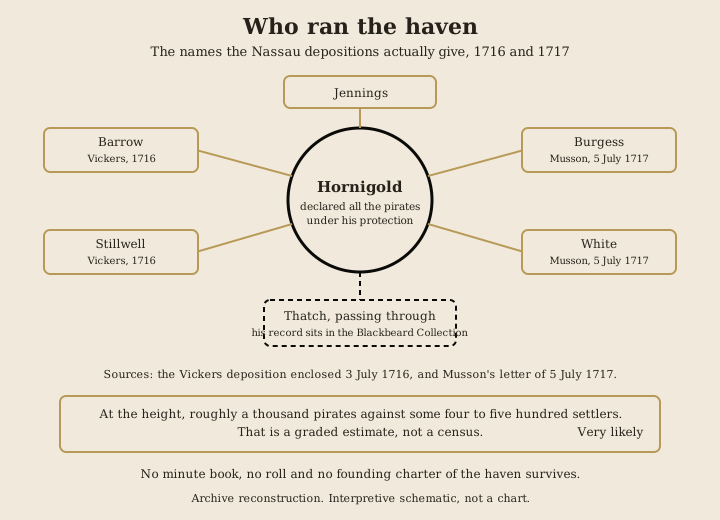
- Benjamin Hornigold sits at the centre, described in the reports as having declared all the pirates there under his protection.
- Jennings, Barrow and Stillwell are named in the Vickers deposition enclosed 3 July 1716.
- Burgess and White are named in Musson's letter of 5 July 1717.
- Thache passes through the network; his own record is held in the Blackbeard Collection.
- At the height, roughly a thousand pirates against some four to five hundred settlers. That is an estimate, very likely rather than counted, and not a census.
They moved into a hole in the government. From about 1703 until the Crown resumed the islands there was no legitimate resident governor at New Providence, and by the height of the haven the pirates were the majority of the town's people. Those population figures come from official correspondence written by men with reasons to sound alarmed, so this Archive carries them as an order of magnitude. Nobody counted them.
That pirate companies governed themselves by vote is confirmed, and the evidence for it is independent of Nassau: sworn testimony at the Cape Coast Castle trial of 1723 describes articles agreed and officers chosen by the company. What the Nassau haven itself left is a name in another man's deposition. No minute book, no roll of the flying gang and no founding charter of the place survives, so this room asserts no Nassau assembly and no written constitution. The question that raises is the next room.