Gallery · Henry Every and the Mughal Crisis · Room 4 of 6
The Crisis and the Manhunt
Curator's note
Thirty two days separate the first of these three sheets from the last. In that time a commercial grievance became an obligation on subjects in three kingdoms.
The consequences ran outward from that deck faster than the Fancy could sail. At Surat the governor set a guard on the East India Company's factory, clapped the Company's people in irons and cut off their communication, and English trade in the emperor's ports stopped. Sir John Gayer's Bombay letter of 12 October 1695 records that "one English man in Surrat carrying to Prison, was so wounded by the Rabble, that he dyed three days after". A letter out of Venice corroborates the plunder and the guards through a wholly separate channel.
The Mughal side of the crisis survives in a Persian court chronicle, the English side in the Company's own correspondence, written by a party with everything to lose.
To save itself the Company petitioned the Lords Justices, and the petition was read on 16 July 1696. The Crown answered the next day, and twice more within the month.
The three sheets
and in case of Resistance to Sink and Destroy the said Ship … a Reward of Five hundred Pounds
hath changed his Name, and now goes by the Name of Henry Bridgman
Fifty two Frenchmen, Fourteen Danes, and others of other Nations
to the amount of One thousand Pounds a Man or thereabouts
from any Hazard of Slaughter, Mutilation, or other Acts of Violence
upon their Highest Peril
at the Mercat-Corss of Edinburgh
The first sheet dates itself 17 July and was published on the 18th, which is where the 18 July dating in two standard editions comes from.
That the Company agreed to pay the five hundred pounds rests on an editorial footnote, against three instruments that all direct the payment to the Crown. The Company was the moving party behind both English sheets.
What these sheets say about the Fancy's cruise came to Whitehall from the Company, at second hand. Their forty six guns and hundred and thirty men are the state's allegation of 1696. The standard national reference entry of 1885 reproduced those two figures as plain description. Very likely
The arrests came first
Men of the company were already in custody in Ireland on 20 June and 2 July 1696, taken by a sheriff and two justices of the peace, before any of the three sheets existed. John Dann was taken at Rochester with gold quilted into his jacket. William May was taken three miles off Bath and examined by the Duke of Devonshire, who had signed the July sheet himself.
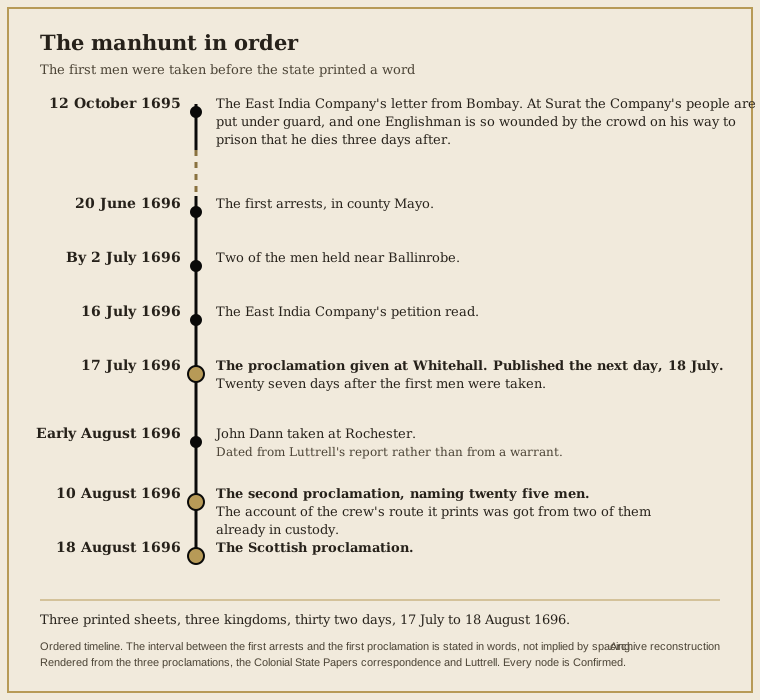
- 12 October 1695. The East India Company's letter from Bombay. At Surat the Company's people are put under guard, and one Englishman is so wounded by the crowd on his way to prison that he dies three days after.
- 20 June 1696. The first arrests, in county Mayo.
- By 2 July 1696. Two of the men held near Ballinrobe.
- 16 July 1696. The East India Company's petition read.
- 17 July 1696. The proclamation given at Whitehall, published the next day. Twenty seven days after the first men were taken.
- Early August 1696. John Dann taken at Rochester. That date comes from Luttrell's report rather than from a warrant.
- 10 August 1696. The second proclamation, naming twenty five men. The account of the crew's route it prints was got from two of them already in custody.
- 18 August 1696. The Scottish proclamation.