Gallery · Collection · COL-006
Henry Every and the Mughal Crisis
How did the taking of one pilgrim ship pull an empire, a trading company and a kingdom into crisis, and where does the record of the man who commanded it end?
COme all you brave Boys, whose Courage is bold,
Will you venture with me, I'll glut you with Gold?Make haste unto Corona, a Ship you will find,
That's called the Fancy
Henry Every commanded a stolen ship for two years and took the richest prize of the age.
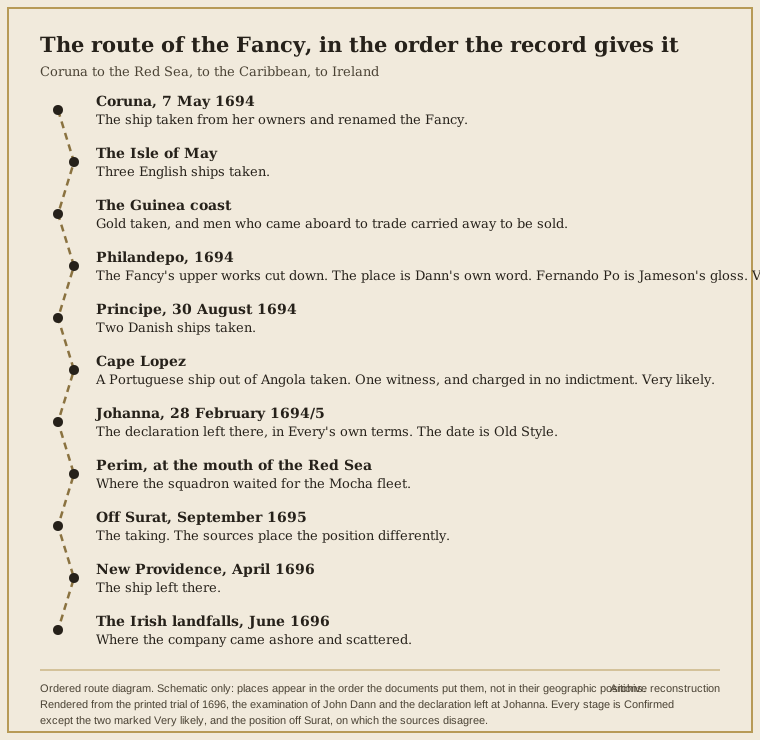
The ship was stolen for wages. At Coruna in the spring of 1694 the Charles the Second lay in a venture that had gone bad, with eight months' pay owing to her company. On 7 May 1694 the men took her and sailed. Every was her master, the officer who navigated her; some of the men put the proposal to him, it was agreed on and sworn to, and they elected him commander. They renamed her Fancy.
In September 1695, near Surat, the company took a Mughal merchantman with small resistance and stripped her of gold and silver. Then they took Aurangzeb's own ship, homeward bound from the pilgrimage to Mecca with pilgrims and their goods aboard, called the Ganj-i-Sawai and rendered in the English record as the Gunsway. Each man's share of that voyage was reckoned at about a thousand pounds, a sum that recurs in the sworn evidence and in the second English proclamation.
What was done aboard the Ganj-i-Sawai is attested by two witnesses. One is a Persian court chronicle written to condemn the pirates. The other is an English commercial letter written to distance the East India Company from them. The two accounts reach us by separate routes, both fed by the Surat information environment, and both report mass rape. The English printed trial says of the same ship only that several men were killed aboard, because the case the Crown chose to bring was a case about property.
The consequences ran outward from that deck faster than the Fancy could sail. Surat rose, English factors were seized and English trade in the emperor's ports stopped. To save itself the Company pressed the Crown, and the Crown answered with the apparatus of a state across three kingdoms in thirty two days: a proclamation of 17 July 1696 setting five hundred pounds on Every's head, a second of 10 August reporting that he had changed his name to Bridgman and listing twenty five of his company, and a Scottish proclamation at Edinburgh on 18 August forbidding anyone to shelter them on their highest peril.
Six men came to the Old Bailey on Monday 19 October 1696, indicted for the taking of the Ganj-i-Sawai, and the jury acquitted all who had pleaded not guilty. The court treated the verdict as a scandal. The second indictment abandoned the Ganj-i-Sawai altogether and prosecuted the mutiny and theft of the Charles the Second at Coruna, a charge two years older and committed against Englishmen in a Spanish harbour, and on it every man was convicted. Five were hanged at Execution Dock on 25 November 1696. They died for stealing an English ship. No jury convicted anyone of what was done aboard the Ganj-i-Sawai.
Every himself was indicted in his absence, at the head of the bill, as "Henry Every not yet taken". "In the trial print, the proclamations and the sworn examinations of the case, the last named person to record seeing Henry Every is John Dann, in his examination of 3 August 1696: Dann and Every landed at Dunfanaghy in county Donegal towards the latter end of June 1696, and parted at Esquire Ray's within six miles of Dunfanaghy." The printed Every, meanwhile, was already everywhere. A ballad in his own imagined voice, the royal proclamations, a gallows ballad sung for his crew and the printed report of the trials all appeared within roughly two years of the Red Sea. The legend was in cheap print and in state print while the man was still alive.
The rooms
-
The Venture and the Mutiny
Eight months' pay owing at Coruna, the ship taken on 7 May 1694 and renamed, and a commander elected by the men who took her. -
The Fancy and the Red Sea
Two years of a stolen ship, the men carried off the Guinea coast, and the wait at Bab-el-Mandeb for the Mocha fleet. -
The Gunsway
What two independent and mutually hostile witnesses record of what was done aboard the emperor's pilgrim ship in September 1695. -
The Crisis and the Manhunt
Surat rises, the Company petitions, and three printed sheets put five hundred pounds and twenty five names across three kingdoms in thirty two days. -
The Two Juries and the Gallows
Acquitted of the Gunsway, convicted of a two-year-old theft in a Spanish harbour, and five hanged at Execution Dock on 25 November 1696. -
The Record That Stops
No arrest, no trial and no account of his death in the papers of the case, and a printed Every who arrived first and stayed.
What it adds up to
Each strand of that story carries a different weight of evidence. The mutiny and its date, the election, the renaming of the ship, the two trials, the acquittal, the convictions, the hangings and the terms of all three proclamations come from the printed trial, from sworn examinations taken within weeks of the events, and from the proclamations themselves. The sexual violence aboard the Ganj-i-Sawai is very likely, resting on two hostile and independent witnesses, and the sources give no reliable count of the dead or the assaulted. The value of the plunder is given as a spread, with each figure tied to its source. John Dann's examination has Every meaning to go to Exeter, being a Plymouth man, and on that one clause a Devon origin is very likely; his birthplace and birth year stay open. None of the documents this Collection rests on, the trial print, the three proclamations, the sworn examinations and Luttrell's week by week record of 1696 to 1700, establishes what became of him, and that silence is the thing this Collection is built around.
The shipboard practices this company used have their own galleries: the election of a captain by the whole company, the written articles that bound a crew, and the quartermaster's divided authority. The pardon of 1698, and the second name excluded from it, belongs to the Kidd Collection.
Go deeper
- Person Henry Every English pirate who led the 1694 mutiny aboard the Charles the Second and took the Ganj-i-Sawai in 1695; his crew were tried in London in 1696, and he was never taken.
- Event Trials of Every's Crew Admiralty sessions at the Old Bailey in 1696: the crew were acquitted on the Ganj-i-Sawai indictment at the first sitting, then convicted on the Charles the Second mutiny; five were hanged and one reprieved.
- Document The Tryals of Joseph Dawson and Others (1696) The printed record of the 1696 Admiralty trial of Every's crew, printed for John Everingham, and the fullest surviving account of the case.