Gallery · Interpretation · Captain Kidd Collection
Was Captain Kidd a Pirate?
The answer differs by act and by document.
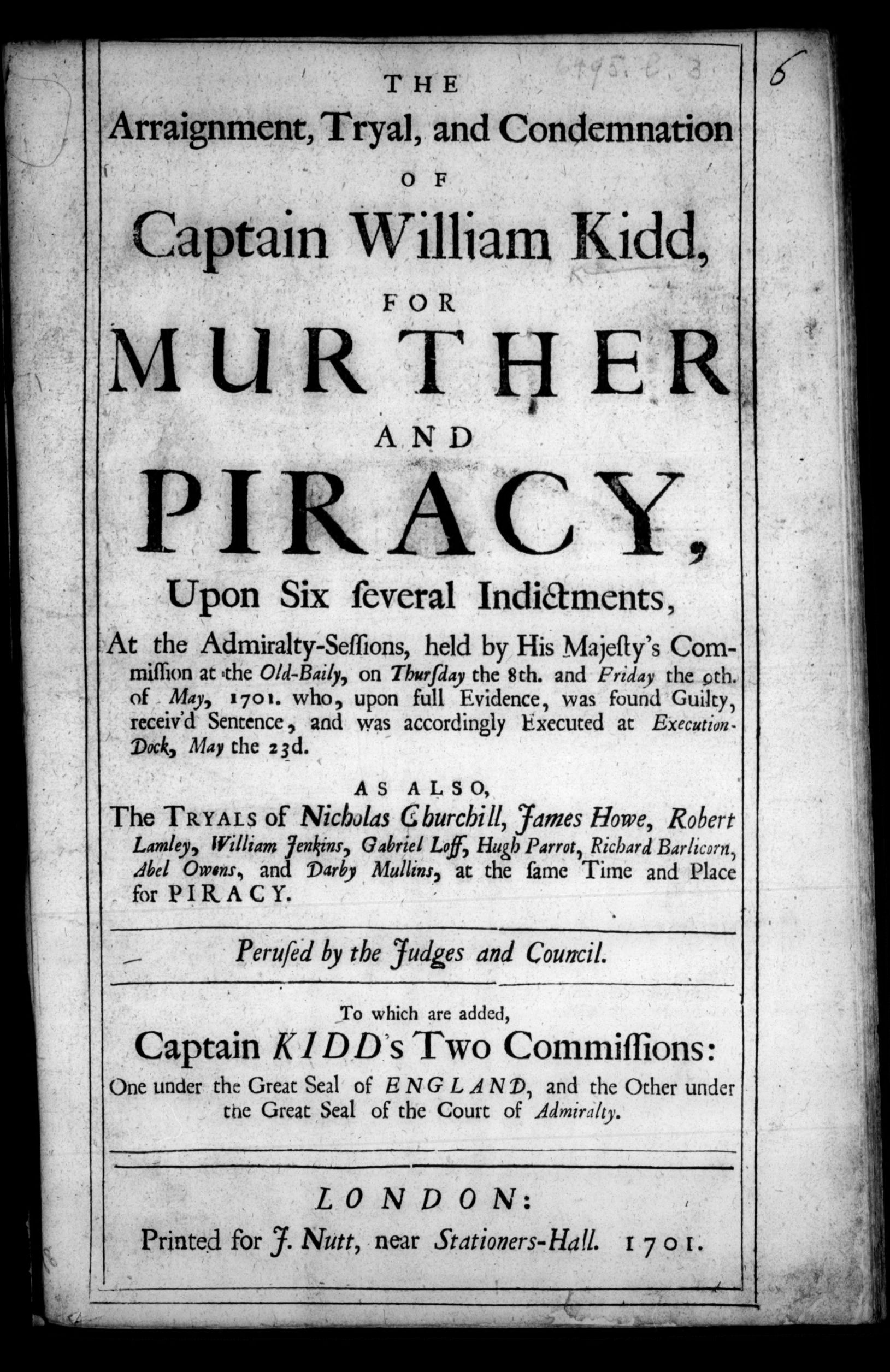
The place to begin is the secure fact: William Kidd held a commission. He was licensed to pursue pirates, and he held separate authority against French shipping in a war England was then fighting. Whatever else he became, he did not begin outside the law. He began as one of its instruments.
That is why the question has no one-word answer. Piracy, in Kidd's world, was not a temperament or a costume. It was a legal status that attached to particular acts, and it attached or failed to attach act by act, document by document. The same broadside fired at the same hull could be service to the Crown or a capital crime, and the difference lay in paper: who issued the commission, what it covered, whose flag the prize sailed under and what protection she carried. Asked properly, the question splits into three.
First: did his authority cover pirate hunting?
Yes, and this part is uncontroversial. The commission to take pirates is confirmed, dated 26 January 1695/6 by its own dateline, a reading taken from the printed text rather than the original manuscript. Acts within that commission were state violence, however rough, in the same way a warship's captures were. Nothing in the voyage's early, empty months required piracy to describe it. A privateer who takes nothing is a failure, and failure is not a crime.
Second: was the Quedagh Merchant piracy or prize?
This is the real question, and it is the one the French passes exist to answer. In January 1698 Kidd took the Quedagh Merchant, an Indian-owned merchant vessel and the voyage's one great capture. She was carrying French protection papers. Under Kidd's authority against French shipping, a vessel under French passes was arguably lawful prize, and the capture arguably sat inside his licence.
Arguably is the honest word, and it cuts both ways. The passes survive, though in transcription rather than in facsimile. What they establish is an argument, and the argument has moving parts: whether the papers were genuine, whether they covered the ship at the moment of capture, and whether a pass of French protection brought a vessel of Indian ownership within the terms of Kidd's particular authority. These were exactly the questions a prize proceeding existed to weigh, with the documents on the table.
They were never weighed that way. The printed trial record shows the passes were never produced and that no witness would say he had seen one, even though official hands had held Kidd's papers before the trial began. The one tribunal that could have settled the capture's status decided it without the documents at its centre. His conviction for piracy is a legal fact. Whether the conviction answered the legal question is a different matter, and the honest answer is that the question went to the gallows unresolved.
I want to be precise about what that absence does to the verdict and what it doesn't. It does not reverse it: a court that had read the passes might still have convicted, on the view that the papers were pretext rather than protection, which is the view the prosecution's case already implied. What the absence does is remove the verdict's authority over the historical question. A judgment reached without the central evidence settles nothing about that evidence, however lawful the judgment was as an exercise of the court's power.
Third: the rest of the voyage
The passes cover particular captures. They are not a general absolution, and other conduct alleged across the voyage has to be weighed on its own evidence, claim by claim. A voyage of that length produced smaller takings, confrontations and decisions whose legal character has to be assessed one act at a time, and they are not swept into either verdict here.
The killing of William Moore stands entirely apart: a murder conviction resting on eyewitness testimony from Kidd's own deck, untouched by any question of prize law. No pass, genuine or false, French or forged, has any bearing on a captain striking his gunner. A man can be wrongly convicted of piracy and rightly convicted of killing his gunner. The trial said both, and nothing in the paperwork contradicts the second.
Why the question is worth asking properly
It would be easy to shrug at all this. Kidd hanged three centuries ago; the verdict cannot be appealed; what turns on the answer now? Two things. The first is the legend. Popular history treats the verdict as a description, and every retelling that begins with "the pirate Captain Kidd" quietly asserts that the Old Bailey settled a question it never actually examined. Getting the answer right is the difference between repeating a court's conclusion and reading its record.
The second is the method, which reaches well past Kidd. His case is the cleanest surviving example of a general problem in this subject: piracy was a legal category applied by interested parties, and the survival of the evidence was itself shaped by the interests involved. Learning to ask "which act, under which document, judged by whom, on what evidence" is how Sailing the Black Flag: The Archives handles every capture in this period. Kidd is the training ground because his paperwork survives well enough to show the machinery working, and failing.
So: pirate or not?
Legally, Kidd died a pirate. The Old Bailey convicted him and the sentence was carried out on 23 May 1701. Historically, the answer has to be taken apart. As a pirate hunter he was licensed. On the Quedagh Merchant he had a documentary defence that was never weighed. On Moore he was a convicted killer regardless. The label that history attached to him, the archetypal pirate of legend, fits the verdict and fits the evidence worst of all.
There's one limitation I should state plainly. The trial record tells us what the court concluded, and the passes tell us what the court never read. Neither tells us everything that happened aboard two ships in the Indian Ocean in 1697 and 1698, and the fuller chronology of the voyage lies in depositions and colonial records beyond these two documents. Where the balance of evidence changes, this account will change with it.
The precise answer, then: Kidd was a commissioned privateer, convicted as a pirate, on charges his missing paperwork might have complicated, alongside a murder his paperwork could never reach. The conviction is history. The description is still open, and it will be settled, to whatever degree it can be, by the documents themselves: the commissions with their exact wording, the passes with their dates and named vessels, and the trial record read against both.