Gallery · Primary Source · SRC-001
The French Passes
The texts survive as archived copies at The National Archives, CO 5/860 No. 64 ii (Rouparelle) and No. 64 iii (Quedagh Merchant), digitised in the TNA image library. The Quedagh Merchant pass is shown below in the 1911 photographic facsimile that announced the documents' rediscovery; the Rouparelle pass is described but not yet shown. The original manuscripts remain at Kew.
Curator's note
The original passes are at The National Archives, Kew. What's on display here is the photograph that brought them back into the light, the plate made for Ralph Paine's The Book of Buried Treasure in 1911, the book that publicised their rediscovery among the Board of Trade papers. In the top right corner of the document there's the enclosure mark 64(iii), the same mark that identifies it at Kew today.
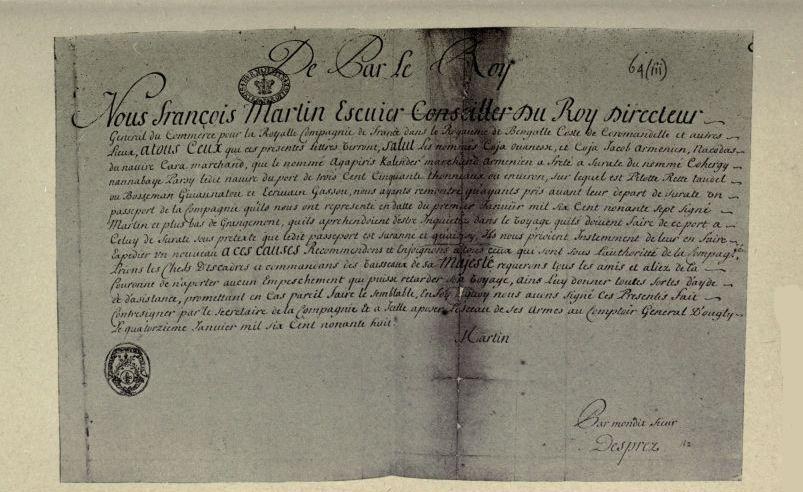
What these documents are
The French passes were protection papers carried by vessels Kidd captured, two of which survive: one for the Quedagh Merchant, taken on 30 January 1697/8, and one for the Rouparelle, taken in November 1697. A pass declared a ship to be under French protection. Under Kidd's authority against French shipping, such papers were the difference between piracy and lawful prize.
Both survive here in transcription rather than in facsimile. They were rediscovered among Board of Trade papers in 1910 and printed in the House of Commons Journal, and are transcribed in J. F. Jameson's 1923 edition of the colonial privateering papers. The Quedagh Merchant pass is recorded as signed by Francois Martin, the founder of Pondicherry, at Hugli on 14 January 1698. These readings come through Jameson's transcription of the Commons Journal, not from the original manuscripts, which is why the textual claims below are held at highly probable rather than confirmed. The present-day location, though, is established: both passes survive as copies enclosed with Bellomont's correspondence at The National Archives, CO 5/860 No. 64 ii (the Rouparelle pass, undated) and No. 64 iii (the Quedagh Merchant pass, signed at Hugli on 14 January 1698), and both are digitised in the TNA image library.
Papers of this kind were ordinary instruments of seventeenth-century trade, not exotica. Merchant vessels in contested waters carried whatever documents would get them past whichever navies and licensed raiders they expected to meet, and a prudent owner might hold protection from more than one power. That ordinariness cuts both ways in Kidd's case. It makes the presence of French passes aboard an Indian-owned ship entirely plausible. It also means a pass, by itself, tells you what protection a ship claimed, which is not always the same as what she was.
Orientation: how to read a pass
In reading a pass, three things matter. Who issued it, because the issuer determines what protection it claimed. Which vessel it names, because the defence turns on matching paper to prize. And its date, because protection had to hold at the moment of capture.
It then has to be read the way the trial never did: alongside the capture. The legal question was never whether French passes existed somewhere in the Indian Ocean. It was whether these papers, on this ship, on that January day, brought the capture within Kidd's authority.
What they establish
- Kidd held authority against French shipping. Letter of marque: Privateering commission and letter of marque against the French, c. December 1695 (Calendar of State Papers Colonial)
- Quedagh Merchant carried French protection papers. Highly Probable Captured documents: French pass for the Quedagh Merchant, signed Francois Martin, 14 January 1698 at Hugli, printed in the House of Commons Journal XIII.21 (Jameson 1923)
- The government possessed French passes before Kidd's trial. Highly Probable Parliamentary and custody records: Kidd's arraignment statement that Lord Bellomont had seized his papers (printed 1701 trial record); the passes were later printed in the Commons Journal XIII.21 and survive as copies at The National Archives, CO 5/860 No. 64 ii (Rouparelle, undated) and No. 64 iii (Cara or Quedagh Merchant, 14 Jan 1698), enclosed with Bellomont's letter and digitised in the TNA image library
- The jury did not see the passes. Trial record: Printed Admiralty sessions trial record (1701): the passes were not produced and no witness would say he had seen one
- Two French passes, for the Rouparelle and the Quedagh (Cara) Merchant, survive in print, and their absence from the trial was central to Kidd's defence. Highly Probable Parliamentary print: House of Commons Journal XIII.21, transcribed in Jameson (1923); rediscovered among Board of Trade papers in 1910. The passes survive at The National Archives as CO 5/860, Nos. 64 ii (Rouparelle) and 64 iii (Quedagh Merchant), enclosures to Bellomont’s letter.
The custody question
For these documents, where they travelled matters almost as much as what they say. The chain is now documented end to end: taken at the captures, carried by Kidd on his return in 1699, delivered to Bellomont, who recorded receiving them on 8 July 1699 and sent them to the Council of Trade as enclosures to his letter No. 64 on 26 July 1699; copies were laid before the House of Commons; the papers were retained among the Board of Trade records, where Ralph Paine's inquiry found them again in 1910. What the chain makes stark is the trial: the passes sat in official custody in London while Kidd was tried a mile away, and the courtroom absence is confirmed by the trial record itself. Why they were not produced, and on whose decision, is the question the surviving record does not answer.
What they do not establish
The passes support a defence around particular captures. They do not prove Kidd innocent of everything alleged across the voyage, and they have no bearing at all on the death of William Moore. Treating them as a general acquittal repeats, in reverse, the trial's own mistake of deciding the case without weighing them.
Limitations of this room
The repository reference is secure and the custody chain is documented, but what is shown here is a 1911 photograph of one pass, not modern photography of either original, and the textual readings still come through the printed transcriptions rather than the manuscripts. The open question is no longer where the passes went; it is why the one tribunal that needed them never saw them.
One further honesty. The passes survive the way most seventeenth-century evidence survives: as papers that passed through interested hands. Kidd surrendered them expecting them to save him, and officials received them with their own stakes in what they proved. The documents can be read. The uses everyone intended for them have to be reconstructed, and no record yet read completes that reconstruction.
The description above is the room, and it claims nothing the documents have not already been confirmed to support.