Gallery · Person · PER-006
Edward Thache (Blackbeard)
Also recorded as: Edward Teach; Edward Thatch / Thach (period spellings); Blackbeard; Tatch (Dickinson letter, 1717)
Born: unresolved; c. 1680 commonly given Died: 22 November 1718 Highly Probable
Pirate captain active 1716 to 1718, killed at Ocracoke in 1718 and never brought to trial; no period document records him harming a captive before that final fight.
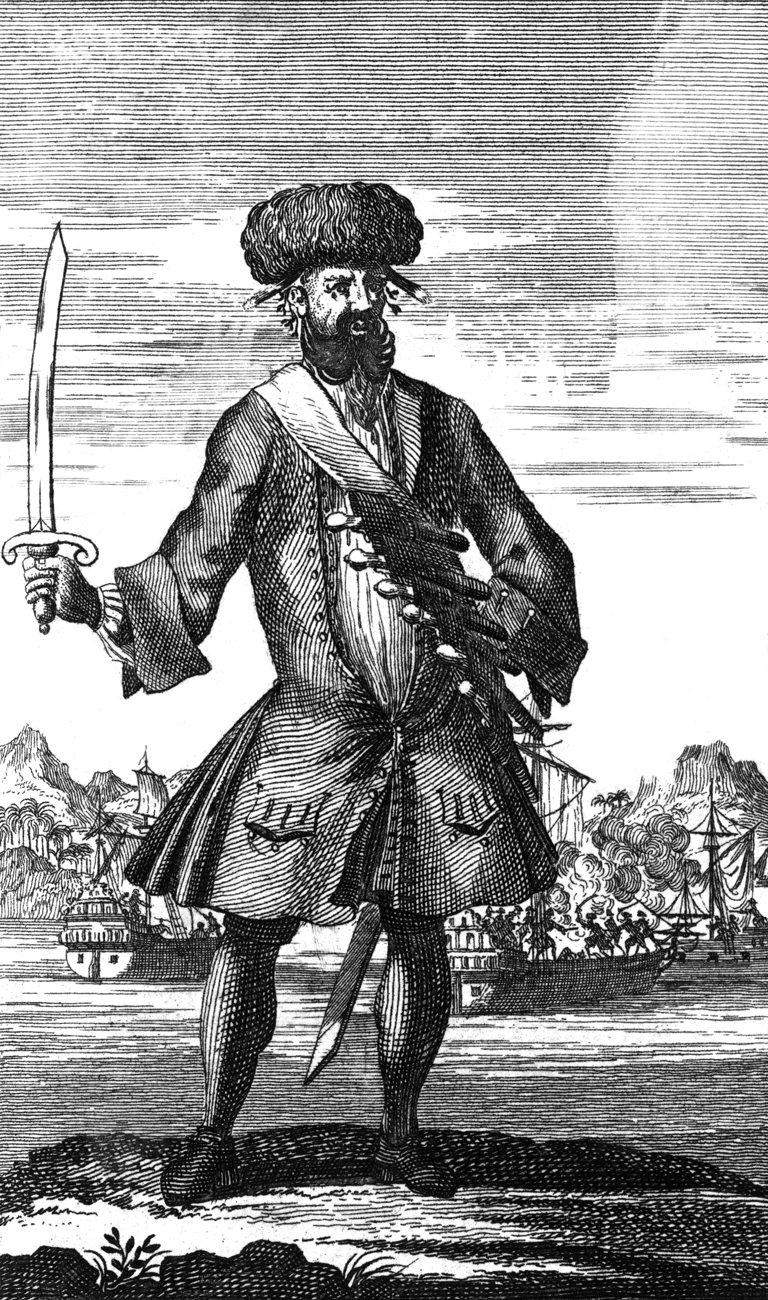
Blackbeard is remembered as the cruellest pirate of the golden age. The period record does not name one person he killed before the fight that killed him.
The name on the paper is not Teach. In the documents drawn up while he was alive the surname is Thach or Thatch, and the earliest of them, Henry Timberlake's deposition of 17 December 1716, writes "Edward Thach". Teach is a printer's spelling. The Boston News-Letter used it in 1718 and Johnson's General History fixed it in 1724, and the print won. The forename Edward is the one part of his name every early record agrees on.
Where he came from is not settled, and both candidate origins reach us through weak evidence. Bristol rests on a single sentence in Johnson, General History, Vol. 1 (1724): "Edward Teach was a Bristol man born, but had sailed some time out of Jamaica, in privateers, in the late French war." Jamaica rests on Charles Leslie's New Account of Jamaica (1739), which calls him Jamaica-born of creditable parents, and on Baylus Brooks's reconstruction of an Edward Thache family in Spanish Town. The Jamaica case is the stronger of the two and is the leading modern reading. The link between Brooks's documented Thache and the pirate is inference, though, and the historians who reviewed it said as much. No birth record for the man himself has ever been produced, so the usual date of about 1680 is a back-calculation from his apparent age at death and nothing firmer.
He learned the trade under Benjamin Hornigold. The Timberlake deposition that first gives us his name places him with Hornigold's company off Hispaniola in December 1716, and Captain Matthew Musson's report of July 1717 lists "Thatch" among the captains working out of New Providence. Hornigold was the senior man and Thache his consort. Within a year Thache had his own command and Hornigold had taken the king's pardon and turned pirate-hunter. The consortship is documented; the sources will carry the relationship as far as consort and second, no further.
In late 1717 he took the ship that made his name. La Concorde was a French Nantes slaver, captured near St Vincent on 28 November 1717 with 455 enslaved Africans still aboard. Thache kept her, armed her and renamed her Queen Anne's Revenge.
By the spring of 1718 he commanded a small squadron and blockaded Charleston, then Charles Town. His men stopped eight or nine vessels and took hostages, among them the councillor Samuel Wragg and his young son. The ransom he set was not money but a chest of medicine, and once it was delivered the captives were freed, stripped of their valuables and put ashore. Governor Robert Johnson reported the whole affair to the Board of Trade on 18 June 1718 and named "Teach alias Blackbeard" as its author.
Queen Anne's Revenge did not last the year. About 10 June 1718 she grounded on the bar at Beaufort Inlet, then called Topsail, and was lost. Two of his own men, David Herriot and Ignatius Pell, later swore he had run her ashore on purpose to break up the company and keep the plunder for a chosen few, then sailed off with those few and left the rest marooned on a sandbank. Captain Brand of HMS Lyme read the same grounding as an accident of pilotage. The record keeps both. Weeks later, in late June 1718, Thache surrendered to Governor Charles Eden at Bath and took the Act of Grace, the royal pardon of 1717. It did not hold. Through that summer and autumn he was back at an anchorage inside Ocracoke Inlet, and further captures are recorded against him. Pirate informants later accused Tobias Knight, the governor's secretary, of dealing with him, and pointed to sugar stored in Knight's barn; Knight was tried and acquitted, and the corruption stays on this record as an allegation, not a finding.
He was killed at Ocracoke Inlet on 22 November 1718 (3 December new style), resisting a boarding party led by Lieutenant Robert Maynard and sent from Virginia by Governor Spotswood into water that was not Virginia's to police. His body was found to carry five shot and about twenty cuts; he was beheaded in the fight, and his head hung from Maynard's bowsprit for the passage back. He was never tried. No court ever ruled on his guilt for anything, which is why this record does not call him convicted, and the Ocracoke fight has its own page.
The myth audit
Most of what people know about Blackbeard is Johnson's, and Johnson wrote in 1724, six years after the man was dead. The fourteen wives are his, with no marriage record behind a single one; even the one North Carolina marriage, later attached to a "Mary Ormond", has no contemporary document. The surname Drummond is folklore. The week-long carousal with Charles Vane at Ocracoke in October 1718 is Johnson's too, and the trial testimony that does survive puts Vane in Bahamian and Cuban waters at the time, so Sailing the Black Flag: The Archives holds the carousal at Possible.
The largest reveal is the quietest. Set against the documents, the sadist does not appear. Every captive we can name from the period record walked away alive: Bostock off Puerto Rico, Wyer of the Protestant Caesar, the Wraggs at Charleston, the French officers of La Concorde. The harshest act anyone swore to was the marooning of his own crew, and a marooning is not a killing. Angus Konstam put it plainly: until his last fight, Blackbeard "had not so much as killed a single man". The terror was real and it was worked at, the long black beard that gave him his name, the show of force, the reputation carried ahead of him, but it was a device for making men surrender without a fight, and on the evidence it worked. The violence came at the end, and it was his own.
Connections
- Edward Thache (Blackbeard) commanded Queen Anne's Revenge
- Edward Thache (Blackbeard) killed at The Ocracoke Fight
- The Ocracoke Fight death of Edward Thache (Blackbeard)
Evidence behind this record
- The pirate's surname is attested in life as Thach or Thatch; the earliest datable attestation is 'Edward Thach' in Henry Timberlake's deposition of 17 December 1716. Deposition (period transcription): Deposition of Henry Timberlake, master of the brigantine Lamb, 17 December 1716, describing an encounter of 13 December 1716 off western Hispaniola; transcribed by Brooks from the Public Record Office original
- 'Teach' is a later print standardisation, not the pirate's own or his associates' usual spelling. Highly Probable Period print and early secondary source: The Boston News-Letter (1718) called him 'Capt. Teach'; Johnson, General History, Vol. 1 (1724) fixed the form in popular memory
- The forename Edward is consistent across the earliest independent period documents of 1716 to 1718. Depositions and official records: Timberlake (1716), Dickinson (1717), Bostock (1717) and the 1718 naval and newspaper reports all give Edward
- The nickname Blackbeard is first attested in Jonathan Dickinson's letter of 23 October 1717 ('One Capan Tatch Allias Blackbeard'); the long black beard is independently described in Henry Bostock's deposition. Highly Probable Letter and deposition (period transcription): Dickinson letter, 23 October 1717; Bostock deposition sworn 19 December 1717 (Margaret taken 5 December 1717), 'a tall Spare Man with a very black beard which he wore very long'
- The Bristol origin rests on a single sentence in an uneven early secondary source and has no corroborating period record. Possible Early secondary source: Johnson, General History, Vol. 1 (1724), 'a Bristol man born, but had sailed some time out of Jamaica, in privateers'; capped at Possible for want of corroboration
- A Jamaica / Spanish Town origin is the leading modern reconstruction, but the identification of the documented Thache family with the pirate is inferential. Probable Early secondary source and genealogical reconstruction: Charles Leslie, A New Account of Jamaica (1739), 'born in Jamaica, of very creditable parents'; Baylus Brooks's Spanish Town Thache reconstruction, which reviewers (Konstam, the QAR project) accept only as a possibility
- No birth record for the pirate has been produced; the usual date of about 1680 is a back-calculation from apparent age at death. Possible Estimate (no primary): About 1680 is derived from an assumed age of 35 to 40 at death in 1718; the NPS c. 1660 and Brooks's early-to-mid 1680s figures are recorded as disagreements
- His nationality was English / British, whether he was born in Bristol or in the British colony of Jamaica. Highly Probable Interpretation of period record: Secure independent of the birthplace dispute, since both candidate origins lie within British territory
- Thache operated as a consort of Benjamin Hornigold from late 1716, taking his own command by 1717. Deposition and colonial report: Timberlake deposition, 17 December 1716, placing Thache with Hornigold's company; Capt. Matthew Musson's report of 5 July 1717 lists 'Thatch' among the captains based at New Providence
- Thache was killed resisting arrest at Ocracoke on 22 November 1718 and was never tried, so no court adjudicated his personal guilt for any act. Colonial and naval reports: Spotswood's dispatch and the near-contemporary naval and press accounts; he was never tried, and these pages never call him convicted
- No period source in evidence records Thache killing or seriously harming a captive before the Ocracoke battle; the sadistic-murderer image is largely later legend. Highly Probable Interpretation of period record: The Bostock, Wyer, Wragg and French-crew captives were all released alive; Konstam, 'until Teach's final battle, he had not so much as killed a single man'; David Moore concurs; that is the editorial line here
- The fourteen wives story has no documentary support; even a single North Carolina marriage lacks any contemporary record. Speculative Early secondary source and later tradition: Fourteen wives derive solely from Johnson, General History, Vol. 1 (1724), and are Speculative; a single NC marriage, later attached to a 'Mary Ormond' from nineteenth-century family lore, is held at Possible with the name not documented
- The week-long carousal with Charles Vane at Ocracoke in October 1718 rests on Johnson alone and is contradicted by the surviving trial testimony. Possible Early secondary source: Johnson and later writers; capped at Possible because the trial testimony in evidence places Vane in Bahamian and Cuban waters in late October to November 1718
Open research
Origins unresolved: Jamaica / Spanish Town (Probable, the leading modern reconstruction, but the Brooks identification with the pirate is inferential) versus Bristol (Possible, resting on Johnson, General History, Vol. 1 (1724) alone). No birth record for the pirate has been produced; c. 1680 is a back-calculation from apparent age at death, with an NPS c. 1660 outlier and a Brooks early-to-mid 1680s implication both recorded as disagreements. Surname in life is Thach/Thatch; Teach is a print standardisation via the Boston News-Letter and Johnson. No period source in evidence records him killing or seriously harming a captive before Ocracoke. The 1719 Williamsburg trial of his crew has no surviving primary court record.