Gallery · Henry Every and the Mughal Crisis · Room 2 of 6
The Fancy and the Red Sea
Curator's note
Every left a signed account of himself at Johanna, addressed to any English commander who might come after him. This room sets it beside the record of the cruise he was in the middle of when he wrote it.
I have never as yet wronged any English or Dutch, nor ever intend whilst I am Commander … As yet an Englishmans Friend.
By the date on that paper the Fancy had already taken English ships. At the Isle of May, in the Cape Verde islands, "they took three English Ships".
On the Guinea coast the company did this, in the printed trial's own words: "when some of the Natives came on board with their Gold to trade with them, they took away their Gold, and carried them away for Slaves". Those men were among the facts the jury convicted on.
Two Danish ships were taken at Principe, and were charged and convicted at the trials. A Portuguese slaver was robbed near Cape Lopez, and the town of Mayd was burnt.
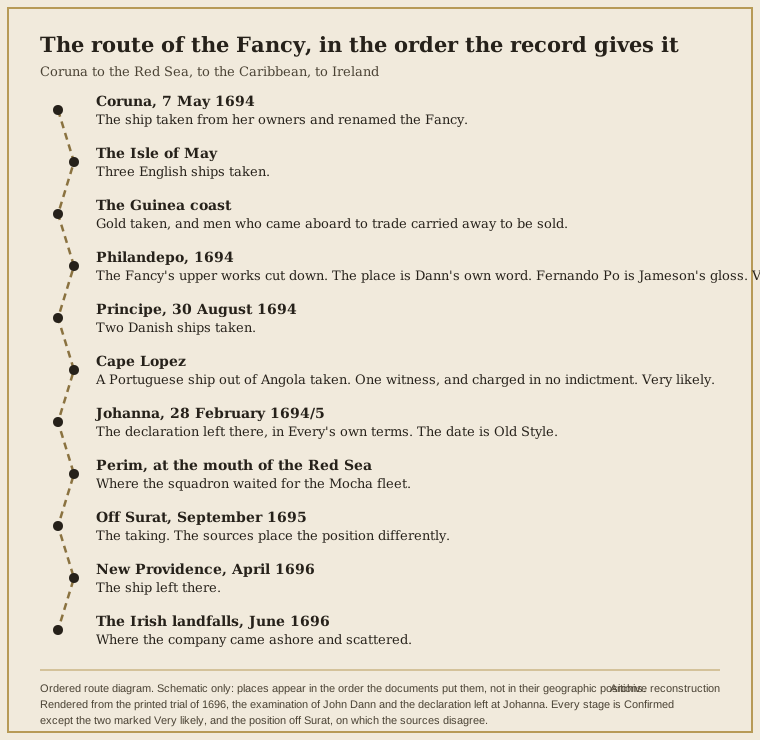
- Coruna, 7 May 1694. The ship taken from her owners and renamed the Fancy.
- The Isle of May. Three English ships taken.
- The Guinea coast. Gold taken, and men who came aboard to trade carried away to be sold.
- Philandepo, 1694. The Fancy's upper works cut down. The place is Dann's own word; Fernando Po is Jameson's editorial gloss, and the identification is very likely.
- Principe, 30 August 1694. Two Danish ships taken.
- Cape Lopez. A Portuguese ship out of Angola taken. One witness, and charged in no indictment, so very likely.
- Johanna, 28 February 1694/5, Old Style. The declaration left there in Every's own terms.
- Perim, at the mouth of the Red Sea. Where the squadron waited for the Mocha fleet.
- Off Surat, September 1695. The taking. The sources place the position differently.
- New Providence in the Bahamas, April 1696. The ship left there.
- The Irish landfalls, June 1696. Where the company came ashore and scattered.
The run ended at Perim, in the straits of Bab-el-Mandeb, where the Red Sea narrows to a few miles of water that every ship out of Mocha has to pass. About June 1695 five further English vessels joined Every's company there, and they all joined in partnership, agreeing that Captain Every should be the commander. One of them is said to have been Thomas Tew's Amity. Of the consorts gathered there, Dann recorded that "the sloop fell asterne and never came up to them".
They lay at the straits about five weeks, waiting for the fleet coming up from Mocha. Very likely
Madagascar and its harbours have their own gallery. The arithmetic of how a company divided what it took is written into the articles a crew signed, and the next room reports what that arithmetic came to.