Gallery · Theme · THM-001
Pirate Articles
Also recorded as: The Articles; The Pyrates Articles; pirate code (modern); pirate constitution (modern)
Pirate articles were the sworn, written constitution of a single ship's company, fixing shares, discipline and injury compensation and subscribed by every member. The verbatim article sets survive only in Johnson; the institution of signing and swearing them is confirmed by sworn depositions.
This is the first of the theme pages at Sailing the Black Flag: The Archives, and it sets a rule the other two follow. The pirate constitutions as texts are Johnson-only. The institution of sworn written articles, elected quartermasters and whole-company votes is confirmed by sworn depositions from four courts across four years. If you hold those two facts apart, the subject comes clear.
What a pirate company's articles were
Pirate articles were the written agreement of a single ship's company. Each set was a run of numbered clauses fixing how plunder was shared, how the crew was disciplined, what a man was owed if he lost a limb in action, and how the men were to conduct themselves aboard. Every person who joined the company subscribed to the articles and swore to them, commonly on a Bible, and in Phillips's crew, for want of a Bible, on a hatchet. The articles were made by that company, applied only to it, and had no standing in any court on shore.
Signing was not optional. When the Cape Coast court in 1723 acquitted Richard Scot, it noted that he was "not in a condition to fign their Articles, which the Court asked him about, becaufe all are obliged to it." The bench treated the failure to sign as the thing worth remarking on. Membership ran through the pen.
The homonym you have to watch
One word does two jobs, and the confusion is easy to make. In an Admiralty trial print, "the Articles" almost always means the numbered charges of the indictment, read out by the court's Register and exhibited against the accused. That is the dominant sense in the 1721 Jamaica trials and in the 1696 trial of Henry Every's crew, where "the Articles" are the counts of the charge. It is not the pirates' shipboard constitution.
The 1723 Roberts pamphlet puts the trap on the page. It opens by charging that the men were "Articled together", meaning indicted, and then fills its columns with depositions about signing the pirates' own articles, meaning the constitution. Every instance of the word in a trial source has to be read in its sentence before it is cited. Read wrongly, an indictment count becomes a democratic document.
The surviving sets, and why they carry an asterisk
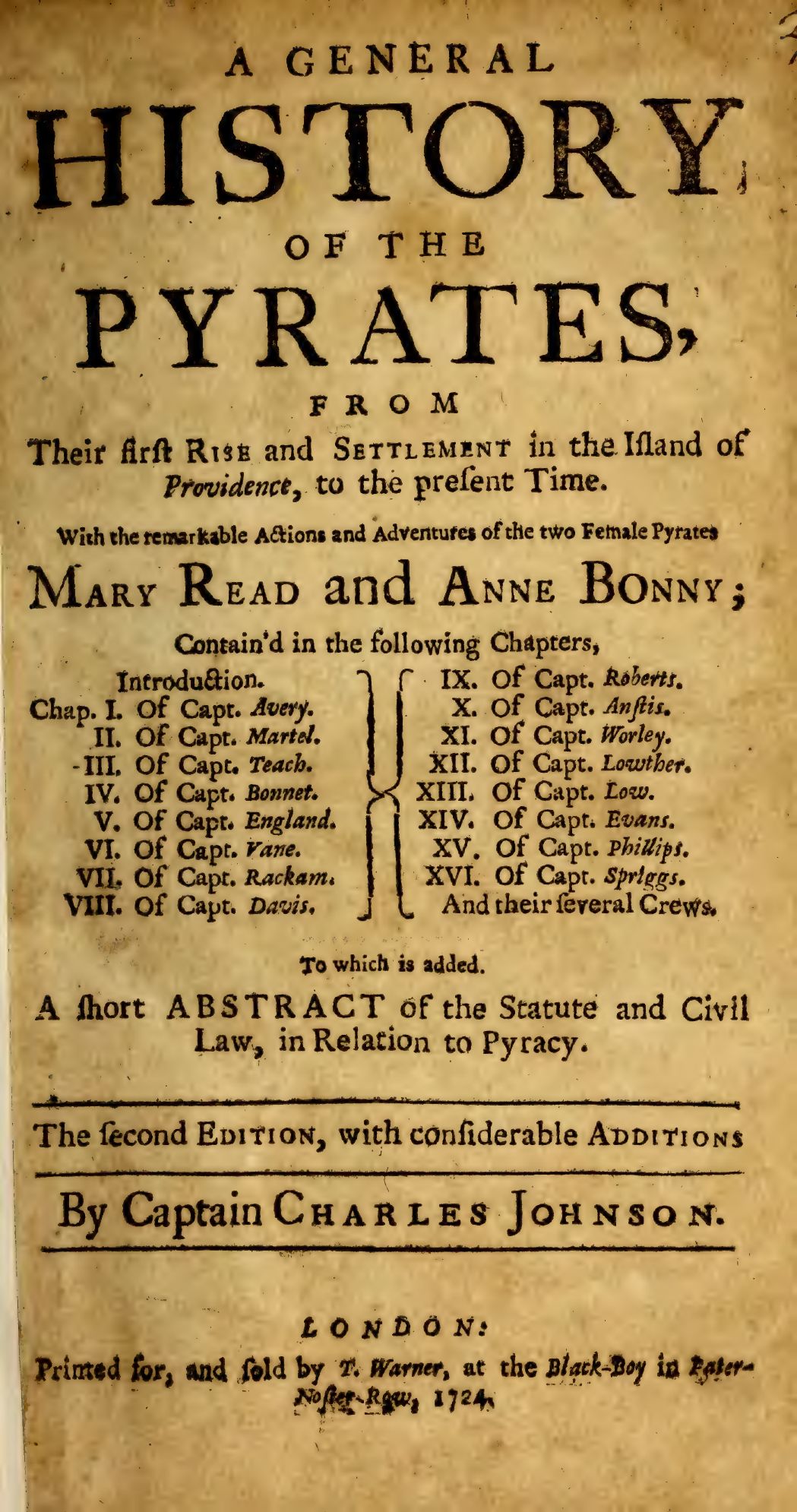
Three numbered article sets survive in something close to verbatim form: Bartholomew Roberts's eleven articles, George Lowther's eight, and John Phillips's nine. All three come to us through one channel only, Charles Johnson's General History of the Pyrates of 1724 and 1728. No independent manuscript of any of them has been found. On the Archives' grading that caps them at Possible, and the page treats the cap as a feature rather than an embarrassment.
Johnson himself supplies the reason. Of Roberts's set he admits the crew had "taken Care to throw over-board the Original they had sign'd and sworn to", so that he prints "some" of the articles and suspects "the remainder contained something too horrid to be disclosed." A source that tells you the paper was destroyed is a source you quote with the caveat attached. The famous Article I is worth the space even so:
Every Man has a Vote in Affairs of Moment; has equal Title to the fresh Provisions, or strong Liquors, at any Time seized, and use them at pleasure, unless a Scarcity ... make it necessary, for the good of all, to vote a Retrenchment.
Phillips's preamble carries the hatchet oath and Johnson's claim of an exact text: "one of them writ out the following Articles (which we have taken verbatim) and all swore to 'em upon a Hatchet for want of a Bible." Lowther's opens on the Bible and the share table: "the following short Articles were drawn up, signed and sworn to upon the Bible ... 1. The Captain is to have two full Shares".
The institution, carried without Johnson
Here is where the page stands on firmer ground than the texts. The practice of drawing up, producing, signing and swearing articles is attested by sworn depositions that owe Johnson nothing.
George Fenn, mate of the King Solomon, "depofeth, That the Prifoner William Philips, when he returned from the Pyrates, told him, that he had been obliged to Sign the Pyrates Articles that Night, for that a Piftol was laid upon the Table to force him to it." The pistol on the table is the physical fact of the thing: a document produced at a ceremony, and a man made to put his hand to it.
Stephen Thomas gave the counter-image in the same court. He deposed that for John Stratton "no Piftol or Articles, were produced that Night by the Pyrates for his Signing." The articles were a thing that could be present or absent at a signing, and the court thought the difference mattered.
And the company governed by the vote the articles promised. Richard Scot swore that a shipmate "had begg'd the Deponent's Vote (all the Pyrates Affairs being carried by that) for his Difcharge." That parenthesis, dropped in passing by a witness with no theory to sell, is the best single line the Archives holds for pirate self-government. It is a deposition, not a set-piece, and it says the whole business ran on votes.
The Kidd instrument: what a lawful version looked like
Running beside the buccaneer custom was the privateer's "articles of agreement", a formal and lawful contract of service between a commander and his crew. One survives for William Kidd: the articles of agreement of 1696 between Kidd, commander of the Adventure Galley, and his quartermaster John Walker, with a list of the company, preserved among the state papers at The National Archives (CO 5/931). It is a real physical instrument, and it shows the mould the pirate articles were cast in. The outlaws took the form of the privateer contract and much of its content, and threw away its legality.
The buccaneer ancestry
The articles did not appear from nowhere. They descend from the buccaneers' written share-and-compensation agreement, the "chasse-partie". Exquemelin's Bucaniers of America (English 1684, from the Dutch of 1678) describes how the buccaneers before a voyage drew up "certain articles, which are put in writing, which every one is bound to observe; and all of them, or the chiefest part, do set their hands to it", followed by a fixed tariff for injury: six hundred pieces of eight or six slaves for a right arm, five hundred for the left, and so down to a hundred for an eye or a finger. The line into the 1720s is plain in the numbers. Roberts's crew promised eight hundred dollars for a lost limb, Phillips's four hundred pieces of eight for a joint, Lowther's a hundred and fifty pounds sterling. The Exquemelin wording is given here at second hand and is not yet established character for character against the 1684 printing, so the Archives does not print it as settled.
What sits outside the subject
Three things share the vocabulary and must be kept out. The merchant service had its own articles of agreement, the wage contract of an honest voyage; it borrows the name and none of the constitution. The "Custom of the Coast" was the unwritten body of buccaneer usage, customary law rather than a document, which the written articles partly codify and are not identical with. And the indictment sense of "articles", already covered above, is the one that catches readers who trust the word rather than the sentence.
One term the Archives will not vouch for. "Matelotage", the buccaneer partnership arrangement, turns up everywhere in modern popular writing but appears in no primary source cited for this theme. It should not be dressed as period usage without a cited original.
A closing honesty. The record here is good on the fact of the articles and poor on their words. The depositions prove men signed, swore, and voted; they almost never give the clauses. The clauses survive only where a bookseller chose to print them.
Evidence behind this record
- Pirate articles were the sworn, written constitution of a single ship's company, fixing shares, discipline, injury compensation and conduct, and subscribed by every member. Trial depositions: 1723 Cape Coast Castle trial of Roberts's crew (forced-signing and swearing depositions); institution attested independently of Johnson
- Signing the articles was compulsory in a pirate company; the Cape Coast court treated a man's not signing as itself notable. Court record: 1723 Cape Coast trial, acquittal of Richard Scot: 'not in a condition to fign their Articles, which the Court asked him about, becaufe all are obliged to it'
- Men were compelled to sign the articles under threat; in one deposition a pistol was laid on the table to force a man to it. Trial deposition: 1723 Cape Coast trial, George Fenn re William Philips: 'obliged to Sign the Pyrates Articles that Night, for that a Piftol was laid upon the Table to force him to it'
- Pirate companies governed their affairs by vote, including votes on an individual man's discharge, independently of Johnson. Trial deposition: 1723 Cape Coast trial, evidence of Richard Scot: begged 'the Deponent's Vote (all the Pyrates Affairs being carried by that) for his Difcharge'
- Three numbered pirate article sets survive in verbatim or near-verbatim form (Roberts 11, Lowther 8, Phillips 9), but all three survive only in Johnson's General History, which concedes Roberts's original was thrown overboard. Possible Printed history (Johnson): Johnson, General History of the Pyrates (Gutenberg 40580); Roberts's, Lowther's and Phillips's articles; Johnson's admission the Roberts original was destroyed. Johnson-only, capped Possible
- The lawful privateer 'articles of agreement' whose form the pirate articles borrowed survives as a physical instrument: the 1696 articles between William Kidd and his quartermaster John Walker, with a list of the company. State paper: Articles of agreement between Captain William Kidd, commander of the Adventure Galley, and John Walker, Quartermaster, 1696; The National Archives, CO 5/931
- In an Admiralty trial print the word 'articles' usually means the numbered charges of the indictment, not the pirates' shipboard articles; the 1723 Roberts pamphlet uses both senses. Court record: 1721 Jamaica trials and 1696 Every trial (indictment sense); 1723 Roberts pamphlet opens 'Articled together' (indictment) then deposes on signing the shipboard articles
Open research
The verbatim article sets (Roberts, Lowther, Phillips) remain Johnson-only and capped at Possible; no independent manuscript has been found. The Exquemelin chasse-partie wording is given at second hand and is not yet established character for character against EEBO-TCP A39081. 'Matelotage' is not attested in any primary source cited for this theme and is held unverified.