Gallery · Interpretation · Captain Kidd Collection
Captain Kidd: Political Fall Guy
Why did Kidd become expendable?
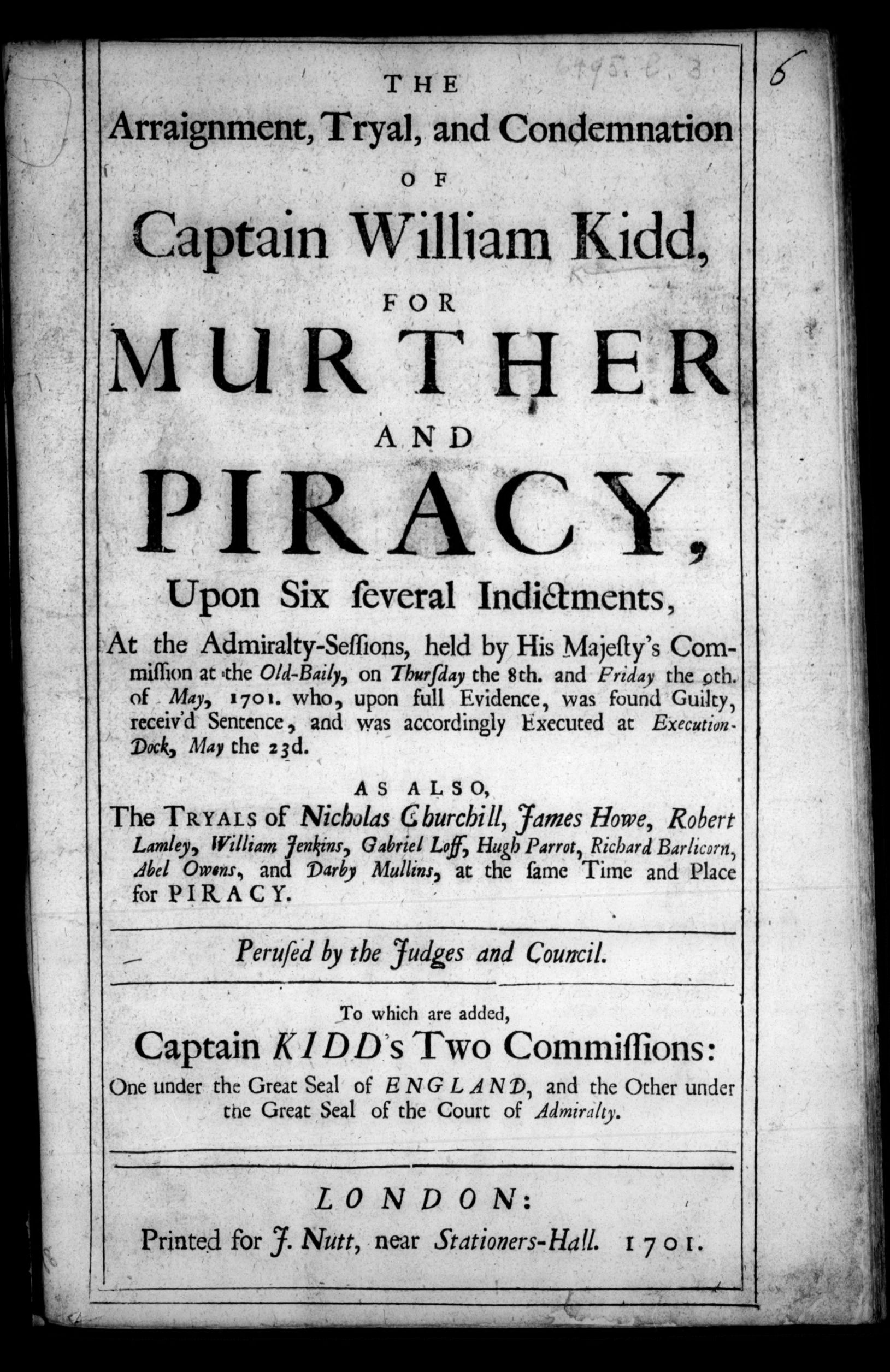
In 1699 William Kidd sailed back across the Atlantic carrying the papers he believed would save him. The men who had financed his voyage were, at that same moment, discovering that the safest thing Kidd could do for them was disappear.
He did not disappear. He returned to North America and to his patron, the Earl of Bellomont, and Bellomont ordered his arrest. Two years later Kidd was hanged. The question here is not whether the verdict was legally available. It is why a man with backers that close to power found, at the end, that he had no backers at all.
The venture was political from the subscription
Kidd's expedition was never a private waterfront gamble. Investors close to government subscribed to it, Bellomont among them, and its paperwork reflected its standing: a commission to pursue pirates, separate authority against French shipping. Correspondence and official records confirm Bellomont's part in organising the venture.
What a subscription of this kind actually was matters, because the mechanism explains the exposure. Privateering ventures were financed like any other shipping speculation: subscribers put up capital for the ship, the stores and the wages, against a share of whatever the voyage brought home. The difference was the cargo. This voyage's intended cargo was other people's property, made lawful by the papers Kidd carried. The investors were, in the most literal sense, buying shares in captures that had not happened yet, on the security of documents whose scope would only be tested afterwards.
Money of that kind buys reach, and it also creates exposure. Every investor's name attached to Kidd's voyage was a name attached to whatever Kidd did ten thousand miles from anyone's oversight. While the voyage promised prize money, the association was an asset. The moment reports of questionable captures reached London, the same association became a danger, and the danger scaled with the rank of the men involved. A merchant could survive an embarrassing investment. A minister's reputation was a different kind of capital, and it did not recover on the same terms.
What the venture's failure did to its sponsors
The voyage's collapse is told in the Collection's rooms: no lawful prey, a dead gunner, a crew deserting at Madagascar, and one rich capture, the Quedagh Merchant, whose legality hung on French passes. For the investors, each stage of that collapse converted profit into risk. A successful privateering venture pays a dividend. A failed one that shades into piracy asks questions in Parliament.
The trade context sharpened everything. English commerce in the East depended on the goodwill of the powers whose subjects owned ships like the Quedagh Merchant, and attacks on that shipping under English colour of law were a diplomatic liability before they were a legal one. A pirate operating openly was a nuisance the state could disown. A licensed captain taking the wrong prizes was the state's own signature on the problem. That distinction is why Kidd's case travelled upward, out of the admiralty courts' routine business and into politics, in a way an ordinary pirate's never would.
By the time Kidd turned for home, the men behind him faced a choice between defending their captain and defending themselves. Defending Kidd meant arguing, publicly, that the capture of an Indian-owned merchantman under English colour of law was legitimate, at a time when such captures were poisoning relations with the very trade the government needed protected. Defending themselves meant distance. The record shows which they chose.
The arrest, read carefully
Bellomont's double role is the hinge. The same man appears in the subscription at the venture's beginning and in the arrest order at its end. Both actions are documented. The connection between them is not, or not directly: no surviving letter has Bellomont saying plainly why he moved when he moved.
I want to be exact about how strong my central claim is. That political self-protection influenced the handling of Kidd is an interpretation, held as probable, resting on the pattern of correspondence, the parliamentary context and the scholarship rather than on a confession. What can be said with confidence is what the pattern looks like: a patron who arrested his own privateer, a government that held the exculpatory papers, and a trial at which those papers were absent.
The arrest bought something regardless of its motive. It put the government visibly on the right side of the piracy question at the moment visibility mattered most. It converted Bellomont from a name on the subscription into the officer who brought the pirate in. And it moved the whole affair from the colonies, where Kidd had connections, to London, where his backers had them. Every one of those effects favoured the men with the most to lose. None of them required a single dishonest act to produce.
The missing passes fit the pattern
The French passes were real, and the printed trial record shows they were never produced in court. That official hands held them before the trial is held as highly probable while the chain of custody is documented. Those facts are the most suggestive in the whole affair, because the passes were exactly the evidence a vigorous defence of the venture would have wanted in court, and exactly the evidence an embarrassed political class would not.
I'd be careful here. Documents go missing from seventeenth-century proceedings for reasons that include incompetence, procedure and accident. Absence alone proves no conspiracy. But the absence did not need to be arranged to be convenient, and its convenience is a fact about the politics whatever its cause.
The other reading
I'll put the innocent version at full strength rather than knock down a straw man. In that version Bellomont was a governor doing exactly what governors were for. Reports of piratical captures had reached him concerning a captain he happened to have backed; the embarrassment of the connection made vigorous action more necessary, since any hesitation would look like protection. The passes went to London because London was where evidence in a state trial belonged. Their absence from the courtroom was procedure, accident or the ordinary carelessness of seventeenth-century document handling, of which the archives offer no shortage of examples.
Nothing in the confirmed record refutes that reading. That is precisely why the central claim is held as probable rather than confirmed, and why the two readings are presented as a genuine choice. What can be said is that the innocent version requires a run of procedural misfortunes that all happened to fall the same way, on the same case, to the benefit of the same men. Historians are allowed to notice a pattern without claiming to have proved a plan.
What Kidd was for
Strip the case to its function and the sequence explains itself. When piracy threatened trade, a licensed pirate hunter was useful. When the hunter's voyage soured into scandal, a prosecuted pirate was more useful still: proof that the state punished what it had briefly sponsored. Kidd served his backers twice, once as a weapon and once as an example.
None of this required his judges to lie or his jury to be corrupted. It required only that the machinery run its course without the documents that might have slowed it, and that no man with the standing to intervene found it in his interest to do so.
The limits of the record
The sources for this argument are strongest exactly where the argument needs them least. The commissions, the arrest and the verdicts are secure. The motives are not: the correspondence shows men acting, and rarely shows them explaining. The record is good on what was done to Kidd, and much worse on what his backers said to each other while it was being done.
Kidd told the court, in effect, that his papers would answer for him. The papers were in London.