Gallery · Event · EVT-001
Trial of William Kidd
Also recorded as: Kidd trial
From: May 1701
Murder and piracy proceedings at an Admiralty sessions held at the Old Bailey, 8 and 9 May 1701.
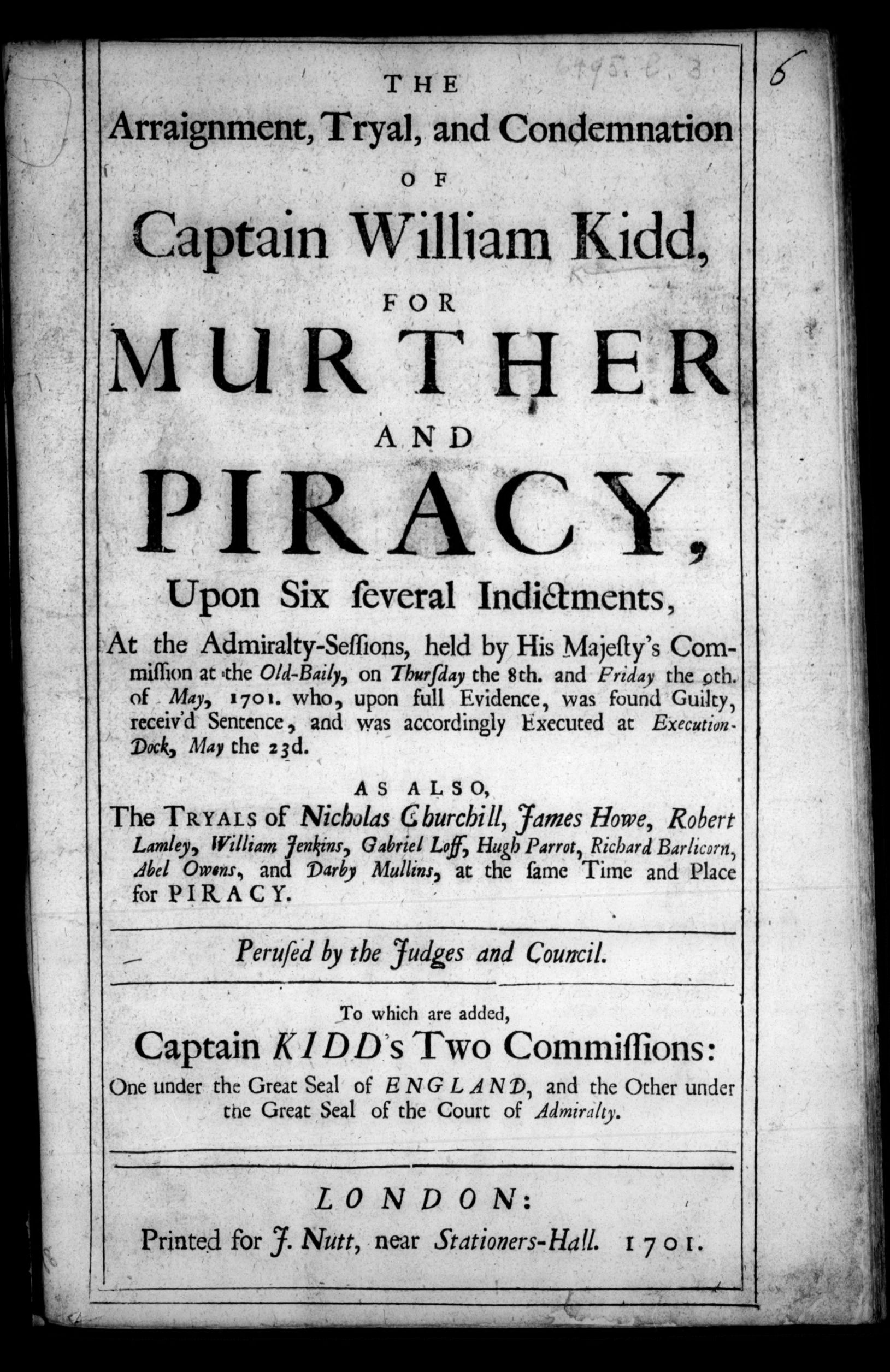
Kidd was tried on 8 and 9 May 1701 at an Admiralty sessions held under royal commission at the Old Bailey, before Lord Chief Baron Ward. This was not an ordinary Old Bailey criminal session, so the proceedings survive through the printed trial record rather than the Old Bailey Proceedings series. He faced six indictments: one for the murder of his gunner, five for piracy. He was found guilty on all six.
The murder charge came first, on 8 May. It concerned William Moore, whom Kidd had struck on 30 October 1697 with a wooden bucket bound with iron; Moore died the next day. The Crown's witnesses, Joseph Palmer and the surgeon Robert Bradinham, had stood on the same deck. Kidd's defence was that Moore was a mutineer, which would have made the killing lawful; Palmer and Kidd's own servant Richard Barlicorn testified there was no mutiny at that moment, and the jury returned Guilty.
The five piracy indictments ran from the taking of the Quedagh Merchant on 30 January 1697/8 down to smaller captures off the Malabar coast. On the two richest prizes, the Quedagh Merchant and the Rouparelle, Kidd's defence was that each had carried a French pass, which under his commission made her lawful prize rather than piracy. The passes were not in the courtroom. The printed record shows that no witness would say he had seen one, and Kidd told the court his papers had been taken from him by Lord Bellomont. On the trial record, that courtroom absence is confirmed. Whether the government still held the passes at that moment, and where they now sit, is held as highly probable; the full chain of custody is not yet established.
One fairness point belongs on the record: the two chief Crown witnesses, Palmer and Bradinham, were pardoned former members of Kidd's crew who had turned King's evidence. The defence pressed that they were guilty men saving themselves.
Kidd was convicted on every count and hanged at Execution Dock on 23 May 1701. The two passes that would have tested the richest of the piracy verdicts survive today in print, through the House of Commons Journal, but no jury ever read them.
Connections
- William Kidd tried in Trial of William Kidd
- William Moore death tried in Trial of William Kidd
- Trial of William Kidd evidence absent The French Passes
- The French Passes connected to Trial of William Kidd
Evidence behind this record
- The government possessed French passes before Kidd's trial. Highly Probable Parliamentary and custody records: Kidd's arraignment statement that Lord Bellomont had seized his papers (printed 1701 trial record); the passes were later printed in the Commons Journal XIII.21 and survive as copies at The National Archives, CO 5/860 No. 64 ii (Rouparelle, undated) and No. 64 iii (Cara or Quedagh Merchant, 14 Jan 1698), enclosed with Bellomont's letter and digitised in the TNA image library
- The jury did not see the passes. Trial record: Printed Admiralty sessions trial record (1701): the passes were not produced and no witness would say he had seen one
- Kidd struck William Moore with a bucket and Moore died the next day. Trial testimony: First (murder) indictment and testimony of Joseph Palmer and surgeon Robert Bradinham, printed 1701 trial record: a blow with a wooden bucket bound with iron on 30 October 1697, Moore dying the next day
- Kidd was tried at an Admiralty sessions held at the Old Bailey on 8 and 9 May 1701, on six indictments, and found guilty on all. Trial record: Printed Admiralty sessions trial record (1701)
- The jury found the taking of the Quedagh Merchant to be piracy; Kidd had renamed her the Adventure Prize. Trial record: Second indictment and verdict, printed 1701 trial record; capture dated 30 January 1697/8, about ten leagues from Cochin
- Kidd was hanged at Execution Dock, Wapping, on 23 May 1701. Trial pamphlet: Title page of the printed 1701 trial pamphlet
- Two French passes, for the Rouparelle and the Quedagh (Cara) Merchant, survive in print, and their absence from the trial was central to Kidd's defence. Highly Probable Parliamentary print: House of Commons Journal XIII.21, transcribed in Jameson (1923); rediscovered among Board of Trade papers in 1910. The passes survive at The National Archives as CO 5/860, Nos. 64 ii (Rouparelle) and 64 iii (Quedagh Merchant), enclosures to Bellomont’s letter.
- The two chief Crown witnesses were pardoned former members of Kidd's crew, Joseph Palmer and the surgeon Robert Bradinham, who turned King's evidence. Trial record: Printed 1701 trial record
Open research
The printed 1701 trial record fixes the six indictments, the guilty verdicts, the presiding judge (Lord Chief Baron Ward) and the two chief Crown witnesses. The French passes absent from this trial survive at The National Archives as CO 5/860, Nos. 64 ii and 64 iii.