Gallery · Person · PER-001
William Kidd
Also recorded as: Captain Kidd; William Kyd; Robert Kidd (in the 1695 commission)
Born: c. 1654 (traditionally c. 1645) Died: 23 May 1701 Highly Probable
Commissioned privateer later convicted of murder and piracy.
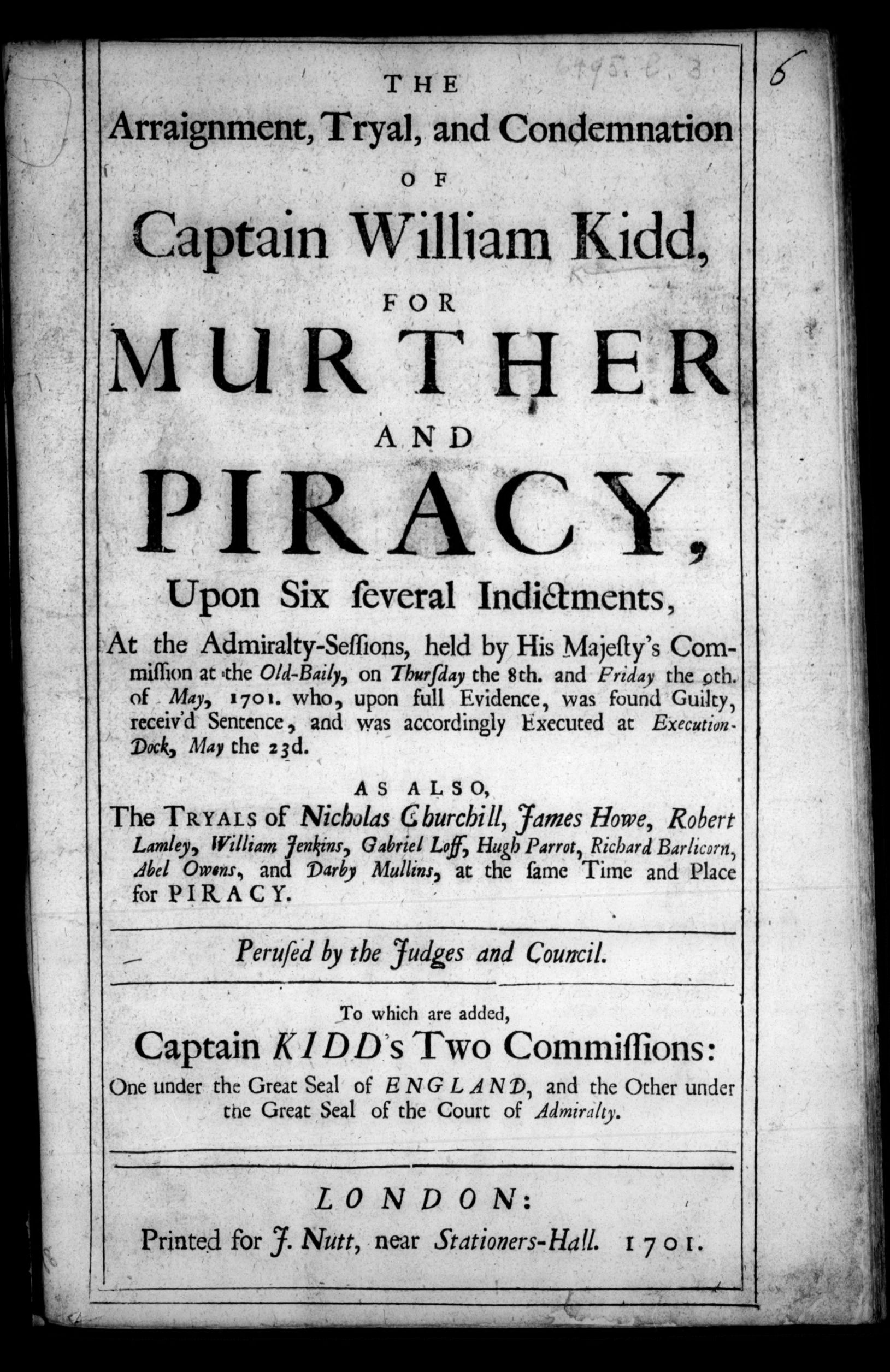
Kidd's name now stands for piracy itself. The record is stranger than the reputation.
He began the venture that destroyed him as a licensed man. A royal commission of 26 January 1695/6 authorised him to seize four named pirates, and separate authority covered French shipping, England being then at war with France. Both instruments are documented; the commission's own dateline fixes the date, though the original manuscript itself remains unexamined.
The voyage produced two acts that followed him to trial. On 30 October 1697 he struck his gunner, William Moore, with a wooden bucket bound with iron, and Moore died the next day. In January 1698 he took the Quedagh Merchant, a rich Indian-owned merchantman. Whether that capture was piracy or lawful prize depends on documents the jury at his trial never saw: the French passes found aboard.
He was arrested after returning to North America in 1699, on the order of the Earl of Bellomont, the same governor who had backed his commission. Tried in London on 8 and 9 May 1701 on six indictments for murder and piracy, he was convicted on all and hanged at Execution Dock on 23 May 1701. Later accounts add that the first rope broke and he was hanged a second time, a detail the 1701 trial pamphlet does not record.
Two details of his identity deserve explanation. His birth year is given here as c. 1654 because his own 1695 deposition, sworn when the venture was being organised, gives an age pointing to the mid-1650s; the traditional c. 1645 is an inherited convention the deposition does not support. And the royal commission of 1695 names him "Capt. Robert Kidd", a period official document, not a later error, so Sailing the Black Flag: The Archives records Robert Kidd as an attested alias rather than hiding it. His birthplace remains genuinely contested between Dundee and Greenock, with the Dundee evidence currently stronger.
The record is thin on his early career. This record keeps to what the trial documents, commissions and correspondence can carry, and states its confidence claim by claim below.
Connections
- William Kidd commanded Adventure Galley
- William Kidd captured Quedagh Merchant
- William Kidd killed William Moore
- William Kidd tried in Trial of William Kidd
- Richard Coote, Earl of Bellomont backed William Kidd
- Richard Coote, Earl of Bellomont ordered arrest of William Kidd
- Robert Culliford rival of William Kidd
Evidence behind this record
- Kidd held a commission to pursue pirates. Legal document: Royal commission under the Great Seal, dated 26 January 1695/6, naming the pirates Thomas Tew, John Ireland, Thomas Wake and William Mace (period transcriptions)
- Kidd struck William Moore with a bucket and Moore died the next day. Trial testimony: First (murder) indictment and testimony of Joseph Palmer and surgeon Robert Bradinham, printed 1701 trial record: a blow with a wooden bucket bound with iron on 30 October 1697, Moore dying the next day
- Kidd was tried at an Admiralty sessions held at the Old Bailey on 8 and 9 May 1701, on six indictments, and found guilty on all. Trial record: Printed Admiralty sessions trial record (1701)
- Kidd was hanged at Execution Dock, Wapping, on 23 May 1701. Trial pamphlet: Title page of the printed 1701 trial pamphlet
- The first rope broke and Kidd was hanged a second time. Highly Probable Secondary accounts: Widely and consistently reported in later accounts; not present in the 1701 trial pamphlet
- Kidd's body was gibbeted at Tilbury Point on the Thames and displayed for about three years. Highly Probable Secondary accounts: Consistently reported; the display duration is disputed, two to three years
- Kidd was born about 1654, with the traditional c. 1645 recorded as an inherited convention. Probable Deposition (secondary reading): His 1695 High Court of Admiralty deposition giving his age as 41, known through secondary transcriptions; the c. 1645 tradition is inherited
- The forename Robert appears for Kidd in the 1695 royal commission, an attested documentary alias. Highly Probable Legal document: Royal commission of 26 January 1695/6, two independent period transcriptions; the original manuscript is not yet examined
Open research
Early career before 1689 is thin. Birthplace: Dundee (Highly Probable) versus Greenock (Possible), unresolved. Birth year follows his 1695 deposition, which gives his age as 41 and so points to c. 1654; the traditional c. 1645 is recorded as the inherited convention. The forename Robert in the 1695 royal commission is treated as an attested documentary alias, not an error.