Gallery · Event · EVT-002
Trials of Every's Crew
Also recorded as: Every crew trials; The Tryals of Joseph Dawson et al.
From: October to November 1696
Admiralty sessions at the Old Bailey in 1696: the crew were acquitted on the Ganj-i-Sawai indictment at the first sitting, then convicted on the Charles the Second mutiny; five were hanged and one reprieved.
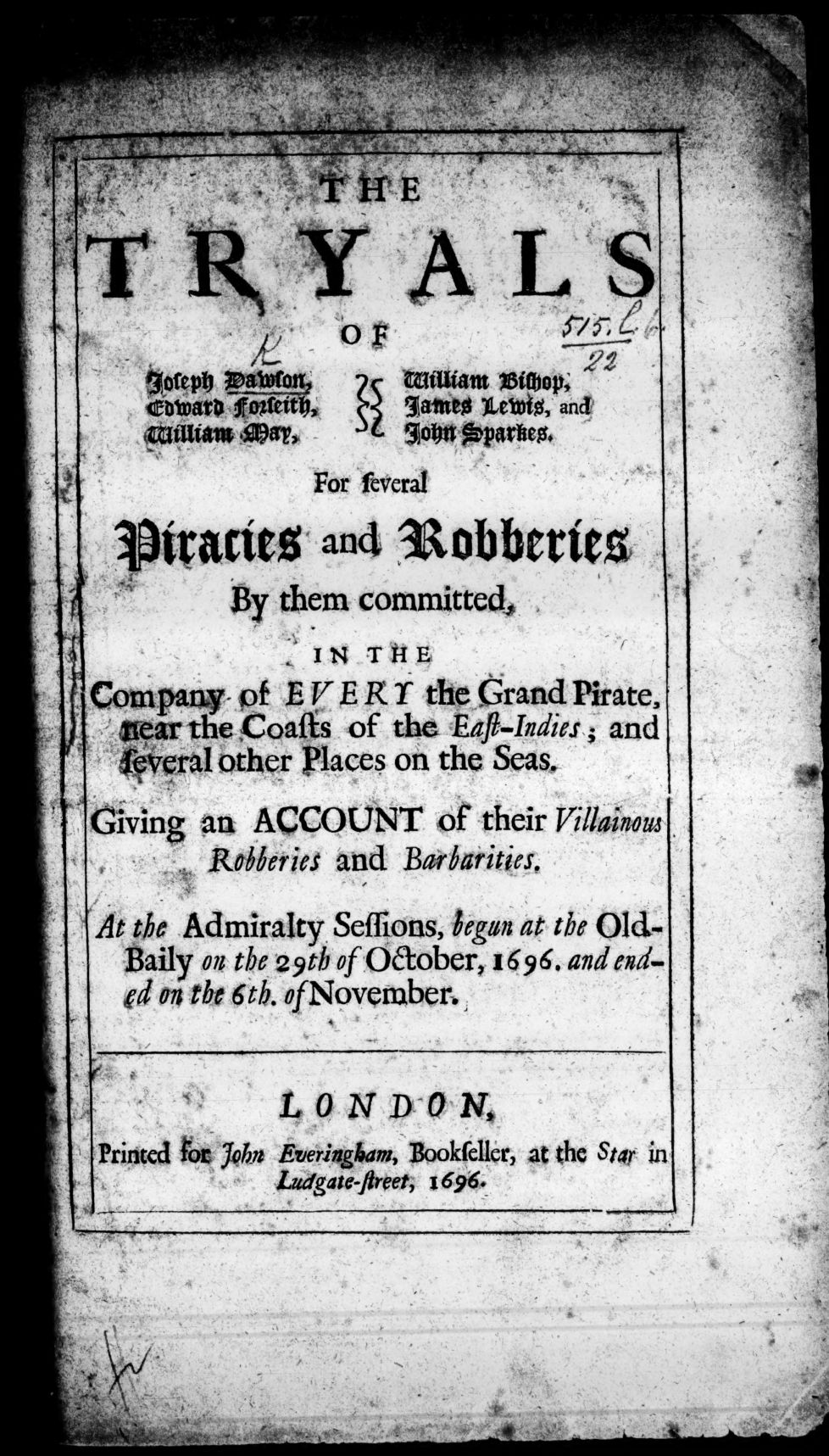
Every escaped, so the state tried his crew instead. Six men stood at Admiralty sessions held in the Old Bailey building in the autumn of 1696: Joseph Dawson, Edward Forseith, William May, William Bishop, James Lewis and John Sparkes. These were sessions of oyer and terminer under the High Court of Admiralty, a separate jurisdiction from the ordinary City and Middlesex sessions. The proceedings survive through the printed record, The Tryals of Joseph Dawson and others, not through the Old Bailey Proceedings series, so this trial is not in Old Bailey Online.
The first sitting was Monday 19 October 1696. Dawson pleaded guilty; the other five pleaded not guilty and put themselves on their trial for the taking of the Ganj-i-Sawai. The Crown's two witnesses, the former crewmen John Dann and Philip Middleton, gave what the court considered full evidence, and Lord Chief Justice Holt summed up against the prisoners. The jury acquitted them anyway. The print records it flatly: "the Jury, contrary to the expectation of the Court, brought in all the Prisoners Not Guilty." That verdict is the famous embarrassment of the case, an English jury refusing to convict the most notorious pirates of the decade on the richest charge against them.
The court did not accept it. The prisoners were held on a new warrant for other piracies rather than released. As the second trial jury was empanelled, Holt warned that the earlier verdict "was a dishonour to the Justice of the Nation"; jurors from the first panel were challenged off the second, and Judge Hedges' charge to the grand jury pressed for conviction. This time the indictment was the Charles the Second mutiny, the seizure of an English ship from an English master, which the first jury had never ruled on. On Saturday 31 October 1696 the five were convicted on the mutiny. Further indictments for the two Danish ships and the Moorish Fateh Muhammed were tried on Friday 6 November and also brought convictions.
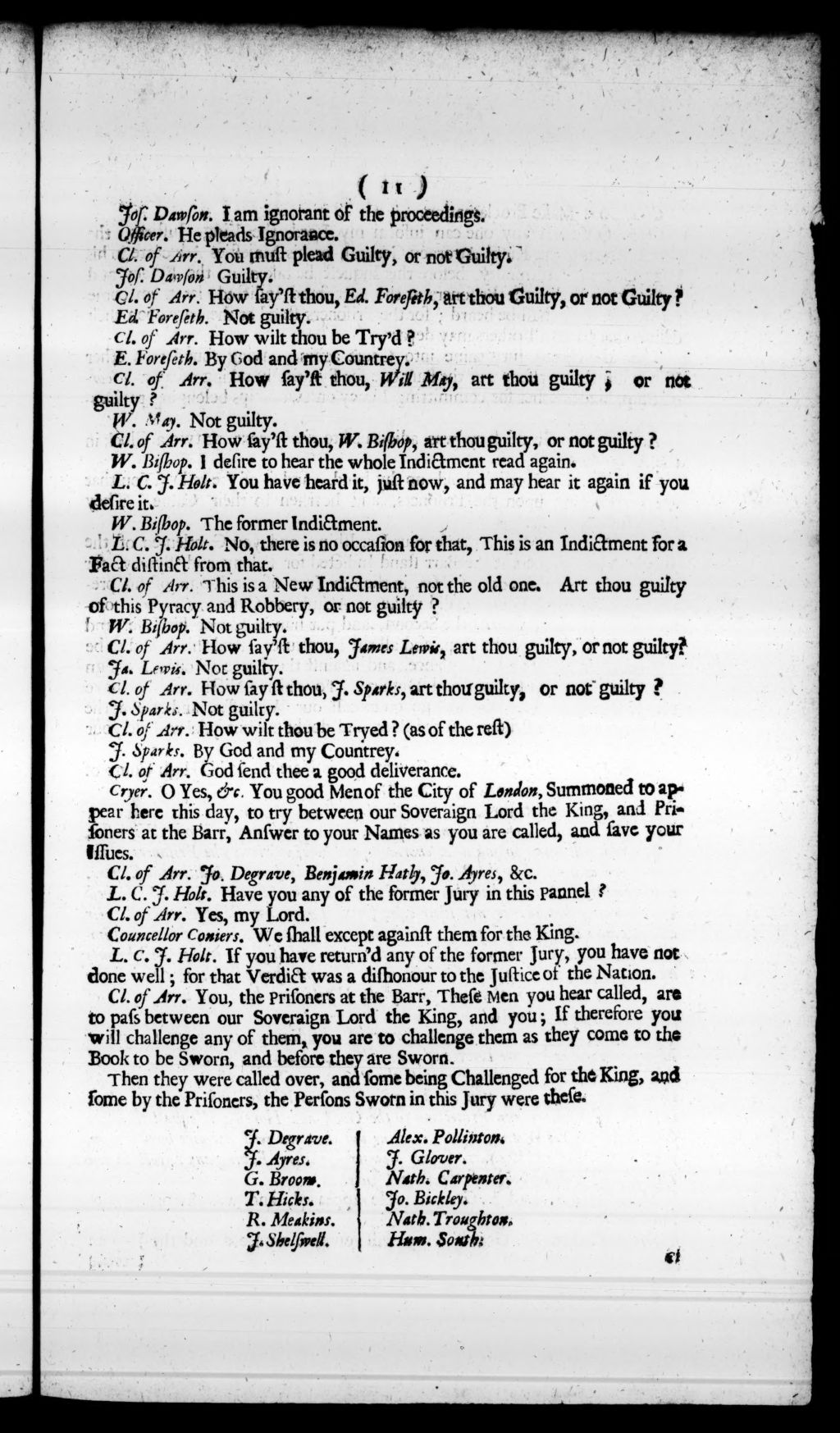
The retrial did work beyond the courtroom. With a Mughal diplomatic crisis running and East India Company trade at stake, the state needed convictions, and the fresh mutiny indictment, the charge the first jury had not acquitted, was the instrument that produced them. Douglas Burgess has read the printed pamphlet itself as a piece of public justification, the government explaining to its readers why these men hanged. The primary record shows the mechanism plainly; the political motive is Burgess's reading, held at Probable.
Six men were condemned: Dawson on four indictments by his own confession, the other five on three. Five were hanged at Execution Dock on 25 November 1696. The print closes on the sentence: "Edward Foreseth and the rest were Executed, on Wednesday, November the 25th 1696, at Execution-Dock, that being the usual Place for the Execution of Pirates." Joseph Dawson, the one man who had pleaded guilty, was reprieved. The pamphlet's phrase "and the rest" does not itself record the reprieve, so the execution date and the count of six condemned are Confirmed while the Dawson reprieve is held at Probable, on the trial print read alongside the scholarship.
One dating point belongs on the record. The pamphlet's title page says the sessions began on 29 October 1696, but its own body reads "Monday the 19th Day of October", and the internal adjournments to Saturday 31 October and Friday 6 November only work from a Monday start. The 29 October on the title page is a printer's error, corrected against the body text.
Connections
- Henry Every crew tried in Trials of Every's Crew
- Trials of Every's Crew tried the crew of Henry Every
- Trials of Every's Crew documented by The Tryals of Joseph Dawson and Others (1696)
- The Tryals of Joseph Dawson and Others (1696) documents Trials of Every's Crew
Evidence behind this record
- The mutiny indictment dates the taking of the Charles the Second to 30 May 1694, a regnal-year form ('the 30th of May, in the 6th Year of the Reign'); the working date of 7 May 1694 rests on Every's declaration and Creagh's testimony, and the two dates do not reconcile. Trial indictment: Printed 1696 trial record (A63217), indictment read verbatim; no '30 April' variant exists in the print; the 7 May / 30 May conflict stays logged as unresolved
- The first trial was a single sitting on Monday 19 October 1696 at which the jury, against the court's expectation, acquitted the prisoners on the Ganj-i-Sawai indictment. Trial record: Printed 1696 trial record (A63217), body reading 'Monday the 19th Day of October' and 'the Jury, contrary to the expectation of the Court, brought in all the Prisoners Not Guilty'; the title-page date of 29 October is a printer's error
- Days later the prisoners were recommitted and convicted at a second trial, on the Charles the Second mutiny (31 October 1696) and on the Danish and Moorish indictments (6 November 1696). Trial record: Printed 1696 trial record (A63217): 'Die Sabbati, tricesimo primo Octobris ... 1696' (Saturday 31 October) and 'Friday Novemb. the 6th 1696'
- The court treated the first acquittal as a scandal: Lord Chief Justice Holt called the verdict a dishonour to the justice of the nation, jurors from the first panel were challenged off the second, and the charge to the second jury urged conviction. Trial record: Printed 1696 trial record (A63217): 'that Verdict was a dishonour to the Justice of the Nation'
- Six men were condemned; five were hanged at Execution Dock on 25 November 1696 (Forseith, May, Bishop, Lewis and Sparkes), and Joseph Dawson, who had pleaded guilty, was reprieved. Trial record: Printed 1696 trial record (A63217): 'Edward Foreseth and the rest were Executed, on Wednesday, November the 25th 1696, at Execution-Dock'. Rendered at Confirmed for the six condemnations and the 25 November execution; the Dawson reprieve sits at Probable, a compound grade shown at the stronger grade with the weaker component named in prose
- The crew were tried at Admiralty sessions held in the Old Bailey building, a separate jurisdiction from the regular Old Bailey Proceedings, so the trial is not found in Old Bailey Online. Highly Probable Trial record and jurisdiction records: Printed 1696 trial record (A63217), title stating Admiralty Sessions; High Court of Admiralty series HCA 1 (SRC-EVR-122); the Proceedings cover only City of London and Middlesex sessions
- The 1696 printed trial, The Tryals of Joseph Dawson and others, survives and is fully digitised in multiple public-domain copies. Printed trial record: Library of Congress (LCCN 19011844), HathiTrust (mdp.35112204867115) and the EEBO-TCP transcription A63217; printed for John Everingham, London, 1696
Open research
The insider depositions of John Dann and Philip Middleton (the key eyewitness evidence) are held at The National Archives in HCA 1 and calendared in CSP Colonial; the exact piece references are not yet established.