Gallery · Primary Source · SRC-002
The Every Trial Print (1696)
The complete text survives in the public-domain EEBO-TCP transcription (A63217) and in the Library of Congress and HathiTrust page images. It is the fullest surviving record of the Every case. The excerpts below are verbatim, with the print's original spelling kept.
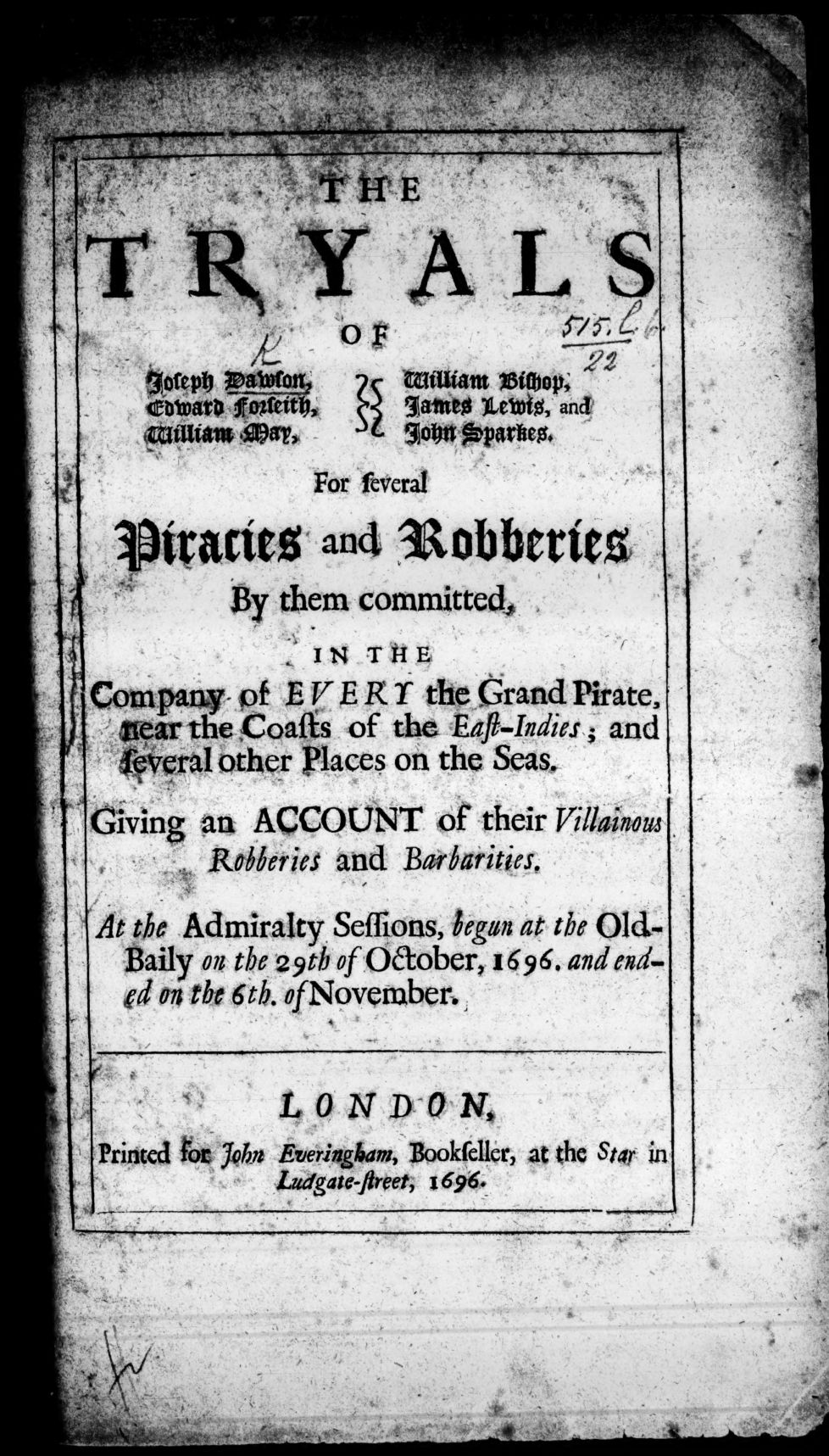
What this document is
The full title runs: The Tryals of Joseph Dawson, Edward Forseith, William May, William Bishop, James Lewis, and John Sparkes, for several Piracies and Robberies by them committed, in the company of Every the grand pirate. It was printed for John Everingham in London in 1696, a 28-page quarto, and it is the record of the Admiralty sessions that tried six of Every's crew after Every himself had vanished. Everything the courtroom did reaches us through this print. It carries the identifiers EEBO-TCP A63217, Wing T2252 and ESTC R38357, and it survives in fully digitised public-domain copies at the Library of Congress (LCCN 19011844), on HathiTrust (mdp.35112204867115), and as the EEBO-TCP full-text transcription.
One point of jurisdiction matters for anyone searching for this trial. It was an Admiralty sessions held in the Old Bailey building, not an ordinary Old Bailey criminal session, so it does not appear in the Old Bailey Proceedings series and cannot be found in Old Bailey Online. The manuscript records sit in the High Court of Admiralty series HCA 1 at The National Archives. This print is the readable spine of the case.
Reading the print: three moments
The document is most useful at three points. The acquittal the court did not want, the rebuke that followed it, and the sentence carried out. Each is given here in the print's own words.
The acquittal
"but the Jury, contrary to the expectation of the Court, brought in all the Prisoners Not Guilty, whereupon the Sessions was Adjourned to Saturday the 31th of October following, and the Prisoners were committed upon a new Warrant for several other Piracies."
This is the first sitting, Monday 19 October 1696, on the Ganj-i-Sawai indictment. The jury heard the Crown's witnesses and Lord Chief Justice Holt's summing up and refused to convict. The same sentence shows what the court did next: it did not free the men, it recommitted them for other piracies.
The rebuke
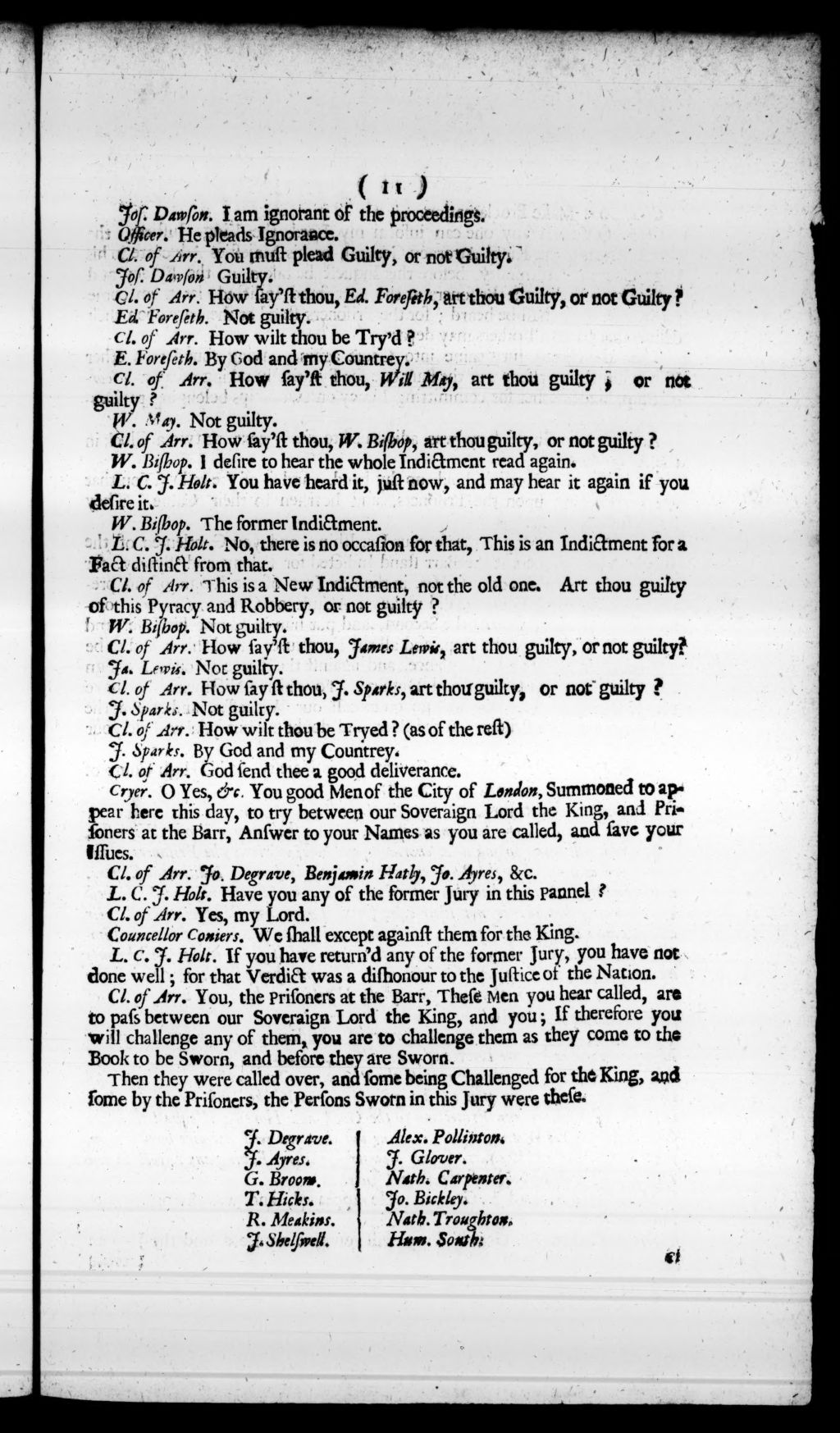
"If you have return'd any of the former Jury, you have not done well; for that Verdict was a dishonour to the Justice of the Nation."
Holt, as the second trial jury was being empanelled. The line is the reason the acquittal is remembered, and it is also the court openly signalling the result it wanted from the retrial. Jurors from the first panel were challenged off the second, and Judge Hedges' charge to the grand jury pressed the point home.
The executions
"According to this Sentence, Edward Foreseth and the rest were Executed, on Wednesday, November the 25th 1696, at Execution-Dock, that being the usual Place for the Execution of Pirates."
The closing lines of the pamphlet. Five of the six condemned men were hanged. The print's phrase "and the rest" does not name who was spared, which is why the record needs its companion sources: Joseph Dawson, the only man who pleaded guilty, was reprieved, a reading held at Probable rather than stated by the print itself.
What it establishes
- The first trial was a single sitting on Monday 19 October 1696 at which the jury, against the court's expectation, acquitted the prisoners on the Ganj-i-Sawai indictment. Trial record: Printed 1696 trial record (A63217), body reading 'Monday the 19th Day of October' and 'the Jury, contrary to the expectation of the Court, brought in all the Prisoners Not Guilty'; the title-page date of 29 October is a printer's error
- Days later the prisoners were recommitted and convicted at a second trial, on the Charles the Second mutiny (31 October 1696) and on the Danish and Moorish indictments (6 November 1696). Trial record: Printed 1696 trial record (A63217): 'Die Sabbati, tricesimo primo Octobris ... 1696' (Saturday 31 October) and 'Friday Novemb. the 6th 1696'
- The court treated the first acquittal as a scandal: Lord Chief Justice Holt called the verdict a dishonour to the justice of the nation, jurors from the first panel were challenged off the second, and the charge to the second jury urged conviction. Trial record: Printed 1696 trial record (A63217): 'that Verdict was a dishonour to the Justice of the Nation'
- The crew were tried at Admiralty sessions held in the Old Bailey building, a separate jurisdiction from the regular Old Bailey Proceedings, so the trial is not found in Old Bailey Online. Highly Probable Trial record and jurisdiction records: Printed 1696 trial record (A63217), title stating Admiralty Sessions; High Court of Admiralty series HCA 1 (SRC-EVR-122); the Proceedings cover only City of London and Middlesex sessions
- The 1696 printed trial, The Tryals of Joseph Dawson and others, survives and is fully digitised in multiple public-domain copies. Printed trial record: Library of Congress (LCCN 19011844), HathiTrust (mdp.35112204867115) and the EEBO-TCP transcription A63217; printed for John Everingham, London, 1696
The title-page error
The print contradicts itself on one date, and the body wins. The title page says the sessions "begun at the Old-Baily on the 29th of October, 1696", but the body opens the first sitting on "Monday the 19th Day of October". Only a 19 October start fits the internal adjournments, to Saturday 31 October and then Friday 6 November, both of which the print dates by weekday. A 29 October start would fall on a Thursday. The 29 October on the title page is a printer's error, and the corrected date of 19 October is the one carried through the Every records.
What it does not establish
The print secures its case on stolen property and mentions only that several men were killed aboard the Indian ships. It says nothing of the sexual violence and torture that the Mughal historian Khafi Khan and the East India Company governor Sir John Gayer both describe. That silence is not evidence the violence did not happen. It is evidence of how the prosecution chose to build a case for an English jury, and the fuller account has to be read from the Mughal chronicle and the Company correspondence, treated on the Every record under a content note.
Limitations of this room
The text is complete and public-domain, so this room can quote it directly. What it cannot do is treat the pamphlet as neutral. It is a printed justification as much as a transcript, issued after a politically awkward acquittal, and its framing choices, above all its near-silence on the violence, are part of what the document is. The insider depositions that fed it, John Dann's examination and Philip Middleton's affidavit, are calendared in the printed Jameson collection and held in manuscript at The National Archives in HCA 1; their exact piece references are not yet established.
- Event Trials of Every's Crew Admiralty sessions at the Old Bailey in 1696: the crew were acquitted on the Ganj-i-Sawai indictment at the first sitting, then convicted on the Charles the Second mutiny; five were hanged and one reprieved.
- Person Henry Every English pirate who led the 1694 mutiny aboard the Charles the Second and took the Ganj-i-Sawai in 1695, then vanished; his crew were tried in London in 1696.