Gallery · Person · PER-010
Bartholomew Roberts
Also recorded as: John Roberts (asserted birth name, modern attribution); Captain Roberts; Black Bart (modern); Barti Ddu (modern, twentieth-century coinage); The Great Pyrate (Johnson-derived)
Born: c. 1682 (exact 17 May 1682 unsupported), Pembrokeshire, Wales Died: 10 February 1722 (Old Style), off Cape Lopez Highly Probable
Welsh pirate captain of the Royal Fortune, elected to command after Howell Davis was killed at Principe in 1719; cruised Brazil, the Caribbean, Newfoundland and West Africa; killed in action against HMS Swallow off Cape Lopez in 1722, after which fifty-two of his crew were hanged at Cape Coast Castle.
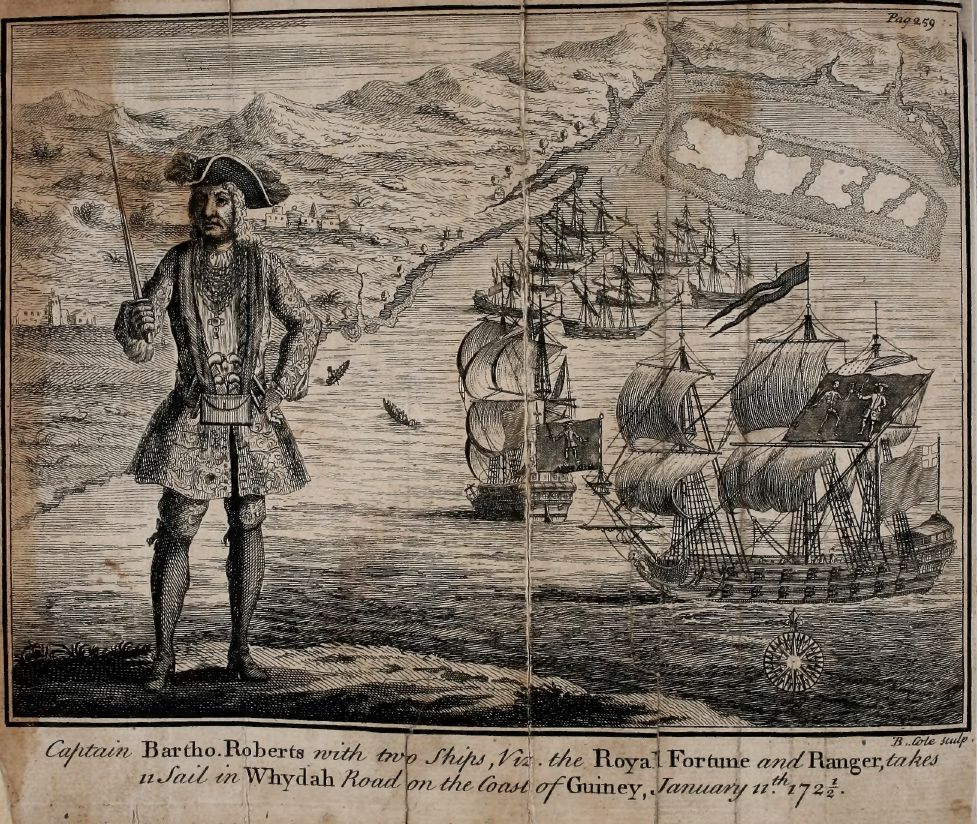
Roberts is documented best at his end. He was elected to command a company that had already changed captains more than once, and by any honest count of prizes it became the most successful pirate crew of the age. The one document that seals his death is the report of the naval officer who ended him: "The Captain, whose Name was Roberts, was killed."
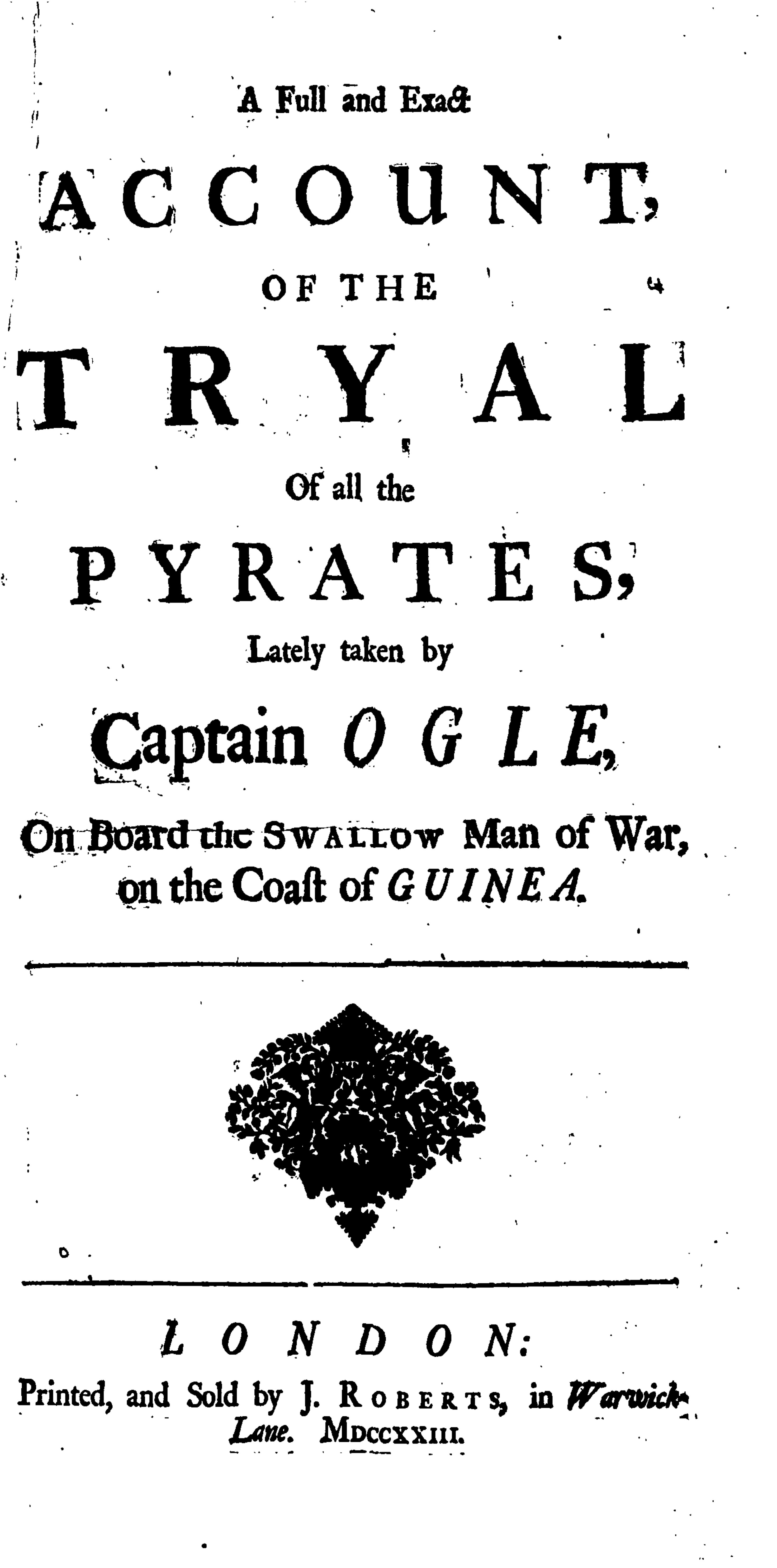
That line is Captain Chaloner Ogle's, written from Cape Coast Road on 5 April 1722 and printed in the London Gazette that September. It is reprinted word for word in the front matter of the 1723 trial pamphlet, so two period witnesses carry the same sentence. The dispatch fixes the fact of the death and nothing of its manner. It says he "was killed" after the Swallow's broadside brought down the Royal Fortune's mainmast off Cape Lopez on the morning of 10 February 1722, and it stops there. The famous detail, that grapeshot took him in the throat and killed him at once, comes from Johnson's General History and from the tertiary books that follow it. So does the burial: his crew weighted the body and put it overboard in his finery, at his own earlier request, and it was never recovered. Both are Johnson's, and both are held at Possible. The date itself needs an Old Style note, because the English legal year still turned on 25 March, and a February 1722 event was written 1721 at the time.
The documented arc, 1719 to 1722
He was Welsh, born about 1682 in Pembrokeshire, and by 1719 he was second mate on the London slave ship Princess under Captain Abraham Plumb. In early June 1719 the pirate Howell Davis took the Princess at Anomabu on the Gold Coast and pressed Roberts into the company. Davis was dead within weeks, killed in an ambush ashore at Principe, and the crew elected Roberts captain although he had been among them only about six weeks. The election is accepted; the six weeks and the speech that Johnson gives him are Johnson's, and capped there.
From there the cruise is wide and, in its detail, mostly Johnson. Brazil in the autumn of 1719, where the company cut a rich prize out of a Portuguese fleet off Bahia. The Guiana coast, then the Caribbean, where Walter Kennedy deserted with the accumulated plunder early in 1720. Newfoundland in June 1720, where Roberts raided the Trepassey fishery. Back to the Caribbean through the winter, then across again to West Africa in 1721. The firm anchors sit at the two ends. His own hand survives once: a ransom receipt for the ship Hardey, dated 13 January 1721/2 and signed "Batt. Roberts", which puts him alive and working the Guinea coast a month before he died. And the Calendar of State Papers Colonial independently fixes Thomas Anstis raiding on his own in the Good Fortune by June 1721, which dates the desertion that thinned Roberts's company the spring before the end.
The crew as polity
Roberts's company is the best-documented working example of Golden Age pirate self-government, which is why it anchors the Roberts Collection and its themes on written articles, elected quartermasters and whole-company votes. The distinction the Collection insists on holds here too. The texts of the eleven articles are Johnson's, and capped at Possible. The institution behind them is not. The 1723 trial depositions describe men signing pirate articles at Cape Coast, sharing plunder by rule, and being forced to sign at pistol point, and the court itself charged the crew with fighting the King's ship "without any Pretence of Authority more than that of your own private depraved Wills". A crew that governed itself by vote and by written law is the reading the depositions support; the wardrobe and the speeches are the reading Johnson supplies.
The captures, counted honestly
The round numbers do not survive contact with the documents. The often-printed "over 400 ships" is a modern aggregate, attributed by Wikipedia to a present-day author; Johnson narrates many separate captures and gives no career total. That Roberts took an unusually large number of vessels, many of them small fishing and coasting craft, is Highly Probable. The figure 400 is an estimate and should never be printed as a documented fact. The same caution governs the end. The "roughly 272 prisoners" carried to Cape Coast is a reconstruction, not a number the pamphlet prints; Atkins, the Swallow's surgeon, gives about 200 Englishmen and 60 or 70 enslaved Africans across the three ships, which is the order of magnitude the reconstruction rests on. The figures that are firm are the ones the printed trial actually tallies: 74 acquitted, 52 executed, 20 to seven years' servitude.
The Porcupine
The gravest act against Roberts's company is the burning of the slave ship Porcupine at Whydah in January 1722, and here the grading splits. For years the burning was carried as Johnson only. It is not. Ogle's dispatch reports an English ship burnt at Whydah for refusing ransom "with a considerable Number of Negroes a-board", and the 1723 trial record carries sworn depositions naming the Porcupine, burnt on 14 January, taken by prisoners who had been her own officers and crew. One acquitted man, Edward Evans, her cook, deposed that those who jumped overboard to escape the flames "were immediately seized by the Sharks, who tore their Limbs off in the sight of those Villains". Another described the enslaved Africans "burnt or drowned, unable to help themselves being fetter'd". The burning and the deaths of fettered captives are therefore Confirmed as a period-documented atrocity. Only the specific toll, about eighty, is Johnson's alone: Ogle says "a considerable Number", the trial says "many", and the number eighty stays at Possible.
The myth audit
Four things attach to Roberts that need sorting from the record. The wardrobe is one: the crimson damask waistcoat, the feather in the hat, the gold chain and the tea-drinking temperance are Johnson's portrait, not documented dress, and there is no authenticated likeness of him at all. The engraving in the Royal Museums Greenwich collection is a later print, not a life portrait. "Black Bart" is the second: 1722 records call him Bartholomew or Bartho. Roberts, and the nickname is a modern coinage, as is the Welsh "Barti Ddu", which is credited to the twentieth-century poet Isaac Daniel Hooson. The third is the birth date. The exact 17 May 1682 is repeated everywhere online and rests on nothing; the surviving Little Newcastle registers begin only in 1783, a century too late to hold his baptism, so the place and date are tradition carried in secondary literature, not a record.
The fourth is the Governor of Martinique. The story that Roberts hanged him from a yardarm is not pure Johnson invention: a Bermuda deposition of April 1721, calendared at CSP Colonial vol 32 item 463.iii, reports the hanging before Johnson wrote. Modern scholars still doubt the literal event, holding that the sitting governor was not among those taken. Sailing the Black Flag: The Archives keeps the story at Possible; the original deposition survives in CO 37/10 at Kew. It is contested and contemporaneously reported, which is not the same as either true or invented.
One honest limit governs the whole record. The corpus is loud at the end and thin at the start: the death, the naval action and the mass trial are documented in Ogle's dispatch and the printed pamphlet, while the years before 1719 rest on tradition and the middle of the cruise rests largely on Johnson. Roberts himself was never taken, never tried and left no admission, so no court ever weighed his personal guilt. The page states its confidence claim by claim below.
Connections
- Bartholomew Roberts and the Pirate War features Bartholomew Roberts
- Bartholomew Roberts commanded Royal Fortune
- Bartholomew Roberts hunted by HMS Swallow
- The Cape Coast Trial and Executions, 1722 tried the crew of Bartholomew Roberts
Evidence behind this record
- After Howell Davis was killed at Principe, Roberts was elected captain of the company, about six weeks after being taken. Possible Printed narrative (Johnson): Johnson, General History, Vol. 1 (1724), Roberts chapter. The election is accepted; the six-weeks interval and the election speech are Johnson-derived and capped at Possible under the house Johnson rule.
- Roberts was taken off the slave ship Princess by Howell Davis at Anomabu on the Gold Coast in June 1719. Probable Printed narrative and secondary authority: Dictionary of Welsh Biography (SRC-ROB-001) and Johnson, General History, Vol. 1 (1724). Broadly accepted; the specifics are Johnson-derived.
- Roberts was bound by a quartermaster and a council that could check him, and lost men who left with their own ships and companies: Thomas Anstis with the Good Fortune and Walter Kennedy with the plunder. Probable Calendar record and printed narrative: The Calendar of State Papers Colonial anchors the Anstis desertion (Highly Probable); the Kennedy desertion is held at Possible; Johnson, General History, Vol. 1 (1724) supplies the quartermaster and council detail (Possible)
- The famous 'over 400 ships' career total is a modern aggregate found in no period source. Possible Modern aggregate: Johnson lists many separate captures but no career total; the number is a modern figure (Possible), though that the total was very large is Highly Probable.
- A ransom receipt for the ship Hardey, dated 13 January 1721/2, was signed by Roberts as 'Batt. Roberts'. Probable Reproduced autograph document: Johnson, General History, Vol. 1 (1724), reproducing the document. Evidence that Roberts was alive and operating in mid January 1722, and of his own spelling of his name.
- Roberts was killed in the action against HMS Swallow off Cape Lopez on 10 February 1722. Official dispatch and printed trial record: Ogle's own dispatch, printed verbatim in London Gazette 6091 (SRC-ROB-212) and reprinted in the 1723 trial record (SRC-ROB-005): 'The Captain, whose Name was Roberts, was killed'. Date is Old Style (1721/2).
- That Roberts was killed by grapeshot to the throat, dying at once, and was buried at sea in his finery, is a tradition carried by Johnson alone. Possible Printed narrative (Johnson): Johnson, General History, Vol. 1 (1724). Ogle's dispatch gives no cause and Atkins does not describe the death; the manner is capped at Possible.
- He operated as a pirate captain under the name Bartholomew Roberts, commanding the Royal Fortune, c. 1719 to 1722. Highly Probable Period print and eyewitness memoir: The 1723 trial pamphlet and Ogle's dispatch (which name him Bartholomew or Bartho. Roberts throughout), Johnson's General History, Vol. 1 (1724) and John Atkins's Voyage to Guinea (1735)
- His nationality was Welsh. Highly Probable Scholarly reference: Dictionary of Welsh Biography, corroborated by Johnson and popular histories; period documentary proof is thin and rests on the DWB, local tradition and Johnson
- He was born about 1682, at Casnewydd Bach (Little Newcastle), Pembrokeshire. Probable Scholarly reference and local tradition: Dictionary of Welsh Biography ('1682?') and Royal Museums Greenwich ('c.1682'); the Haverfordwest variant names the nearest market town, about ten miles south
- His birth name was John, adopted 'Bartholomew' after he turned pirate. Probable Scholarly reference: Dictionary of Welsh Biography titles the article 'ROBERTS, BARTHOLOMEW [originally JOHN]'; no period document naming him John was located
- His exact birth date was 17 May 1682. Speculative Later tradition: Widely repeated online but tied to no baptism or parish record; the DWB gives only '1682?'
- He was elected captain after Howell Davis was killed at Principe, having been in the company about six weeks. Possible Period print (Johnson): Johnson's General History, Vol. 1 (1724); the 'six weeks' and the election speech are Johnson-derived and capped at Possible
- He was killed in action against HMS Swallow (Captain Chaloner Ogle) off Cape Lopez on 10 February 1722. Official dispatch and trial print: Ogle's dispatch, read verbatim in London Gazette issue 6091 and reprinted in the 1723 pamphlet: 'The Captain, whose Name was Roberts, was killed'; the date is Old Style 1721/2
- The cause of death was grape or small shot striking his throat, killing him at once. Possible Period print (Johnson): Johnson's General History, Vol. 1 (1724), repeated by tertiary sources; Ogle's dispatch gives no cause and Atkins does not describe the manner
- His crew weighted his body and put it overboard in his finery at his own prior request, and it was never recovered. Possible Period print (Johnson): Johnson's General History, Vol. 1 (1724) and museum retellings; Johnson-derived and capped at Possible
- The figure of over 400 vessels taken is a modern aggregate, not a count found in any period source. Possible Tertiary (modern): Attributed by Wikipedia to a modern author (Conlin 2009); Johnson lists many separate captures but records no career total. That the total was very large is Highly Probable; the number 400+ is Possible only
- At Whydah in January 1722 the Porcupine was burned after her ransom was refused, with enslaved Africans left fettered aboard; the burning is Confirmed by Ogle's dispatch and sworn depositions, while the often-repeated toll of about eighty is Johnson's alone and rates only Possible. Official dispatch and sworn trial depositions: Ogle's dispatch (an English ship burnt 'with a considerable Number of Negroes a-board') and multiple sworn depositions in the 1723 pamphlet naming the Porcupine, burnt 14 January, slaves 'burnt or drowned, unable to help themselves being fetter'd'; only the figure 'eighty' is Johnson-only
- He captured a French warship and hanged the Governor of Martinique from a yardarm. Possible Colonial deposition and period print: A 1721 Bermuda deposition (CSP Colonial vol 32 item 463.iii, original CO 37/10) and Johnson both report it, so it is not Johnson-only; modern scholars doubt the literal event. Held at Possible; the original deposition survives as CO 37/10
- 'Black Bart' and the Welsh 'Barti Ddu' are later coinages, not names used in his lifetime. Probable Tertiary reference: 1722 records use Bartholomew or Bartho. Roberts; 'Barti Ddu' is attributed to the twentieth-century poet Isaac Daniel Hooson
- Thomas Anstis deserted Roberts in April 1721 and raided independently in the Good Fortune. Highly Probable Primary calendar: Calendar of State Papers Colonial vol 32 (entry 758) places the Good Fortune under Anstis by June 1721, corroborating Johnson
- Roberts was killed in action and never tried; 'proven' can attach only to the Cape Coast Castle proceedings against his crew, never to Roberts personally. Period print and legal frame: He was never captured, arraigned, deposed or confessed; no court adjudicated his personal guilt
- The dandy wardrobe (crimson damask, a feather in the hat, a gold chain) and the tea-drinking temperance are Johnson's tradition, not documented detail. Possible Period print (Johnson): Johnson's General History, Vol. 1 (1724), a semi-journalistic compilation of disputed authorship; corroborated by no documentary source, capped at Possible
- No surviving parish or baptismal record exists for him; the birthplace and 1682 date are secondary assertions, since the Little Newcastle registers begin only in 1783. Highly Probable Original register (absence) and secondary literature: The surviving Little Newcastle books begin at christenings 1783; his asserted 1682 birth predates them by about a century
- Bartholomew Roberts was killed in the action against HMS Swallow (Captain Chaloner Ogle) off Cape Lopez on 10 February 1722 (Old Style 1721/2); Ogle's own dispatch, printed verbatim in the London Gazette, states "The Captain, whose Name was Roberts, was killed". Naval dispatch: Chaloner Ogle's dispatch, printed in the London Gazette, issue 6091
Open research
The manner of death (grapeshot to the throat) is Johnson-only at Possible; Ogle's dispatch confirms the death, not the cause. Birth name John (Probable), the exact date 17 May 1682 (Speculative) and Little Newcastle (Probable) rest on scholarly assertion and local tradition, not on a parish register: the surviving Little Newcastle books begin only in 1783. Rank on the Princess (second mate versus master) is genuinely contradicted between good sources. The Martinique governor hanging is held at Possible until the original deposition, CO 37/10, is read.