Gallery · Collection · COL-002
Bartholomew Roberts and the Pirate War
How did the most successful pirate crew of the age govern itself, and what did it take to destroy it?
How a privateer became a pirate, how the pirates became a war, and how the war ended the age. This Collection carries the second act.
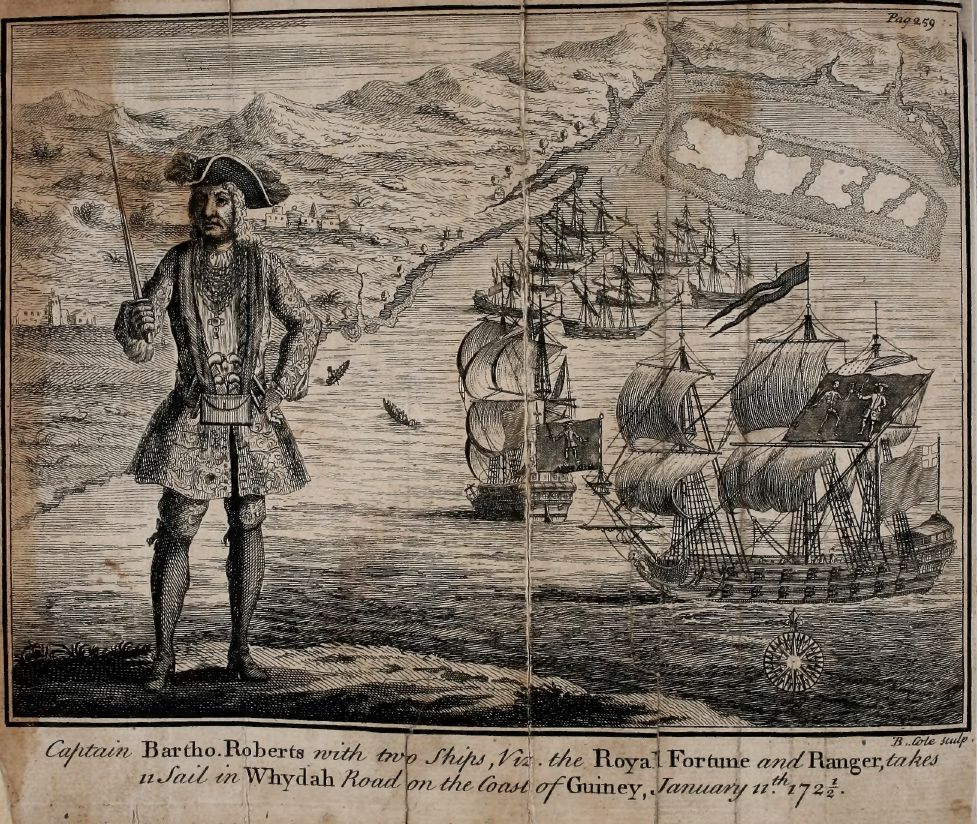
Most people meet Bartholomew Roberts as "Black Bart", the flamboyant star of the pirate legend: the dandy in crimson damask, the captain who took four hundred ships, the swashbuckler cut down with a sword in his hand. Almost none of that survives contact with the record. "Black Bart" is a modern nickname, used by no one in 1722. The four-hundred figure is a modern total, printed in no period document. Even the manner of his death, the grapeshot to the throat, comes from a single book and appears in no dispatch.
If you see past that, the thing the legend hides comes into view. Roberts commanded not a mob but a polity: a company that chose its captain by vote, bound itself by written articles, and set a quartermaster over the captain's own appetite for plunder. His crew is the type specimen for the way pirates governed themselves, and this Collection is where that specimen lives.
The record is just as clear on how that polity ended. It was not worn down at sea. It was answered by the state. On 10 February 1722 Chaloner Ogle's HMS Swallow caught the Royal Fortune off Cape Lopez and Roberts was killed in the first exchange. Ogle's own dispatch says only that "the Captain, whose Name was Roberts, was killed". Six weeks later a Vice-Admiralty court sitting inside Cape Coast Castle tried the survivors and hanged fifty-two of them, the largest mass execution of pirates in the whole Golden Age. The fifty-two is confirmed from the printed record; the word "largest" is a judgement the Archives carries at probable.
The record here is strong exactly where the story ends and thin exactly where it is most colourful. The last week rests on three independent witnesses: Ogle's dispatch, the printed 1723 trial record, and the memoir of John Atkins, who served as the Swallow's surgeon and sat as Register at the trial. The early cruises rest mostly on Johnson. So this Collection is evidentially loud at the end and visibly cautious at the start, and it says which it is being at every step.
The rooms
-
The Elected Captain
Davis dies, and a company votes Roberts into the command. -
The Articles
Eleven rules, preserved by one book and no other. -
The Crew as a Polity
The quartermaster, the vote, and the men who broke away. -
The Cruises
Brazil, Newfoundland, the Caribbean and the return to Guinea, on a thin record. -
The Porcupine
The burning at Whydah, and what the governance argument must not sanitise. -
The Pirate War
Ogle, the Swallow, and the morning Roberts was killed. -
The Trial
Cape Coast Castle, the printed record, and the court's own words. -
The Executions
Fifty-two hanged, and what ended on the shore.
What it adds up to
Roberts's company answers the first half of the question with unusual clarity for a pirate crew: it chose its captain, wrote its rules, and kept an officer whose job was to check the captain. The outline of that government is firm. The detail, the eleven articles word for word, the six weeks, the speeches, comes to us through one book, and the rooms carry that limit in plain sight rather than hiding it in a footnote.
The second half it answers with the flattest sentence in the whole story. The government at sea was not defeated in a duel. It was shot to pieces by a King's ship one morning and then hanged in batches on a beach, and the state wrote both facts down in its own hand. Roberts was dead by February. Fifty-two of his men were dead by spring.
The record is good on how this crew was destroyed. It is worse on the arguments that crew held on its own deck before the Swallow found it.
Go deeper
- Person Bartholomew Roberts Welsh pirate captain of the Royal Fortune, elected to command after Howell Davis was killed at Principe in 1719; cruised Brazil, the Caribbean, Newfoundland and West Africa; killed in action against HMS Swallow off Cape Lopez in 1722, after which fifty-two of his crew were hanged at Cape Coast Castle.
- Document A Full and Exact Account of the Tryal of all the Pyrates (1723) The printed record of the Cape Coast Castle trial of Roberts's crew, London 1723. It reprints Ogle's dispatch, the indictment, the sworn depositions (including the Porcupine burning), the servitude indentures and the summary tables of verdicts.
Three theme pages carry the governance argument across the site: pirate articles, the quartermaster, and crew voting. Roberts's company is the worked example each one generalises from.