Gallery · Event · EVT-005
The Cape Coast Trial and Executions, 1722
Also recorded as: the Cabo Corso trial; the trial of Roberts's crew
From: 28 March 1722 To: late April 1722
The Vice-Admiralty court held at Cape Coast Castle (Cabo Corso) on the Guinea coast that tried the surviving crew taken from Roberts's ships. Of those brought before it, 74 were acquitted, 52 hanged, and 20 sentenced to seven years' servitude to the Royal African Company; 17 were referred to the Marshalsea in London. It was the largest mass execution of pirates of the Golden Age, a superlative carried at Probable.
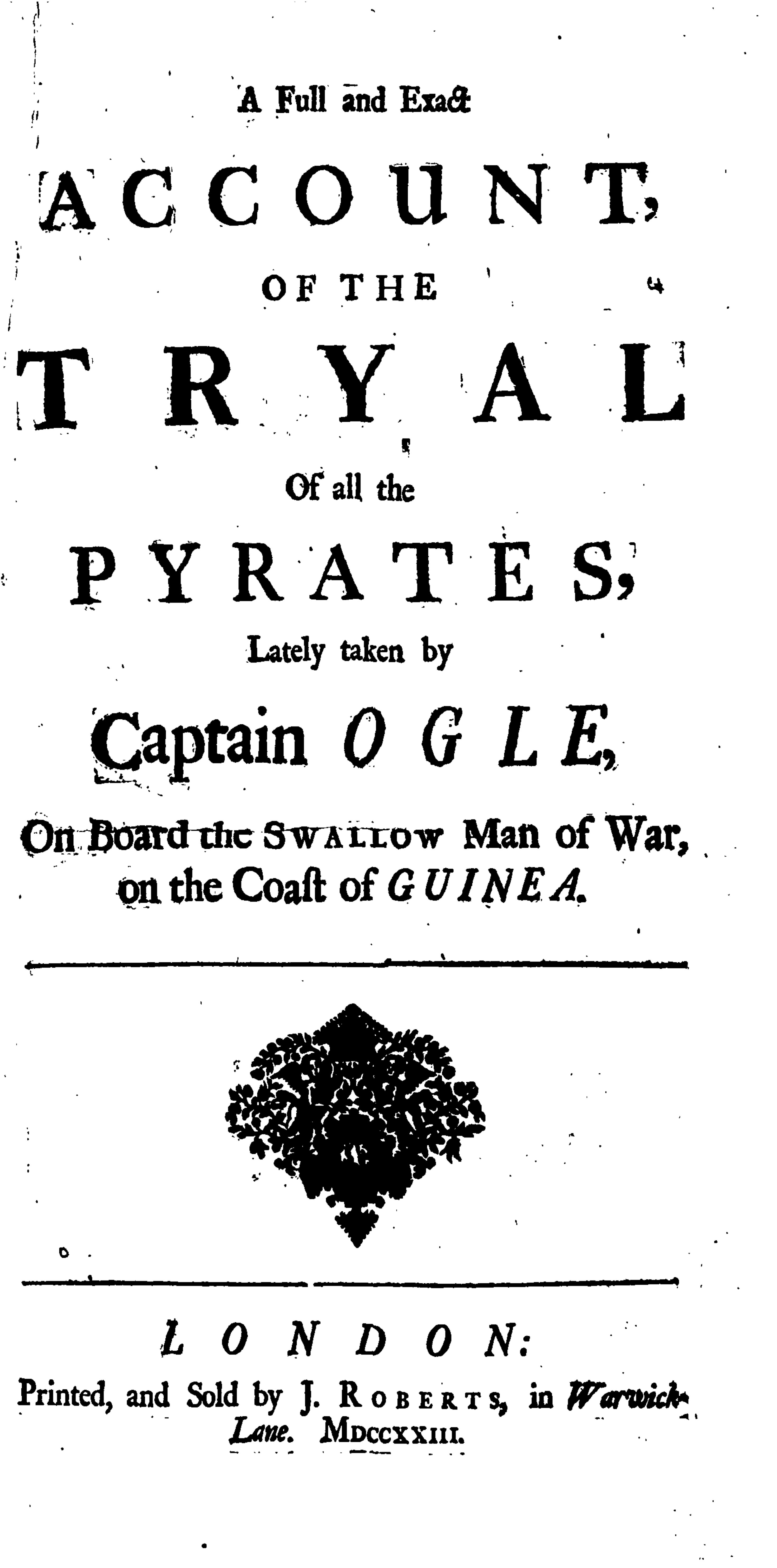
The Pirate War did not end at sea. It ended on shore, in a courtroom inside a slave-trading castle on the Guinea coast, where the men taken from Roberts's ships were tried by a Vice-Admiralty commission. It produced the largest mass execution of pirates of the Golden Age, a superlative Sailing the Black Flag: The Archives carries at Probable while the underlying count of 52 hanged is Confirmed.
The court sat at Cape Coast Castle, which the record spells Cabo Corso, from 28 March 1722 into late April. Its president was Captain Mungo Herdman; John Atkins, the Swallow's surgeon, served as Register and signed the papers. Ogle himself did not sit. As he wrote, "I being Captor, was disqualified from sitting", so the man who had taken the prisoners was kept off the bench that judged them. The whole of the proceeding survives in one place a reader can reach: the 1723 printed account, which reprints the dispatch, the indictment, the depositions and the tables, and is the spine of everything on this page.
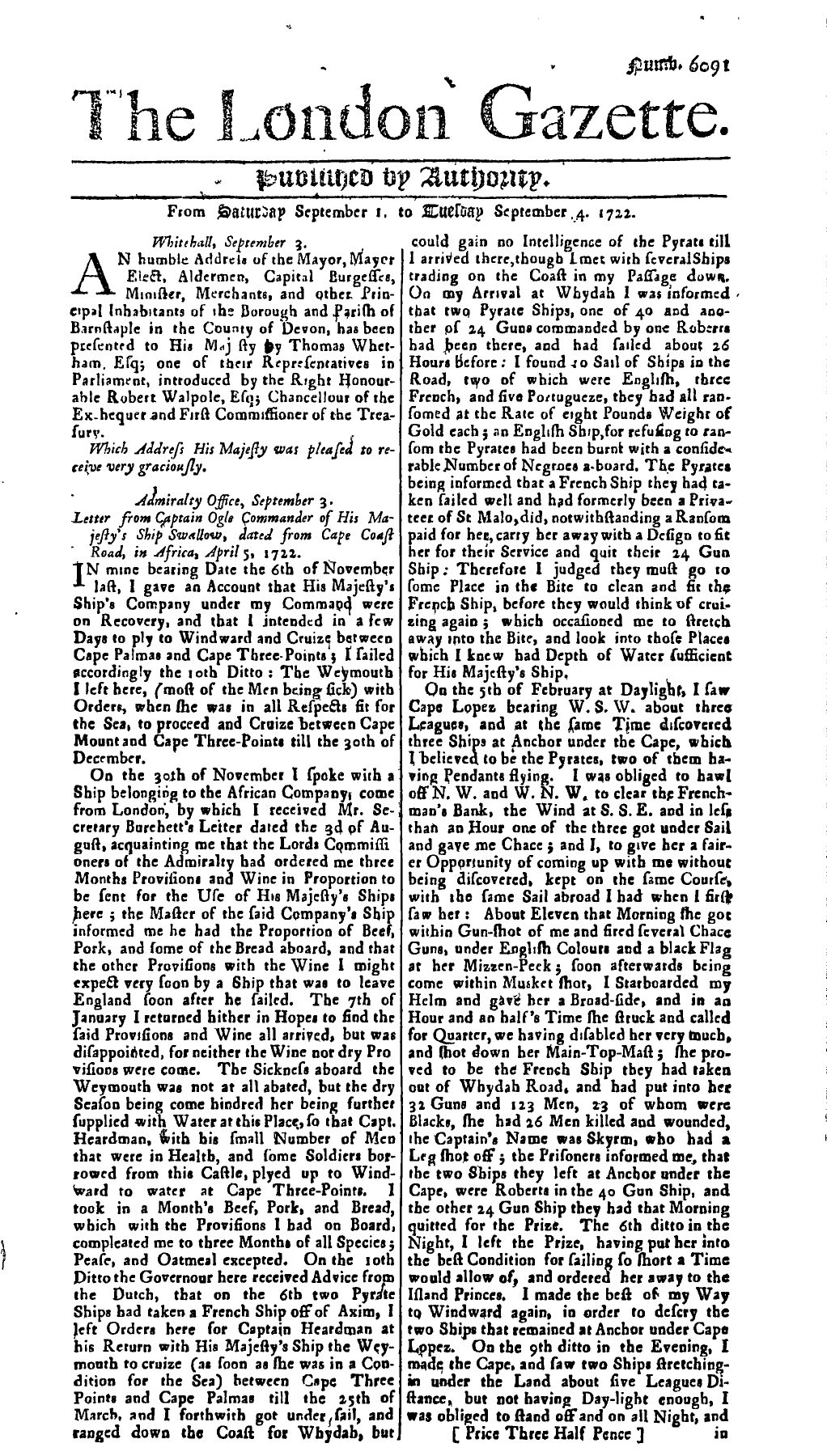
The charge turned the crew's own government against them. They were indicted for making "a Hostile Defence and Resistance for some Hours" against the King's ship, and for doing it "without any Pretence of Authority more than that of your own private depraved Wills ... under a Black Flag". The court pressed the point that these were volunteers who had set their own officers over themselves and fought under their own colours, which is the reading the depositions support: men signing pirate articles, sharing plunder by rule, serving under officers of their own election. The precise wording of the address to the prisoners is not yet established verbatim; the indictment's charge of self-made authority is verbatim from the print.
The verdicts are the firmest numbers in the whole Roberts corpus, because the pamphlet prints them as tables, name by name. Of those brought before the court, 74 were acquitted, listed by name under the heading "Total 74". Of those sentenced to death, "Whereof were Executed 52". Twenty had their sentence changed for "seven Years Servitude in Africa" to the Royal African Company, named man by man. A small group was respited "till the King's Pleasure is known", conventionally two, and 17 were referred to the Marshalsea in London for further process. The figure of 54 condemned is best read as the 52 executed plus the 2 respited. The often-repeated "272 taken" is not in the pamphlet at all; it is a reconstruction, roughly matched by Atkins's count of about 200 Englishmen and 60 or 70 enslaved Africans across the three ships.
The sentence was read in the old triple form: each condemned man was "to be hanged by the Neck till ye are Dead, Dead, Dead. And the Lord have Mercy upon your Souls." The 52 were hanged in batches over the first weeks of April, within the flood-marks below the castle. For named men the court added the further exposure: they were to be "taken down, and your Bodies hung in Chains", gibbeted on the shore as a warning to the coast. The order and the signatures, Herdman as President and Atkins as Register, close the printed proceedings.
Two silences belong on the record. The court that hanged 52 men treated the enslaved Africans found among the crew not as defendants but as property: about 65 to 70 of them were returned to slavery under the Royal African Company rather than tried, and the pamphlet has almost nothing to say about them. And the manuscript proceedings, in TNA HCA 1/99, are catalogued only as "Africa, 1722" and are not digitised, so the case has to be read through the print. The printed record is a good record of who hanged and by what verdict, and a poor one of how the accused answered for themselves.
Connections
- Bartholomew Roberts and the Pirate War features The Cape Coast Trial and Executions, 1722
- The Cape Coast Trial and Executions, 1722 tried the crew of Bartholomew Roberts
Evidence behind this record
- The Vice-Admiralty court held at Cape Coast Castle in 1722 tried Roberts's surviving crew and returned 74 acquitted, 52 executed and 20 sentenced to servitude. Printed trial record: A Full and Exact Account of the Tryal of All the Pyrates Lately Taken by Captain Ogle (1723), summary tables (SRC-ROB-005). Court held at Cabo Corso Castle, President Mungo Herdman, John Atkins Register.
- The hanging of fifty-two of Roberts's crew was the largest mass execution of pirates of the Golden Age. Probable Comparative synthesis over a Confirmed count: The superlative kept, rendered with its Probable grade visible. The 52-executed figure is Confirmed from the 1723 printed record (CLM-ROB-206); the superlative is a comparative reading resting on cross-crew synthesis.
- Roberts was killed in action and never tried; 'proven' can attach only to the Cape Coast Castle proceedings against his crew, never to Roberts personally. Period print and legal frame: He was never captured, arraigned, deposed or confessed; no court adjudicated his personal guilt
- The Vice-Admiralty court sat at Cape Coast Castle (Cabo Corso) from 28 March into late April 1722, with Captain Mungo Herdman as President and John Atkins as Register; Ogle was disqualified from sitting as Captor. Trial print: The 1723 pamphlet: 'A Journal of the Proceedings of the Court of Admiralty, held at Cabo Corso Castle ... April the 20th, 1722. Captain Mungo Herdman, President'; Ogle's dispatch: 'I being Captor, was disqualified from sitting'
- The pamphlet's own summary tables record 74 acquitted, 52 executed, and 20 sentenced to seven years' servitude to the Royal African Company, with a small respited group and 17 referred to the Marshalsea in London. Trial print: The 1723 pamphlet, read in full: 'A LIST OF THE Pyrates Acquitted ... Total 74', 'Whereof were Executed 52', 'seven Years Servitude in Africa, viz. 20'; '54 condemned' equals 52 executed plus 2 respited
- The condemned were sentenced 'to be hanged by the Neck till ye are Dead, Dead, Dead', and named men were ordered afterward to be hung in chains. Trial print: The 1723 pamphlet, read in full; the sentence and gibbeting order are signed by Mungo Herdman with John Atkins as Register
- The figure of about 272 prisoners taken is a reconstruction; the pamphlet prints no single 'taken' total. Highly Probable Eyewitness memoir and reconstruction: Atkins, read in full, gives about 200 Englishmen plus 60 or 70 enslaved Africans across the three ships; the aggregate 272 is not a printed figure
- Formerly enslaved Africans found among the captured crew were treated as Royal African Company property and returned to slavery rather than tried. Probable Period print and secondary synthesis: Johnson and the trial record; about 65 to 70 of those taken were enslaved Africans
Open research
The manuscript proceedings survive in TNA HCA 1/99, a composite piece whose catalogue names only 'Africa, 1722' and does not name Roberts, Ogle or Cape Coast Castle, so the case identity is strong inference rather than a catalogue statement. The readable spine is the 1723 printed account, SRC-004. Per-defendant verdicts for individual attribution remain to be recovered.