Gallery · Person · PER-007
John Rackham
Also recorded as: Rackam (1721 trial print); Rackum (Governor Lawes' dispatches); John Rackam (Rogers' proclamation, 1720); Calico Jack (not period; earliest attestation Gosse 1924)
Born: unknown (the printed "26 December 1682, London" has no documentary basis) Died: 18 November 1720
Pirate captain whose securely documented career runs about two months in 1720; hanged at Port Royal and gibbeted.
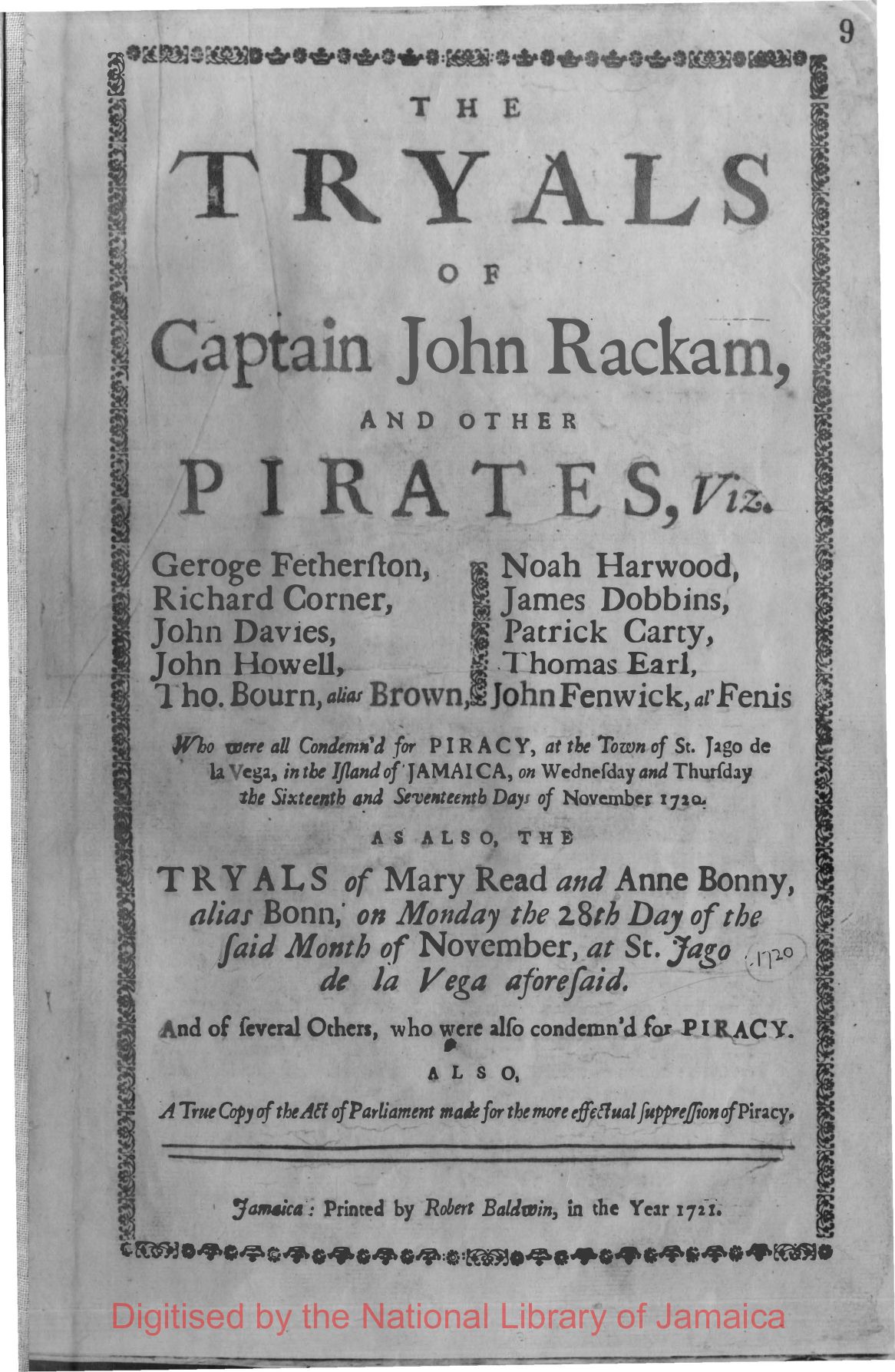
Everything securely documented about John Rackham happens inside about two months of 1720. Almost everything the name now carries, the nickname, the flag, the swagger, was added later, and much of it within living memory.
His documented career opens on 22 August 1720, when his company stole the sloop William, about twelve tons, owner John Ham, out of Nassau harbour. Woodes Rogers proclaimed the company pirates soon after, and the proclamation was reprinted in the Boston Gazette in the issue of 10 to 17 October 1720. That printing is the earliest datable naming of Rackham, and it names Anne Bonny (as "Ann Fulford alias Bonny") and Mary Read alongside him.
The cruise that followed was small and short. The two 1721 indictments charge four takings: seven fishing boats off Harbour Island about 3 September; two merchant sloops off Hispaniola about 1 October; Thomas Spenlow's schooner off Porto Maria Bay on 19 October; and Thomas Dillon's sloop, the Mary, off Dry Harbour Bay on 20 October. The largest single value charged is a thousand pounds Jamaica money. The smallest is fish and tackle worth ten. Jonathan Barnet's sloop took the William off western Jamaica near Negril Point in late October 1720, and no one was killed in the taking.
He was tried at St Jago de la Vega on 16 and 17 November 1720 with his male crew, found guilty on the third and fourth articles, and hanged at Gallows Point, Port Royal, on Friday 18 November 1720. The trial print records that the bodies of Rackham, George Fetherston and Richard Corner were then hung in chains at Plumb Point, Bush Key and Gun Key. It does not say he was beheaded; the beheading some accounts add is refuted by the print. The islet where his body hung came to be called Rackham's Cay, a naming traced to the Jamaica historian James Knight and not attested until decades later.
The twentieth-century legend
The nickname "Calico Jack" is not a period identifier. It is absent from the trial print, from Governor Lawes' letters, from Rogers' proclamation, and from Johnson, General History, Vol. 1 (1724). The earliest attestation found is Philip Gosse's Pirates' Who's Who of 1924. The familiar explanation, that he favoured calico clothing, is later folk etymology.
The flag is younger still. The skull over crossed swords now printed on beach towels has no period source. No witness at the trial described such a flag. The only flag-like object in the whole print is "a white Pendant", and that pendant belongs to Barnet's approaching sloop as the Negril men described it, not to Rackham. The crossed-swords design attached to his name first appears in Hans Leip's Bordbuch des Satans in 1959 and spread through Pirates of the Spanish Main in 1961. The claim that Rackham flew it is Speculative.
His most repeated pre-1720 exploit belongs to another man. Johnson credits Rackham with taking the London ship Kingston off Port Royal in December 1718. Governor Sir Nicholas Lawes, writing on 31 January 1719, records that the Kingston was taken on 11 December "by one Thompson a notorious pyrate". The contemporary dispatch names Thompson. His earlier service under Charles Vane, the vote said to have deposed Vane for cowardice on 24 November 1718, and his acceptance of the King's pardon in 1719 all rest on Johnson alone, and the Vane trial record that mentions a deposing vote does not name the quartermaster. His birth is undocumented. The widely printed "26 December 1682, London" has no basis and should not be repeated as fact.
One honest limit. The record is good on the two months that hanged him and nearly silent on the years before. The man is easier to convict than to know.
Connections
- John Rackham tried in The Trials of Rackham's Company
- John Rackham sailed with Anne Bonny
- John Rackham sailed with Mary Read
Evidence behind this record
- Rackham's company stole the sloop William, about twelve tons, owner John Ham, out of Nassau harbour on 22 August 1720, with Anne Bonny and Mary Read aboard. Highly Probable Proclamation (via contemporary reprint): Woodes Rogers' proclamation, reprinted in the Boston Gazette 10-17 October 1720; known from later carriers; the original issue is not in evidence
- The proclamation named the company pirates, including "Ann Fulford alias Bonny" and Mary Read (no alias); the Boston Gazette reprint of 10-17 October 1720 is the earliest datable naming of the two women. Highly Probable Proclamation (via contemporary reprint): Boston Gazette 10-17 October 1720; the original issue is not in evidence
- The 1721 indictments charge four takings: seven fishing boats off Harbour Island (about 3 September), two merchant sloops off Hispaniola (about 1 October), Thomas Spenlow's schooner off Porto Maria Bay (19 October), and Thomas Dillon's sloop the Mary off Dry Harbour Bay (20 October). Trial record: The Tryals of Captain John Rackam (1721), men's Articles I-IV and the women's Articles I-IV
- Barnet's sloop took the William off western Jamaica near Negril Point in late October 1720. Governor Lawes' letter of 13 November 1720 suggests a capture around 30 October; the frequently cited 22 October is the date the Negril men are charged with going over to Rackham, not a capture date, and the print does not date the seizure. Highly Probable Correspondence and trial record: Lawes to London, 13 November 1720, CSP Colonial vol 32 item 288; The Tryals (1721) marked p32
- Rackham and his male crew were tried at St Jago de la Vega on 16 and 17 November 1720 and found guilty on the third and fourth articles. Trial record: The Tryals of Captain John Rackam (1721)
- Rackham was hanged at Gallows Point, Port Royal, on Friday 18 November 1720; the bodies of Rackham, Fetherston and Corner were hung in chains at Plumb Point, Bush Key and Gun Key. The print does not record a beheading, refuting that variant. Trial record: The Tryals (1721), executions passage, marked p15
- "Calico Jack" is not a period identifier: it is absent from the trial print, Lawes' letters, Rogers' proclamation and Johnson, General History, Vol. 1 (1724). The earliest attestation found is Philip Gosse's Pirates' Who's Who (1924). Documented absence: Full-text search of The Tryals (1721) and Johnson (1724): zero occurrences; earliest use in Gosse (1924)
- No flag is described for Rackham's own sloop in the trial print; the only white pendant in the record is on Barnet's approaching sloop, as the Negril men described it. The skull over crossed swords design attributed to him has no period source and first appears in Hans Leip's Bordbuch des Satans (1959); the claim that Rackham flew it is Speculative. Trial record and attestation history: The Tryals (1721), Negril men's trial (white pendant, marked p32); Leip 1959 and Pirates of the Spanish Main 1961
- The Kingston, taken off Port Royal on 11 December 1718, was taken "by one Thompson a notorious pyrate", not by Rackham; the attribution to Rackham is Johnson-only and is contradicted by the contemporary dispatch. Correspondence: Lawes to London, 31 January 1719, CSP Colonial vol 31 item 34
- Rackham's service as Charles Vane's quartermaster, the vote said to have deposed Vane for cowardice on 24 November 1718, and his acceptance of the King's pardon in 1719 rest only on Johnson (1724); the Vane trial record that mentions a deposing vote does not name the quartermaster. Possible Near-contemporary narrative: Johnson, General History, Vol. 1 (1724); Vane trial print silent on the quartermaster
- No period document records Rackham's birth. The frequently printed "26 December 1682, London" has no documentary basis and should not be repeated as fact. Speculative Documented absence: Targeted searching surfaced only fandom pages
- Rackham's gibbeted body hung on a cay at the entrance to Port Royal that later became known as Rackham's Cay, a naming traced to the Jamaica historian James Knight and not attested until decades later. Probable Near-contemporary manuscript (reported): James Knight, History of Jamaica, British Library, reported via carriers
Open research
Birth date and place are undocumented; the "26 December 1682, London" tradition has no basis (Speculative). Service under Charles Vane, the 24 November 1718 deposing vote and the 1719 pardon are Johnson-only (Possible). The nickname "Calico Jack" (earliest Gosse 1924) and the skull over crossed swords flag (earliest Leip 1959) are post-period; the trial print records only a white pendant, and it is on Barnet's approaching sloop. The Kingston (11 December 1718) was taken by "one Thompson", not Rackham (CSP Colonial vol 31 item 34).