Gallery · Event · EVT-004
The Trials of Rackham's Company
Also recorded as: Rackham trials; The Tryals of Captain John Rackam
From: November 1720
Vice-Admiralty proceedings at St Jago de la Vega that tried John Rackham's company (16 to 17 November 1720) and, separately, Mary Read and Anne Bonny (28 November 1720).
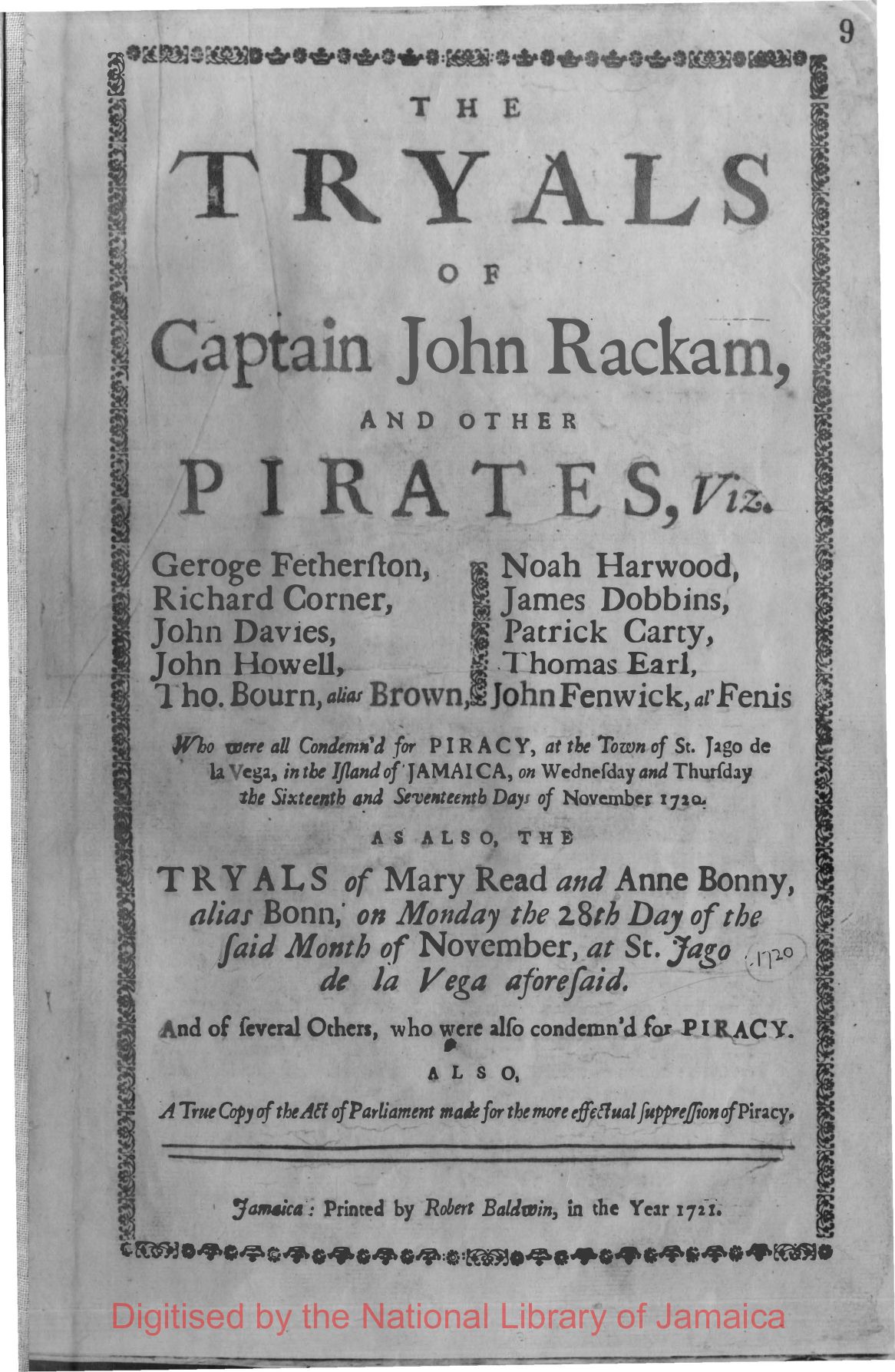
The sittings that hanged John Rackham's company ran at St Jago de la Vega (Spanish Town), the seat of the Jamaica Vice-Admiralty court, under Governor Sir Nicholas Lawes. Rackham and his male crew were tried on 16 and 17 November 1720. Mary Read and Anne Bonny were tried on 28 November. All of it survives in one printed pamphlet, The Tryals of Captain John Rackam and other Pirates, printed at Spanish Town in 1721.
On the date of the capture that filled the dock, Sailing the Black Flag: The Archives states the evidence rather than a single day, because readers meet a firmer date elsewhere. Late October 1720. Governor Lawes' contemporary letter suggests a capture around 30 October 1720. The frequently cited date of 22 October appears to derive from the trial print's reference to the Negril men joining Rackham, not to the capture itself.
Both trials turned on the same four articles, one for each taking of the cruise: the seven fishing boats off Harbour Island about 3 September, the two merchant sloops off Hispaniola about 1 October, Thomas Spenlow's schooner off Porto Maria Bay on 19 October, and Thomas Dillon's sloop the Mary off Dry Harbour Bay on 20 October. The men were convicted on the third and fourth articles. So were the women. The court applied a broad test: armed presence aboard a pirate sloop, willingly, was treated as proof enough.
The executions came in three batches. On Friday 18 November 1720, five men hanged at Gallows Point, Port Royal: Rackham, George Fetherston, Richard Corner, John Davies and John Howell. The bodies of the first three were hung in chains at Plumb Point, Bush Key and Gun Key. The next day, four more hanged at Kingston: Noah Harwood, James Dobbin, Patrick Carty and Thomas Earl. On the Monday following, Thomas Brown alias Bourn and John Fenwick hanged at Gallows Point. That is eleven men, and it reconciles Governor Lawes' report of 28 December 1720 exactly: "Rackum the Pirate and ten more have been tryed and executed". The ten are the eight convicted of Rackham's own crew, plus Brown and Fenwick, all within November. A separate group of nine, charged with going over to Rackham near Negril, were tried later, in January 1721.
The women's trial on 28 November was the same court, the same articles and much of the same testimony. Dorothy Thomas, the two French prisoners and Thomas Dillon described Read and Bonny armed, in men's clothes when giving chase and women's clothes otherwise, handing gunpowder, cursing, and acting "of their own Free-Will and Consent". Both were convicted and sentenced to hang. Then, as the print records, "both the Prisoners inform'd the Court, that they were both quick with Child", and the court ordered execution respited "and that an Inspection should be made". The pamphlet records the order and never the result. Whether either woman was found pregnant, reprieved, or, as with Read, died in custody, is not in this document.
The trial is a good record of rules and a poor one of arguments. It fixes dates, vessels, values and verdicts, and says almost nothing about how the accused answered for themselves.
Connections
- John Rackham tried in The Trials of Rackham's Company
- Anne Bonny tried in The Trials of Rackham's Company
- Mary Read tried in The Trials of Rackham's Company
- The Trials of Rackham's Company recorded in The Tryals of Captain John Rackam (1721)
Evidence behind this record
- Rackham's company stole the sloop William, about twelve tons, owner John Ham, out of Nassau harbour on 22 August 1720, with Anne Bonny and Mary Read aboard. Highly Probable Proclamation (via contemporary reprint): Woodes Rogers' proclamation, reprinted in the Boston Gazette 10-17 October 1720; known from later carriers; the original issue is not in evidence
- The 1721 indictments charge four takings: seven fishing boats off Harbour Island (about 3 September), two merchant sloops off Hispaniola (about 1 October), Thomas Spenlow's schooner off Porto Maria Bay (19 October), and Thomas Dillon's sloop the Mary off Dry Harbour Bay (20 October). Trial record: The Tryals of Captain John Rackam (1721), men's Articles I-IV and the women's Articles I-IV
- Barnet's sloop took the William off western Jamaica near Negril Point in late October 1720. Governor Lawes' letter of 13 November 1720 suggests a capture around 30 October; the frequently cited 22 October is the date the Negril men are charged with going over to Rackham, not a capture date, and the print does not date the seizure. Highly Probable Correspondence and trial record: Lawes to London, 13 November 1720, CSP Colonial vol 32 item 288; The Tryals (1721) marked p32
- Rackham and his male crew were tried at St Jago de la Vega on 16 and 17 November 1720 and found guilty on the third and fourth articles. Trial record: The Tryals of Captain John Rackam (1721)
- Rackham was hanged at Gallows Point, Port Royal, on Friday 18 November 1720; the bodies of Rackham, Fetherston and Corner were hung in chains at Plumb Point, Bush Key and Gun Key. The print does not record a beheading, refuting that variant. Trial record: The Tryals (1721), executions passage, marked p15
- Eleven men were executed in November 1720 (five on 18 November at Gallows Point, four on 19 November at Kingston, two on the following Monday), reconciling Lawes' report that "Rackum the Pirate and ten more have been tryed and executed": Rackham plus eight of his crew, plus Thomas Brown alias Bourn and John Fenwick. Trial record and correspondence: The Tryals (1721), executions passage; Lawes to London, 28 December 1720, CSP Colonial vol 32 item 340
- Mary Read and Anne Bonny were tried at St Jago de la Vega on 28 November 1720, pleaded not guilty, and were found guilty on the third and fourth articles and sentenced to death. Trial record: The Tryals (1721), women's trial
- Dorothy Thomas deposed that the two women wore "Mens Jackets, and long Trouzers, and Handkerchiefs tied about their Heads", that each "had a Machet and Pistol in their Hands", and that they "cursed and swore at the Men, to murther the Deponent"; she knew them for women "by the largeness of their Breasts". Trial testimony: The Tryals (1721), Dorothy Thomas deposition, marked p18
- The French prisoners John Besneck and Peter Cornelian testified that the women were "very active on Board, and willing to do any Thing", that Ann Bonny "handed Gun-powder to the Men", and that they did not seem detained by force "but of their own Free-Will and Consent". No witness reported either woman firing a gun or fighting hand to hand. Trial testimony: The Tryals (1721), Besneck and Cornelian, marked p18
- After sentence both women informed the court "that they were both quick with Child", and the court ordered execution respited "and that an Inspection should be made". The print records the order but no outcome: no inspection result, no reprieve and no later hearing of the two women. Trial record: The Tryals (1721), marked p19
Open research
The eleven November executions reconcile Governor Lawes' "Rackum the Pirate and ten more" (28 December 1720): Rackham plus eight of his convicted crew, plus Thomas Brown alias Bourn and John Fenwick, all in November. The court's ordered inspection of the two women has no recorded outcome. The capture that preceded the trial is undated in the print. Compound-confidence rows (the pregnancy plea, Confirmed, with its unrecorded outcome) are rendered at the event grade plus one attributing sentence, the Archive’s stated convention.