Gallery · Person · PER-011
Woodes Rogers
Also recorded as: Captain Woodes Rogers (1712 title page); Woods Rogers (his father's spelling)
Born: c. 1679, Poole, Dorset (Highly Probable; no baptism register read) Died: 15 July 1732, Nassau (Gentleman's Magazine variant 16 July) Highly Probable
Bristol privateer, author of A Cruising Voyage Round the World, and first royal governor of the Bahamas, who broke pirate Nassau.
Curator's note
Hogarth's portrait of Rogers and his family is the only painted likeness, and it's below from a public domain reproduction. His printed proclamation and his own published journal are the text exhibits, so where I quote him it's in his own words.
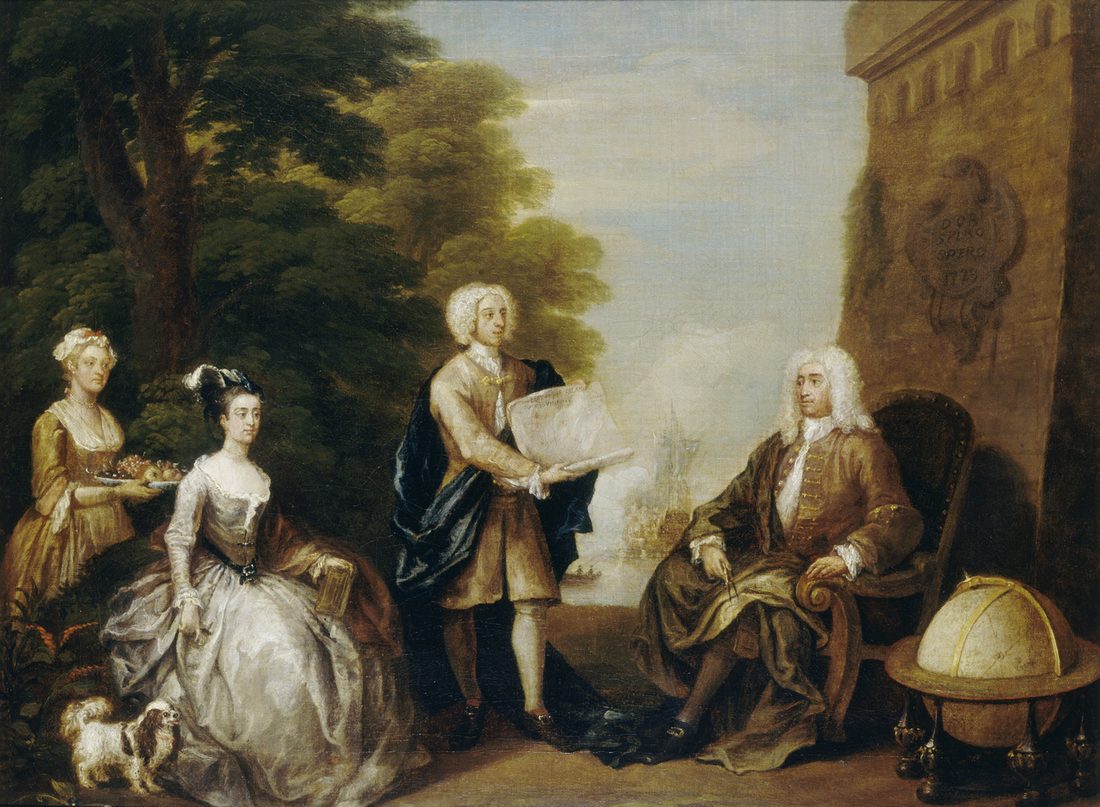
Rogers is the one man in this story who wore the state on his coat. He was a privateer first, then an author, then the governor sent to end the thing the rest of the Archive is about. He also died twice a pauper after handling two fortunes, which is the paradox his page has to hold.
The name is his own, from the title page of A Cruising Voyage Round the World (London, 1712): "Captain Woodes Rogers." Woodes is a family surname worn as a forename; his father used the plainer "Woods Rogers." He carries no pirate nickname, for the good reason that he is the crown's answer to pirates and not one of them. Born at Poole in Dorset about 1679, the family moved to Bristol in the 1690s, and he married Sarah Whetstone, daughter of Rear-Admiral Sir William Whetstone, in January 1705.
The privateer, in his own words
Backed by a syndicate of Bristol merchants, Rogers took the Duke to sea in August 1708 with the Dutchess in consort and the veteran William Dampier as pilot. The owners' Constitution, signed and sealed at Bristol on 14 July 1708, stated the object without decoration: "our grand design Being to seek out one or bothe the Ships belonging to Acapulco in South America." This was privateering under Admiralty commission in the War of the Spanish Succession, and Rogers was never charged with any crime arising from it. His acts on this voyage are a census of lawful prizes.
Off Juan Fernandez at the end of January 1709 his boats brought off a man in goat-skins who had been alone on the island about four years and four months. This was Alexander Selkirk, late master of the Cinque Ports, made second mate of the Duke. Rogers and Edward Cooke, second captain of the Dutchess, each published the rescue in 1712, and the two accounts are the first-hand record behind the Crusoe story.
In April 1709 his landing force stormed Puna and then Guayaquil. He demanded 50,000 pieces of eight to spare the town, settled for 30,000, and marched his men back to the boats with colours flying on 27 April, the sum actually received about 25,500 in cash with some plate. A fever broke out among both crews within a week of leaving, and here the record splits and stays split. His own account and the modern biography put the sickness down to a malignant fever already raging in Guayaquil before he arrived. Wikipedia carries the older charge that his crewmen dug up the recently buried in search of valuables and brought the plague on themselves. The causation is genuinely disputed, and the Archive leaves it disputed.
The wound that marked his face came in December 1709, off the tip of Baja California, in the taking of the Manila galleon Nuestra Senora de la Encarnacion, which he renamed the Batchelor. His journal gives it plainly: "I was shot thro' the Left Cheek, the Bullet struck away great part of my upper Jaw, and several of my Teeth, part of which dropt down upon the Deck, where I fell." Days later, engaging the far larger galleon Begona, the privateers were beaten off after hours of fighting and Rogers took a second wound, part of his ankle and heel-bone carried away when a Spanish fireball burst on the quarter-deck. Months afterwards a doctor cut a lodged musket shot out of his mouth. He published the whole of it as A Cruising Voyage Round the World in 1712.
The slaving voyage
Between 1713 and 1715 Rogers led a commercial voyage to Madagascar to buy enslaved Africans and Malagasy and carry them to the Dutch East Indies, with a side purpose of gathering intelligence on the Madagascar pirates. The East India Company later vetoed the colonial scheme he built on it. This is stated here plainly, as period commerce and not softened. The ship is not named for this voyage in the sources drawn on here; the frigate Delicia attaches securely only to the later Nassau years, so it is left off the Madagascar venture. The whole episode rests on tertiary carriers and is graded Probable.
The governor who broke pirate Nassau
He was appointed Captain-General and Governor-in-Chief of the Bahamas, and the commission itself survives as The National Archives CO 5/189/019. Its exact date is not settled. Carriers give 6 January 1718, 6 February 1718 and 3 September 1717, and the Adam Matthew catalogue of the patent dates it 9 January 1717/18. Only the patent image will fix the day, so this record says "early 1718" and lets the disagreement stand.
His arrival at Nassau is one of the few dates on this page fixed by his own hand. Popular accounts put him there on 22 or 24 July 1718; his despatch to the Council of Trade and Plantations of 31 October 1718 says otherwise. "I arriv'd in this port 26th July in company with the men of warr ordered to assist me," naming HMS Rose, which "got in too eagerly the evening before me," and HMS Milford, with his own ship the Delicia. He found Charles Vane's company in the harbour; Vane fired a prize as a fireship and fled under the black flag the next morning. Rogers read his commission and the King's pardon in the ruined fort and set about rebuilding it, while a tropical fever through the autumn killed more than eighty of his people.
The enforcement came in December. When pardoned men went back to piracy, Rogers tried the recaptured company of John Auger at Nassau on 9 and 10 December 1718. Ten men were tried. John Hipps was acquitted as a forced man. Nine were convicted, and eight of them were hanged at Nassau on 12 December 1718. George Rounsivell, one of the convicted nine, was reprieved at the gallows. The common miscount that folds Hipps's acquittal into Rounsivell's reprieve, and reports nine hanged, is wrong: it was eight.
By what authority did that court sit? Rogers held vice-admiralty powers under his royal commission, and the Piracy Act of 1698 (11 William III, chapter 7) let a colonial court of at least seven commissioned men try piracy on the spot, without a jury, rather than ship the accused to England. On the face of the statute the tribunal was lawful, and no source drawn on here records its jurisdiction being challenged. The contested weight of his rule sits elsewhere, in its summary character. Captain John Hildesley reported that Rogers governed despotically, his Council "obliged to say, write and sign as he directs." That is the honest shape of the complaint against him: not a defect in the court, but the autocratic manner of a man ruling a wrecked colony under something close to martial law.
The debtors' prison paradox
Rogers handled a fortune and ended a pauper, twice. The round-the-world prizes sold for about 148,000 pounds, the Bristol pamphlet giving 147,975 pounds 12 shillings and fourpence-halfpenny. A Chancery decree of December 1712 split the proceeds two-thirds to the owners and one-third to the crews, and after costs his own share came to roughly 1,015 pounds, not enough to clear the debts run up in his absence. His bankruptcy was gazetted on 10 January 1712. The governorship ruined him a second time: he met the colony's bills out of his own pocket, received little support from London, was gazetted bankrupt again on 30 January 1724, and spent time in a debtors' prison, freed only when his creditors relented. He was granted a pension backdated to 1721 after petitioning the Crown in 1726.
The second term and death
George II reappointed him governor by a commission of 22 October 1728. He sailed at the end of May 1729, reached Nassau on 25 August 1729, and convened the first Bahamas Assembly on 29 September 1729. A bitter quarrel with the Speaker, John Colebrooke, led him to suspend the Assembly by the end of 1730. He died at Nassau on 15 July 1732, aged about fifty-three. The Gentleman's Magazine gives 16 July, and the day rests on secondary carriers, so the Archive prints 15 July and records the variant.
The myth audit
Two things regularly attach to Rogers that the sources here will not carry. The colony motto "Expulsis Piratis Restituta Commercia," pirates expelled and commerce restored, is traditionally credited to his administration and later sat on the Bahamas arms, but whether it appeared on a seal of his own tenure, as opposed to a later official adoption tied to him, is unverified. So is the occasional claim that Charles Johnson's General History of the Pyrates was dedicated to him or informed by him. The 1724 edition carries no dedication to Rogers and no sign that he supplied it; it uses him only in its framing of the Providence settlement. Both the motto and the dedication are held as unverified tradition, not fact. What does survive is William Hogarth's family portrait of 1729, "Woodes Rogers and his Family," at the National Maritime Museum, Greenwich (BHC2973), his son holding a map of Providence Island.
The record is good on the voyage and thin in the same places twice over: the governorship rests on calendared despatches and a modern biography, not on the trial manuscript, the commission patent or a period death notice.
Connections
- Woodes Rogers governed Nassau / New Providence
- The End of the Golden Age features Woodes Rogers
Evidence behind this record
- The name is his own, printed "Captain Woodes Rogers" on the title page of A Cruising Voyage Round the World (1712); Woodes is a family surname worn as a forename, his father using the spelling "Woods Rogers". Printed book (own title page): A Cruising Voyage Round the World (London, 1712), title page, read via the Manwaring 1928 reprint
- Rogers commanded the Bristol privateer Duke, with the Dutchess in consort and William Dampier as pilot, on the circumnavigation of 1708 to 1711; the owners' Constitution of 14 July 1708 states the object as "our grand design Being to seek out one or bothe the Ships belonging to Acapulco", and the expedition took Alexander Selkirk off Juan Fernandez in early February 1709. Printed book (own journal) and venture papers: A Cruising Voyage Round the World (1712), journal and Constitution; Cooke's rival 1712 account
- In the taking of the Manila galleon Nuestra Senora de la Encarnacion in December 1709, Rogers was shot through the left cheek, in his own words: "I was shot thro' the Left Cheek, the Bullet struck away great part of my upper Jaw, and several of my Teeth, part of which dropt down upon the Deck, where I fell." A second wound to the ankle and heel came days later in the failed action against the Begona. Printed book (own journal): A Cruising Voyage Round the World (1712), journal leaf (1712 p.294 equivalent), verified verbatim against the primary text
- Rogers's landing force stormed Puna and Guayaquil in April 1709 and ransomed Guayaquil, demanding 50,000 pieces of eight, agreeing 30,000 and receiving about 25,500 in cash with some plate. The cause of the fever that followed is disputed: his own account and the modern biography attribute it to a fever already raging in the town, while a tertiary carrier attributes it to his crewmen digging up the recently buried. Printed book and secondary carriers: A Cruising Voyage Round the World (1712); the Bristol venture pamphlet; Cordingly biography; the grave-digging causation from Wikipedia
- Between 1713 and 1715 Rogers led a commercial voyage to Madagascar to buy enslaved Africans and Malagasy for the Dutch East Indies, also gathering intelligence on the Madagascar pirates. The ship is not named for this voyage in any source read; the Delicia attaches securely only to the later Nassau years. Probable Tertiary carrier: Reported by tertiary carriers; graded Probable under the Archive's tertiary-source cap
- Rogers was appointed Captain-General and Governor-in-Chief of the Bahamas; the commission patent survives as The National Archives CO 5/189/019. The exact date is unresolved: carriers give 6 January 1718, 6 February 1718 and 3 September 1717, and the Adam Matthew catalogue of the patent dates it 9 January 1717/18. Legal document (catalogue record): TNA CO 5/189/019, 'Commission for Woodes Rogers as Governor of Bahama Islands' (catalogue record read via Adam Matthew and TNA Discovery); the patent image not read
- Rogers arrived at Nassau on 26 July 1718, in his own words: "I arriv'd in this port 26th July in company with the men of warr ordered to assist me", naming HMS Rose and HMS Milford with his own ship the Delicia. The circulating 22 and 24 July dates are the fleet's approach, not his arrival in the port. State paper (own despatch): Rogers to the Council of Trade and Plantations, 31 October 1718, Calendar of State Papers Colonial vol 30 item 737 (manuscript CO 23/1)
- Rogers tried the recaptured company of John Auger at Nassau on 9 and 10 December 1718: ten men were tried, John Hipps was acquitted as a forced man, nine were convicted, eight were hanged on 12 December 1718, and George Rounsivell, one of the convicted nine, was reprieved at the gallows. The common report of nine hanged, folding Hipps's acquittal into Rounsivell's reprieve, is wrong. State paper enclosure: CSP Colonial vol 31 item 475 (trial copy, CO 23/1 No. 18); Cordingly biography
- Rogers handled two fortunes and was twice ruined. The circumnavigation prizes sold for about 148,000 pounds (the Bristol pamphlet gives 147,975 pounds 12s 4.5d), but after the Chancery decree split the proceeds two-thirds to owners and one-third to crews his personal share was only about 1,015 pounds; he was gazetted bankrupt on 10 January 1712 and again on 30 January 1724, and spent time in a debtors' prison, freed when his creditors relented. Highly Probable Secondary carriers and pamphlet: Cordingly biography; the Bristol venture pamphlet; Chancery and Gazette bankruptcy records as reported
- George II reappointed Rogers governor by a commission of 22 October 1728; he reached Nassau on 25 August 1729, convened the first Bahamas Assembly on 29 September 1729, and died at Nassau on 15 July 1732. The Gentleman's Magazine gives 16 July. Highly Probable Secondary carriers: Cordingly biography and institutional and encyclopaedic carriers; no contemporary death notice
- William Hogarth painted "Woodes Rogers and his Family" (1729), oil on canvas, which survives at the National Maritime Museum, Greenwich (Caird Collection, BHC2973); his son holds a map of Providence Island. The colony motto 'Expulsis Piratis Restituta Commercia' and the tradition that Johnson's General History was dedicated to or informed by Rogers are unverified and are not stated as fact. Museum object record: National Maritime Museum, Greenwich, BHC2973; motto and Johnson-dedication traditions held unverified per the brief
- The Lords Proprietors surrendered the government of the Bahamas to the Crown in 1717; Woodes Rogers arrived as first royal governor on 26 July 1718, about two hundred pirates took the King's pardon in the first days (a count graded Probable), and his council ordered Fort Nassau repaired from August 1718. State paper and secondary carriers: Rogers's despatch (CSP Colonial vol 30 item 737) for the arrival; secondary carriers for the surrender and pardon numbers
- Woodes Rogers arrived at Nassau on 26 July 1718 as the first royal governor of the Bahamas, in company with HMS Rose and HMS Milford and his own ship Delicia, carrying the King's proclamation of pardon; his own despatch of 31 October 1718 states "I arriv'd in this port 26th July". Despatch: Rogers to the Council of Trade and Plantations, 31 October 1718 (Calendar of State Papers, Colonial, volume 30, item 737)
- Rogers' commission as Captain-General and Governor in Chief dates to early 1718, but the exact day is given inconsistently across carriers (6 January, 6 February and 3 September dates all circulate); the Archive prints "early 1718" pending the patent. Probable Letters patent (unread): The commission patent, The National Archives, CO 5/189/019, not yet read; carriers give conflicting days
- The December 1718 Nassau trial of relapsed pardon-holders (John Auger, Phineas Bunce and company, retaken by Benjamin Hornigold) tried ten, convicted nine, and hanged eight on 12 December 1718; one convicted man, George Rounsivell, was reprieved at the gallows, and John Hipps was acquitted as a forced man, not reprieved. The trial and condemnations are firm from the calendared court copy; the gallows detail rests on consistent independent carriers. Highly Probable Court record (calendared) and independent carriers: Calendar of State Papers, Colonial, volume 31, item 475 (CO 23/1 No. 18); gallows detail from consistent independent carriers
- Woodes Rogers died at Nassau on 15 July 1732, aged about fifty-three; The Gentleman's Magazine reported the death as 16 July. The Archive prints 15 July 1732, the closer colonial witness, and records the London variant. Highly Probable Colonial notice and London report: Colonial notice of Rogers' death (15 July 1732); The Gentleman's Magazine (16 July report)
Open research
The exact date of his first governor's commission (TNA CO 5/189/019) is unresolved: carriers give 6 January 1718, 6 February 1718 and 3 September 1717, and the Adam Matthew catalogue dates the patent 9 January 1717/18; only the patent image will settle it. Death 15 versus 16 July 1732 is unresolved on secondary carriers. The 1713-1715 slaving voyage is graded Probable and its ship is unnamed for that voyage (the Delicia attaches only to the Nassau years). The colony motto 'Expulsis Piratis Restituta Commercia' and the tradition that Johnson's General History was dedicated to or informed by Rogers are both held as unverified tradition, not fact. The December 1718 trial's one disputed hanged name (Golding versus Cunningham) and the trial manuscript (CO 23/13) remain open.