Gallery · Collection · COL-003
The End of the Golden Age
How was the Golden Age of piracy brought to an end, and who decided it had been golden?
The end of the Golden Age is usually told as a fading: the famous captains killed or drifted away, the sea grown quiet, the age worn out under a name its own pirates had lived by. Two things in that telling are wrong. The age did not wear out, and no pirate ever called it golden.
The end was a thing the state did on purpose, with four instruments working together. The pardon of 1717 to 1719, the Act of Grace, was the mercy, offered by royal proclamation to any pirate who came in by a date and gave up the trade. The reformed piracy law, the Royal Navy and the vice-admiralty gallows were the force that met the men who refused it. Woodes Rogers carried the pardon to Nassau, arriving in his own words "in this port 26th July" 1718, and when pardoned men went back to sea he tried them and hanged eight of them there that December.
The gallows did its public work in a sequence of set-piece trials that runs from six of Bellamy's crew at Boston in 1717 to the largest of them at Cape Coast Castle in 1722, where fifty-two of Roberts's company were hanged, and ends with one man, William Fly, on a Boston scaffold in 1726. The name came last of all, and late. John Fiske headed a chapter "The Golden Age of Pirates" in 1897, and the phrase is a Victorian historian's, not a period one.
The same standard question runs under every part of the story: which document says so, and at what confidence. The two proclamations are Confirmed to the letter, read from the printed Gazette. The surrender numbers behind them, the count at the December 1718 Nassau trial, and the whole naval strand are thinner, resting on carriers and on Admiralty and Colonial Office papers still unread at Kew. That is the transformation: from an age that faded under its own name to an age that was suppressed, dated, and named afterwards by someone who was not there.
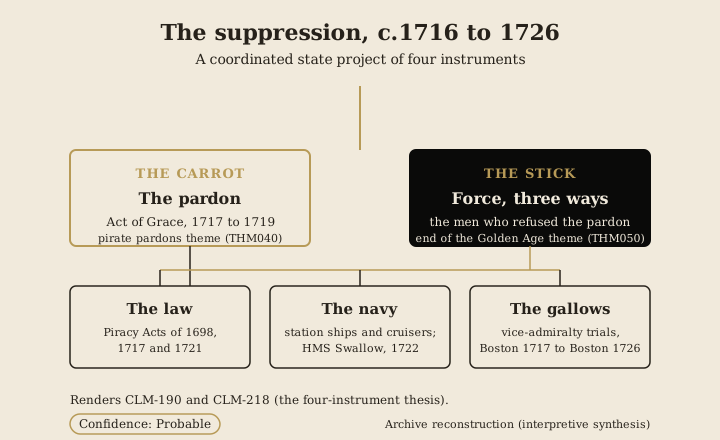
- The carrot: the pardon (Act of Grace, 1717 to 1719), belonging to the pirate pardons theme.
- The stick, first: the law, the Piracy Acts of 1698, 1717 and 1721.
- The stick, second: the navy, station ships and cruisers, and HMS Swallow in 1722.
- The stick, third: the gallows, the vice-admiralty trials from Boston 1717 to Boston 1726.
- The three sticks belong to the end of the Golden Age theme. The four-instrument reading is carried at Probable.
The rooms
-
The Carrot
The state's first instrument, mercy, in the Crown's own words. -
The Governor
Rogers arrives on 26 July 1718 and stakes the Crown's claim in person. -
The Haven
The barred harbour that made Nassau the pirates' capital, and its names. -
The Relapse and the Rope
Mercy turns to enforcement: eight hanged at Nassau in December 1718. -
The Machinery
The law builds the courtrooms and then sharpens them. -
The Gallows
The executions census, the largest at Cape Coast Castle in 1722. -
The Last Hanging
William Fly at Boston in 1726 closes the arc. -
The Name
The age is named by a Victorian chapter title, 1897. -
What Survives
What the Collection holds, and what is still at Kew.
What it adds up to
The suppression is object-rich where it is loudest and quiet where the work was administrative. The proclamations and the trial prints survive and are quoted here to the letter. The surrender rolls, the December 1718 court file, and the Admiralty papers of the naval hunt are still at Kew, unread and undigitised, and the Collection says so in its last room rather than filling the silence.
Two theme galleries carry this Collection's subject across the site, and this is where they are sequenced into one walk. Pirate pardons holds the two proclamations verbatim and the relapse problem; the end of the Golden Age holds the four-instrument suppression, the executions census and the coinage. Each room links out to its theme rather than repeating it.
Go deeper
- Person Woodes Rogers Bristol privateer, author of A Cruising Voyage Round the World, and first royal governor of the Bahamas, who broke pirate Nassau.
- Place Nassau / New Providence New Providence island and its north-shore town of Nassau, the pirate haven of the 1710s and the colony Woodes Rogers reclaimed for the Crown in 1718.
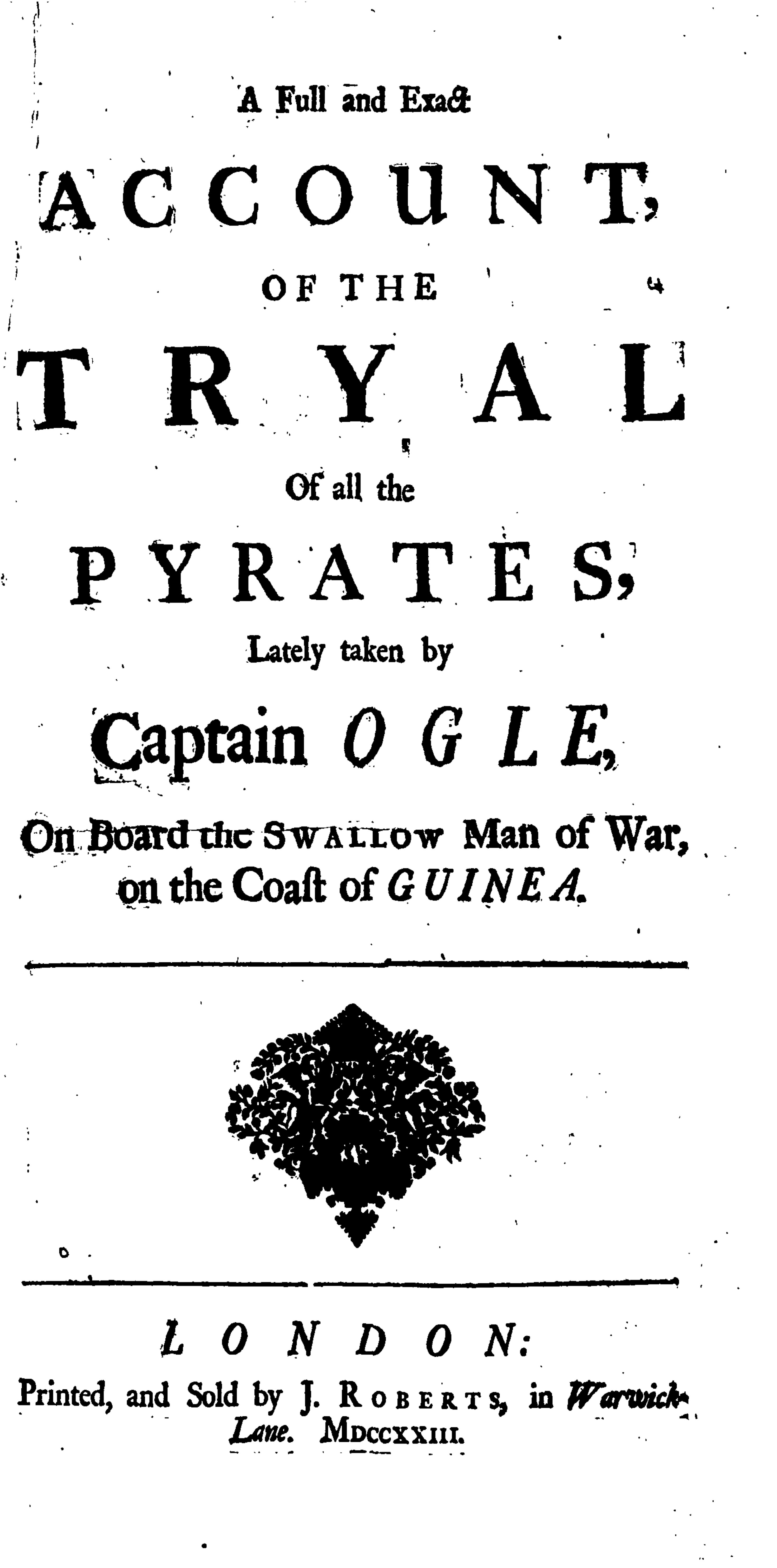
- Document A Full and Exact Account of the Tryal of all the Pyrates (1723) The printed record of the Cape Coast Castle trial of Roberts's crew, London 1723. It reprints Ogle's dispatch, the indictment, the sworn depositions (including the Porcupine burning), the servitude indentures and the summary tables of verdicts.