Gallery · The End of the Golden Age · Room 2 of 9
The Governor
Curator's note
There's only one painted likeness of Rogers, Hogarth's family group of 1729, and it's below from a public domain reproduction. The original hangs at the National Maritime Museum in Greenwich. I've kept the older exhibit as well, a line Rogers wrote himself.
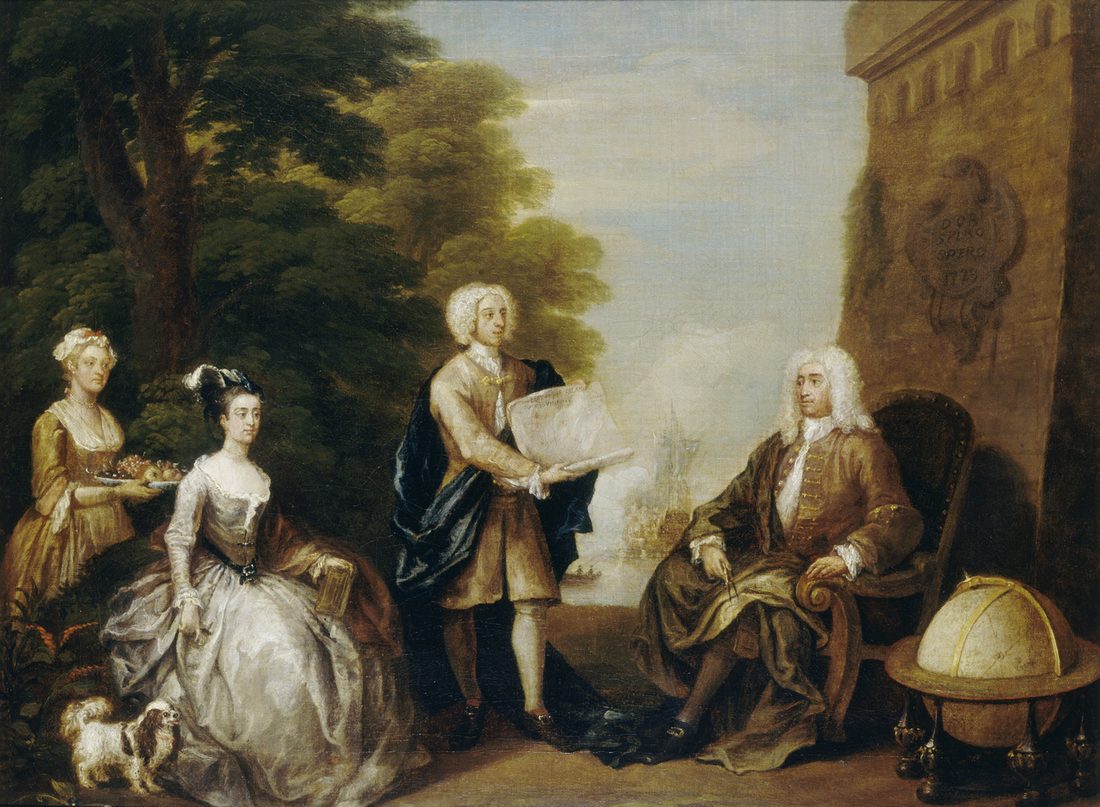
The proclamation in the last room is impersonal: the King's words, no man's face. This room gives the pardon a governor. Rogers reached Nassau on 26 July 1718 as the first royal governor of the Bahamas, escorted by the men-of-war HMS Rose and HMS Milford and his own ship Delicia, and he staked the Crown's claim in a fort that was in ruins. We can date the arrival to the day because he wrote it down himself.
"I arriv'd in this port 26th July"
The scarcity is the point, and it is worth stating plainly rather than papering over. A governor famous enough to have a museum portrait and a colony motto reaches this Collection as a single sentence of his own, because his own words are firmer than any picture of him. That is the honest shape of the record, and it is the reason to read the line rather than look for a face.
His commission is softer than his arrival. It plainly dates to early 1718, but the exact day is given three different ways across the carriers, and the patent that would settle it, held at The National Archives, is not read here. So the Archive prints "early 1718" and does not commit to a day.
The Woodes Rogers person gallery sets out the whole life, the earlier privateering voyage, the governorship and the disputes that followed. What this room adds is the moment the pardon stopped being a document and became a man in a ruined fort, reading the King's claim aloud to a town of pirates. The next room is the town itself.