Gallery · The End of the Golden Age · Room 1 of 9
The Carrot
Curator's note
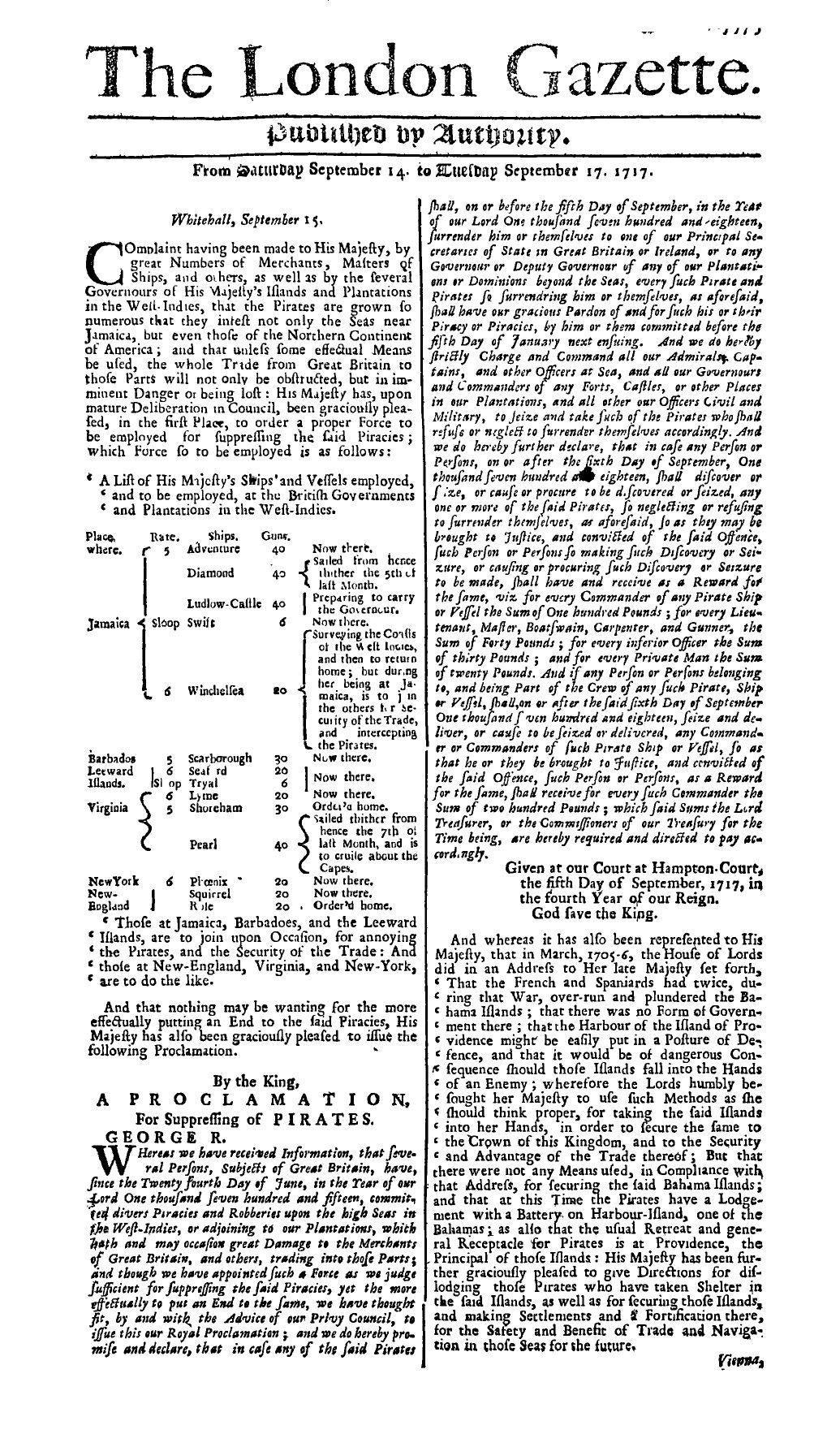
The pardon survives as print, in the two issues of the London Gazette that carried the Crown's terms. The first proclamation is above and the second below, both transcribed to the letter. They're worth reading before anything written about them.
The pardon was the cheaper answer. A squadron cost money and men; a proclamation cost paper. The state's first instrument against the Golden Age was not force but mercy, offered under the royal prerogative rather than by an Act of Parliament, and this room places it first because it came first in the sequence.
The first proclamation, "By the King, A Proclamation, For Suppressing of Pirates", was given at Hampton Court on 5 September 1717, in the fourth year of George I. It offered a pardon to any pirate who surrendered by a fixed day and gave up the trade.
"Given at our Court at Hampton-Court, the fifth Day of September, 1717, in the fourth Year of our Reign."
"committed before the fifth Day of January next ensuing"
The proclamation also recites, separately, the date from which it counts the wave of piracy it means to suppress.
"since the Twenty fourth Day of June ... One thousand seven hundred and fifteen"
It carried a reward schedule as well, to turn pirates against their own commanders: one hundred pounds for a commander taken or given up, forty for a lieutenant, master, boatswain, carpenter or gunner, thirty for an inferior officer and twenty for a private man, and two hundred pounds to any pirate who delivered up a commander.
When the first window closed, a second proclamation, given at St James's on 21 December 1718, opened the door again.
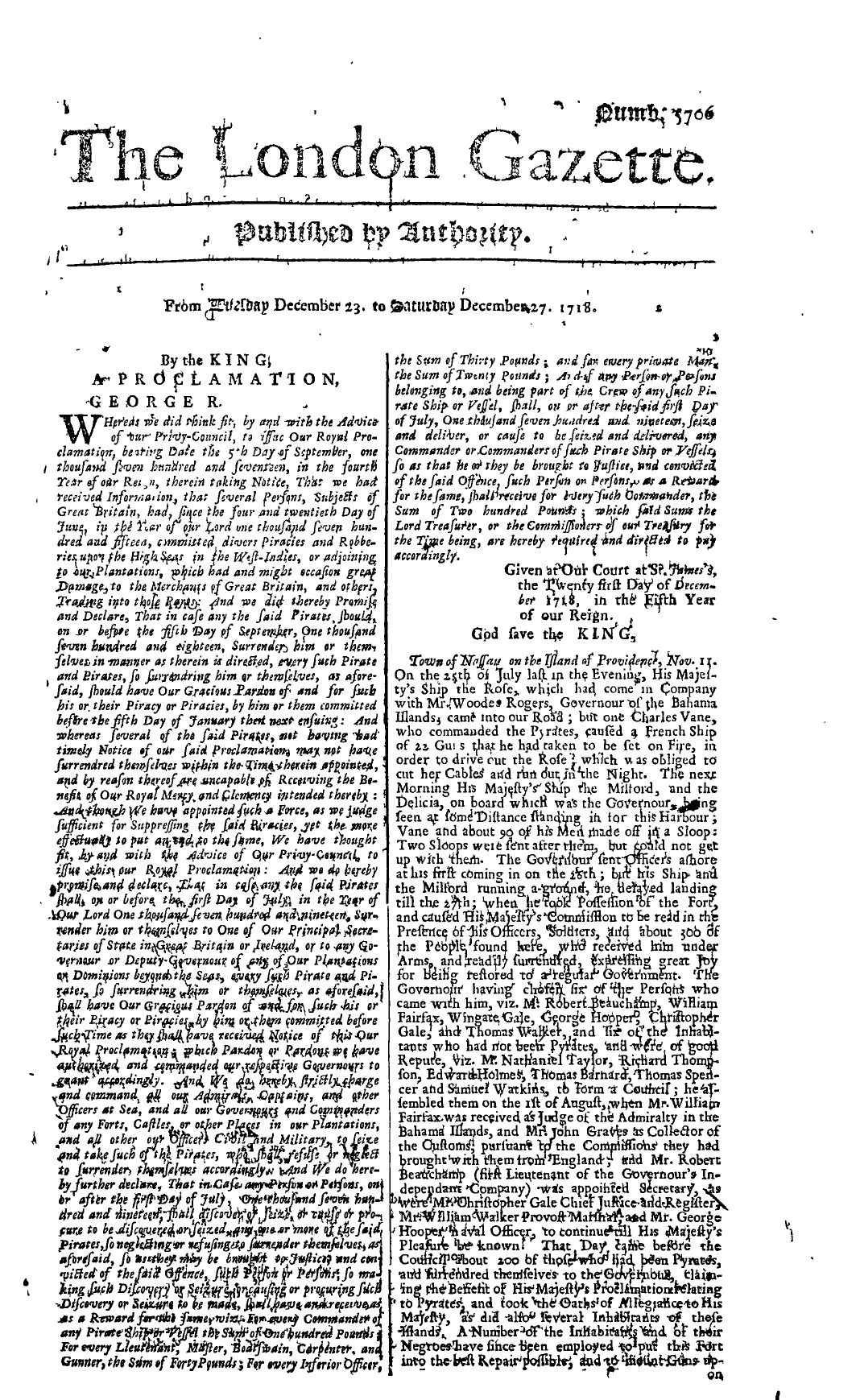
"Given at ... St. James's, the Twenty first Day of December 1718, in the Eighth Year of our Reign."
"the first Day of July ... One thousand seven hundred and nineteen"
Here is the instrument's built-in weakness, and it is the hinge of everything that follows in this Collection. A pardon is a certificate, not a cure. A man could come in, take his life back, and go back to sea, and many did. The pirate pardons theme gallery holds the two proclamations in full and follows the relapse problem across every crew it touched; what this room adds is the pardon's place at the head of the suppression sequence, the mercy that had to fail before the force made sense.
The honest limitation is in the numbers. The surrender rolls that would say exactly how many pirates took the pardon, and who, survive mainly as Colonial Office and Admiralty manuscripts at Kew and are not read here. The words of the pardon are Confirmed; the count of the pardoned is not, and the room does not pretend otherwise.