Gallery · Primary Source · SRC-003
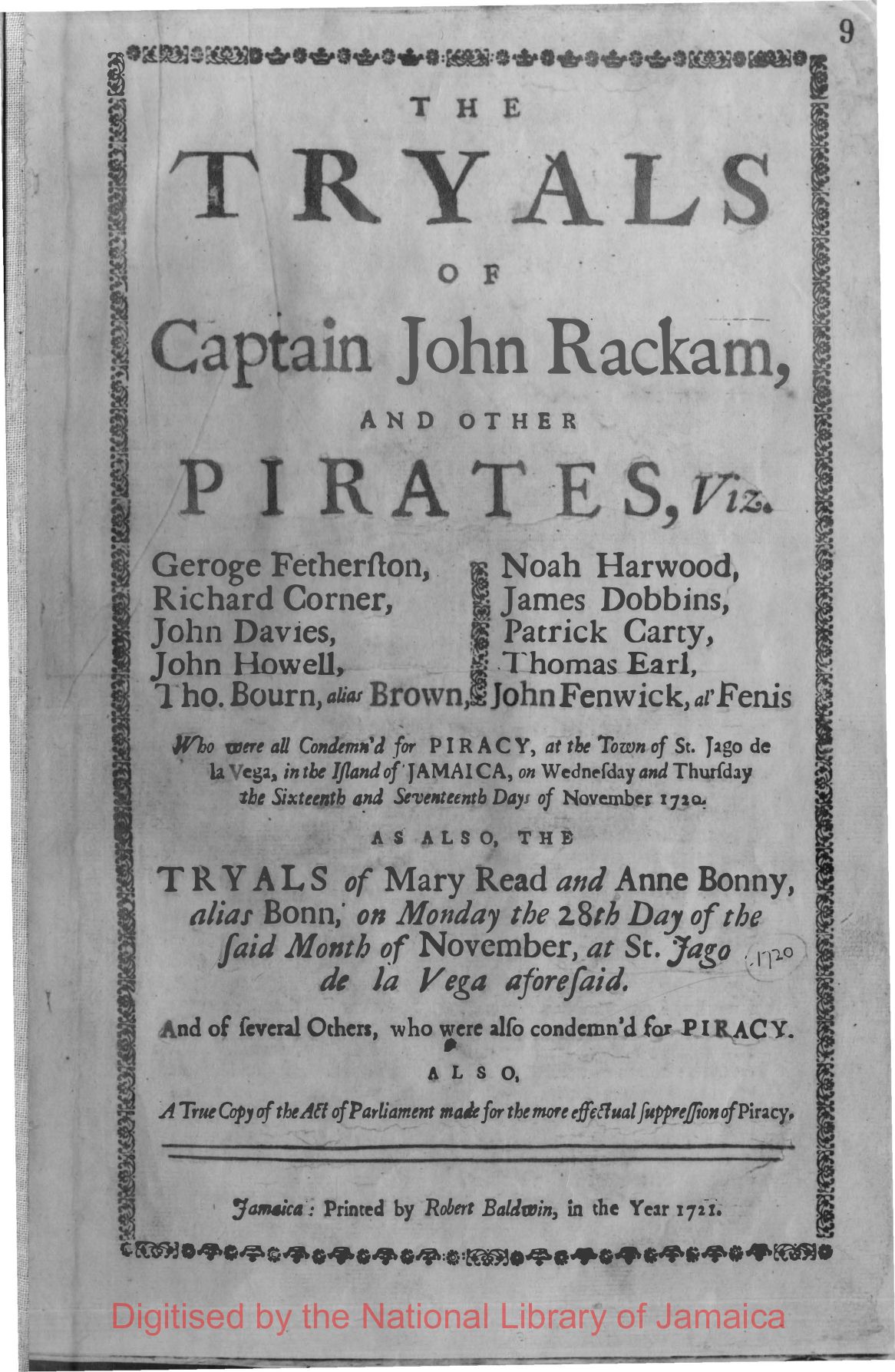
The Tryals of Captain John Rackam (1721)
The only contemporary printed record of these trials, shown here from the National Library of Jamaica facsimile. Every passage quoted on this page is transcribed from the page it sits on. An original is held at the National Library of Jamaica, and a further copy at The National Archives, Kew, CO 137/14/1.
Curator's note
Nearly everything reliably known about Anne Bonny and Mary Read comes through this one printed object. It gives their trial four pages, and it never states their ages, their births, or what became of them. The legend was built later, on the silence around these pages. The pages themselves are what survive, and they're here.
One detail on the title leaf is worth a look. The ten condemned men are set in plain columns, and the two women are announced separately, by name, in the largest italics on the page. The printer knew who would sell this pamphlet, which means the legend starts here, on the title page of the official record.
What this document is
The trials followed the taking of Rackham's sloop off Negril Point by Jonathan Barnet in late October 1720. Within a month the survivors stood before the Vice-Admiralty court at St Jago de la Vega, presided over by the governor, Sir Nicholas Lawes. The pamphlet reports the trial of John Rackham and his crew on 16 and 17 November 1720, then, in a separate section, the trial of Mary Read and Anne Bonny on 28 November, followed by later sittings and a reprint of the piracy Act of 11 and 12 William III. It is the sole edition of the proceedings located to date. The National Archives dates the printing to between the last execution (29 March 1721) and 12 June 1721.
The pages themselves
Two openings carry most of the weight of the women's trial.
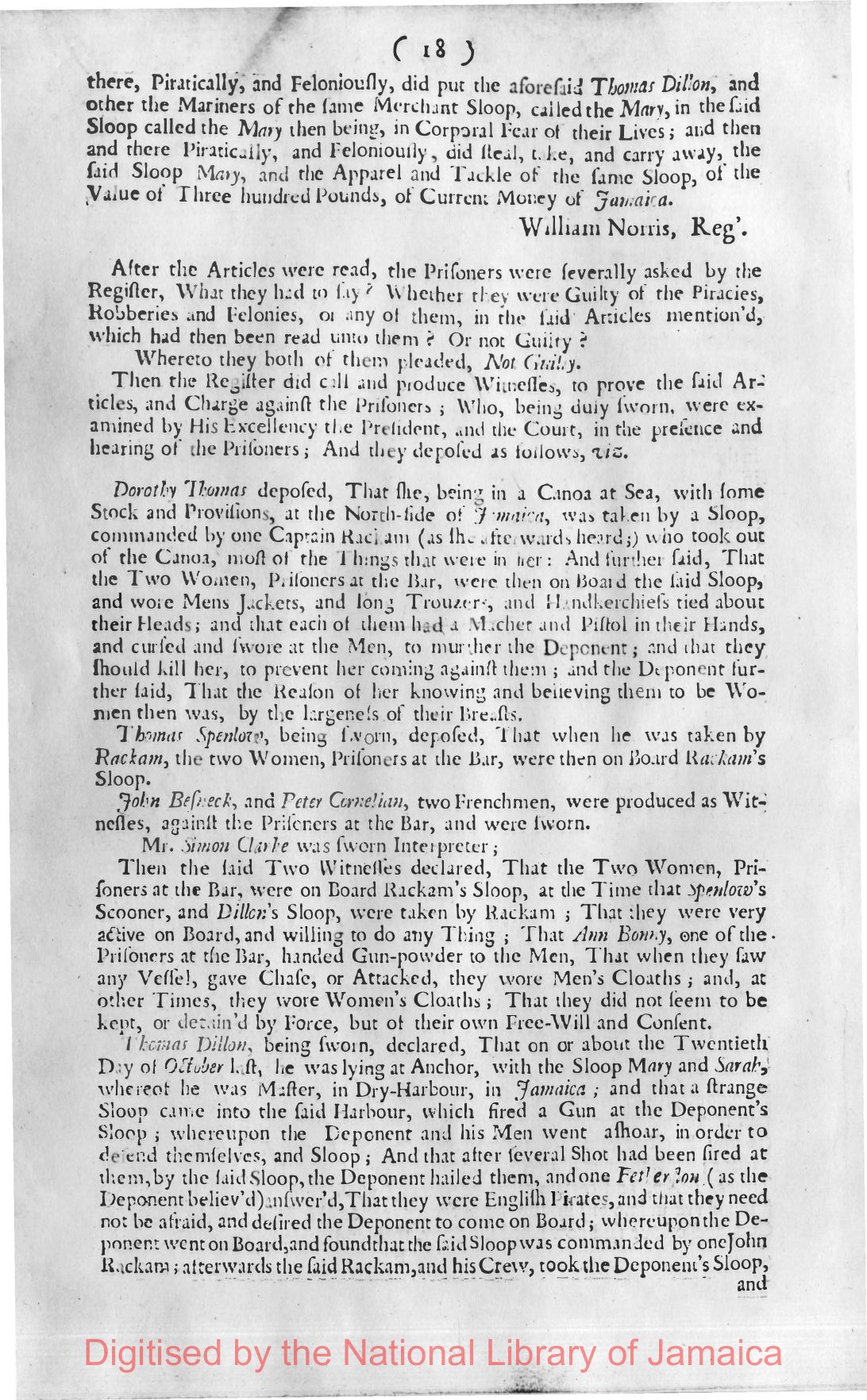
"Dorothy Thomas deposed ... That the Two Women, Prisoners at the Bar, were then on Board the said Sloop, and wore Mens Jackets, and long Trouzers, and Handkerchiefs tied about their Heads; and that each of them had a Machet and Pistol in their Hands, and cursed and swore at the Men, to murther the Deponent ... the Reason of her knowing and believing them to be Women then was, by the largeness of their Breasts."
"That Ann Bonny ... handed Gun-powder to the Men ... they did not seem to be kept, or detain'd by Force, but of their own Free-Will and Consent."
Together these depositions did two things. Dorothy Thomas convicted the women of violence in their own persons, threats made in their own voices. The Frenchmen's "Free-Will and Consent" closed off the one defence that might have saved them, that they were merely the men's companions carried along. And the famous image of Bonny and Read in men's clothing starts on this page, so it is worth reading exactly: the witnesses say the women wore men's clothes when they chased or fought, and women's clothes at other times. The disguise of legend was, in the testimony, working dress.
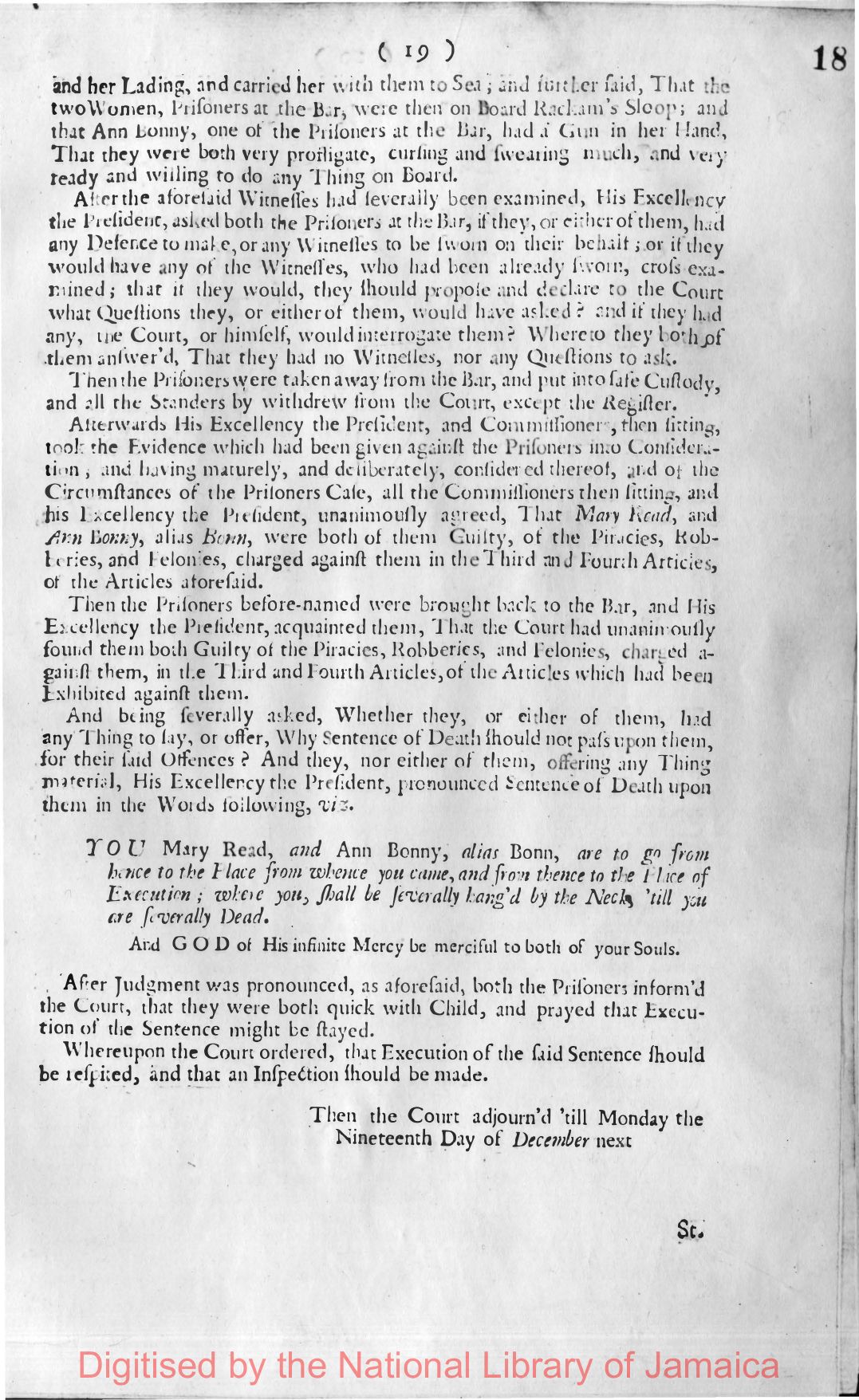
"YOU Mary Read, and Ann Bonny, alias Bonn, are to go from hence to the Place from whence you came, and from thence to the Place of Execution; where you, shall be severally hang'd by the Neck, 'till you are severally Dead. And GOD of His infinite Mercy be merciful to both of your Souls."
"After Judgment was pronounced ... both the Prisoners inform'd the Court, that they were both quick with Child, and prayed that Execution of the Sentence might be stayed. Whereupon the Court ordered, that Execution of the said Sentence should be respited, and that an Inspection should be made."
The plea had a name in law: pleading the belly. The law would not hang a woman while she carried a child, so a successful plea stayed execution until an inspection could settle the matter. The print records the order for that inspection and then leaves the two women forever. What became of them has to be read from other records, and they are thin. The St Catherine parish register records the burial of a Mary Read on 28 April 1721, five months after the trial; she had died in gaol. For Anne Bonny the documentary trail simply ends at the reprieve. A burial of an "Ann Bonny" in the same parish in December 1733 may be the pirate, living quietly in Jamaica, or may be a namesake; no record settles it. Everything else ever written about her ending is invention.
One naming detail sits on the title leaf above: the printed title spells "Anne Bonny", while the body of the proceedings has "Ann Bonny, alias Bonn" throughout, and "Read" every time it is legible.
What the print establishes
- The 1721 indictments charge four takings: seven fishing boats off Harbour Island (about 3 September), two merchant sloops off Hispaniola (about 1 October), Thomas Spenlow's schooner off Porto Maria Bay (19 October), and Thomas Dillon's sloop the Mary off Dry Harbour Bay (20 October). Trial record: The Tryals of Captain John Rackam (1721), men's Articles I-IV and the women's Articles I-IV
- Dorothy Thomas deposed that the two women wore "Mens Jackets, and long Trouzers, and Handkerchiefs tied about their Heads", that each "had a Machet and Pistol in their Hands", and that they "cursed and swore at the Men, to murther the Deponent"; she knew them for women "by the largeness of their Breasts". Trial testimony: The Tryals (1721), Dorothy Thomas deposition, marked p18
- The French prisoners John Besneck and Peter Cornelian testified that the women were "very active on Board, and willing to do any Thing", that Ann Bonny "handed Gun-powder to the Men", and that they did not seem detained by force "but of their own Free-Will and Consent". No witness reported either woman firing a gun or fighting hand to hand. Trial testimony: The Tryals (1721), Besneck and Cornelian, marked p18
- After sentence both women informed the court "that they were both quick with Child", and the court ordered execution respited "and that an Inspection should be made". The print records the order but no outcome: no inspection result, no reprieve and no later hearing of the two women. Trial record: The Tryals (1721), marked p19
- The Tryals of Captain John Rackam, and other Pirates (Robert Baldwin, Jamaica, 1721) is the primary record of the trials. An original survives at the National Library of Jamaica; a copy is held at The National Archives, Kew, catalogued CO 137/14/1 within the Jamaica Original Correspondence. Bibliographical record: National Library of Jamaica; TNA CO 137/14/1
- The pamphlet survives complete and is available in digitised facsimile from the National Library of Jamaica copy; the print has internal defects of pagination and dating that these pages cite around rather than silently correct. Bibliographical record: National Library of Jamaica digitised facsimile of the 1721 print
The custody question
For once the custody is short and clean. The Kew copy sits inside Governor Lawes' correspondence file, which is why the pamphlet and the state-paper letters that summarise the same events travelled together. Whether further originals survive at the British Library or the John Carter Brown Library is not yet established.
Internal defects noted
Every source in the Archive has its faults named. This one has four worth recording. The pagination is irregular and repeats, so citations give the print's own marked page. The Vane section, appended later in the same pamphlet, is internally inconsistent on its March dates and carries a misprinted sitting year of "1716" that the surrounding sittings contradict; this is a defect of the print and is left uncorrected rather than silently smoothed. James Dobbin appears twice in different capacities, once as an assaulted mariner in the second article and again as a convicted crew member executed on 19 November, which is the print's own sequence, not an error. And the reprint of the piracy Act at the back is boilerplate, badly inked in the surviving copy.
Two precision points correct earlier readings. The name "Neptune" is in the pamphlet, but it belongs to Spenlow's schooner in the Brown and Fenwick indictment for a June 1720 taking, not to Rackham's or the women's articles, which name only "a certain Scooner, of an unknown Name". The name "Mary and Sarah" is also in the pamphlet, but only in Thomas Dillon's own deposition; the charged vessel is "the Mary". Anyone quoting the women's indictment should carry neither proper name.
Limitations of this gallery
The print is complete and read, but it is not the whole record. It is silent on the outcome of the ordered inspection, on the women's ages, births and origins, and on any capture date for Rackham. Those silences are not gaps in this transcription. They are gaps in the document, and the Archive exhibits them as such rather than filling them.
Figures in this gallery
- Event The Trials of Rackham's Company Vice-Admiralty proceedings at St Jago de la Vega that tried John Rackham's company (16 to 17 November 1720) and, separately, Mary Read and Anne Bonny (28 November 1720).
- Person John Rackham Pirate captain whose securely documented career runs about two months in 1720; hanged at Port Royal and gibbeted.
- Person Anne Bonny Documented member of John Rackham's crew, 1720; tried and convicted at Spanish Town, reprieved on pleading pregnancy; later life undocumented.
- Person Mary Read Documented member of John Rackham's crew, 1720; convicted at Spanish Town, reprieved on pleading pregnancy, died in custody; buried 28 April 1721.