Gallery · Primary Source · SRC-004
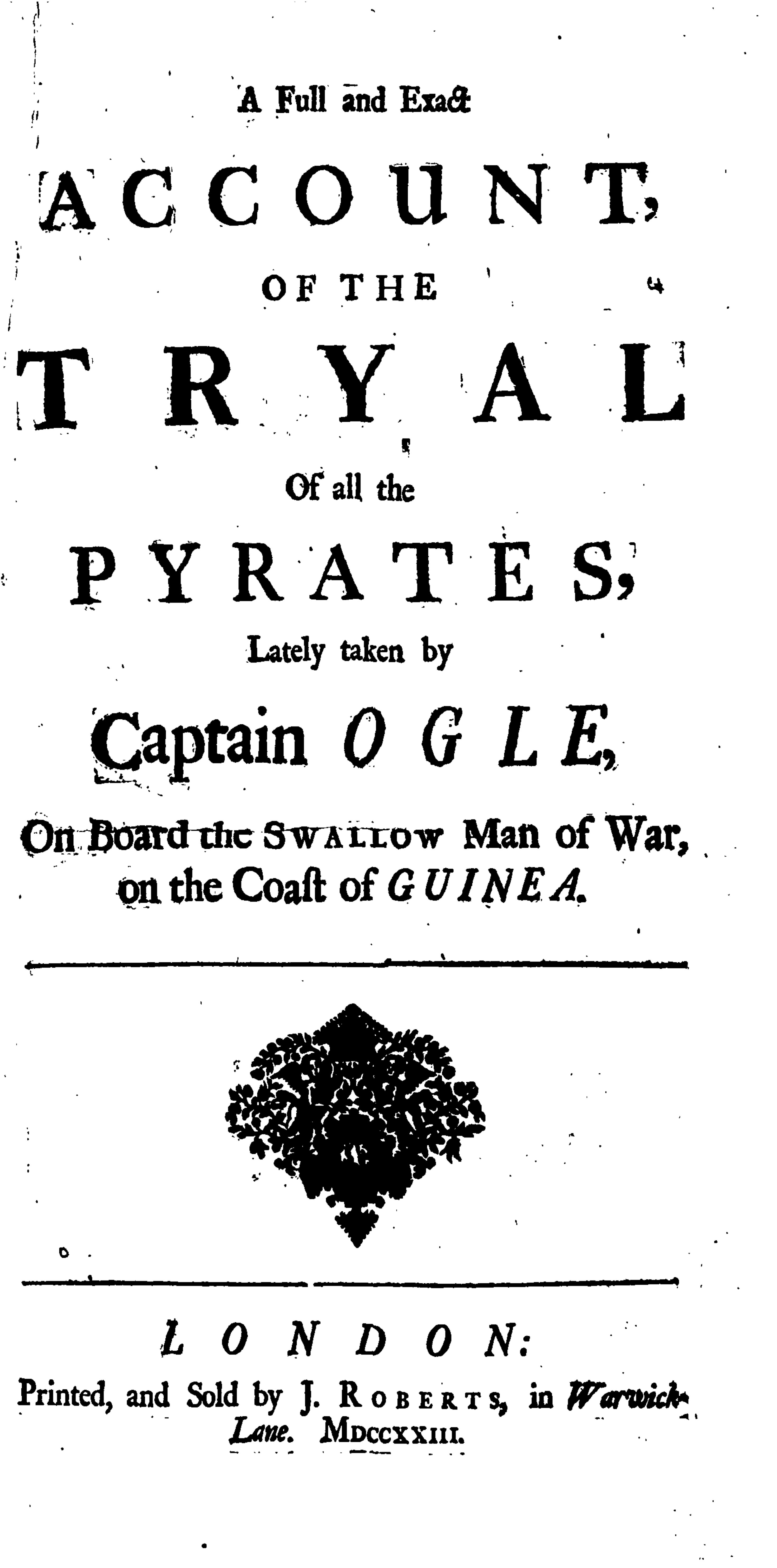
A Full and Exact Account of the Tryal of all the Pyrates (1723)
A fully digitised open-access copy survives at the Internet Archive, with bibliographic control at WorldCat under OCLC 83269383. The excerpts below are transcribed from that copy, whose scan is rough, with obvious corruption corrected against sense; the print's original spelling is otherwise kept.
What this document is
The full title runs: A Full and Exact Account, of the Tryal of All the Pyrates, Lately Taken by Captain Ogle, on Board the Swallow Man of War, on the Coast of Guinea. It was printed and sold by J. Roberts in London in 1723, and it is the printed record of the Vice-Admiralty court held at Cape Coast Castle (Cabo Corso) in the spring of 1722 that tried the crew taken from Bartholomew Roberts's ships. It reprints Captain Chaloner Ogle's dispatch, then gives the indictment, the sworn depositions taken defendant by defendant, the servitude indentures, and the closing summary tables of verdicts.
It should not be confused with the manuscript proceedings. The court's own records survive at The National Archives in the High Court of Admiralty series, HCA 1/99, a composite piece the catalogue describes only as Vice-Admiralty proceedings including "Africa, 1722". That description does not name Roberts, Ogle or Cape Coast Castle, so the case identity is strong inference, and the piece is not digitised and can be consulted only on-site at Kew. This 1723 print, a period printed version of the trial rather than the court's own file, is the readable spine of the case.
A second period witness
The dispatch that opens the pamphlet was also printed verbatim in the London Gazette, issue 6091, giving two independent period witnesses to Ogle's death line and his Whydah burnt-ship line. The surviving scan of the pamphlet is rough, and every excerpt below was checked against sense before it was quoted.
Short verbatim excerpts
Five passages carry most of the weight the print is used for on this site. Each is transcribed from the digitised copy, corrected only where the scan garbled a word the surrounding sense fixes.
"That ye not only made this Fight and insolent Resistance against the King's Ship, without any Pretence of Authority more than that of your own private depraved Wills, but did it also under a Black Flag."
"That every one of them signed their Pyratical Articles, and shared their Plunder, some few only excepted, who since their being on Board, had never seen a Prize taken."
"Captain Joseph Trahern deposed, That he was dragged along to the Signing of their Articles; that he was the last among his Men that did sign them, and shewed himself the most unwilling to go."
"Edward Evans, Cook of the Porcupine ... burnt she was under the dreadful choice of perishing by Fire or Water; those who jump'd over-board to avoid the Flames that spread towards them, were immediately seized by the Sharks, who tore their Limbs off in the sight of those Villains, who took a cruel satisfaction in looking on."
"...and each of you, are sentenced and adjudged to return to the Place from whence ye came, from thence to the Place of Execution, and there within the Flood-marks to be hanged by the Neck till ye are Dead, Dead, Dead. And the Lord have Mercy upon your Souls."
What the print establishes
- Roberts's articles, eleven of them as Johnson prints them, are the fullest single pirate code the period hands us, and survive only because a printed book preserved them. Possible Printed text (Johnson): Johnson, General History, Vol. 1 (1724) (SRC-ROB-300, SRC-ROB-003); the pirate constitutions as texts are Johnson-only. No independent manuscript of the articles survives; the verbatim text is capped at Possible.
- The institution of sworn written articles, elected officers and whole-company votes is documented independently of Johnson by sworn depositions across four Vice-Admiralty courts. Highly Probable Editorial line over trial depositions: The 1723 trial record's own indictment describes Roberts's company as 'wickedly united, and Articled together' (SRC-ROB-005). The institution is deposition-carried; only the verbatim article text is Johnson-only.
- At Whydah on 14 January 1721/2 the Porcupine was burned by Roberts's company with enslaved Africans left fettered aboard, who were burned or drowned. Dispatch and sworn trial depositions: Ogle's dispatch (London Gazette 6091, SRC-ROB-212: an English ship burnt at Whydah 'with a considerable Number of Negroes a-board') and multiple sworn depositions in the 1723 trial record (SRC-ROB-005) naming the Porcupine. The burning and the fettered deaths are Confirmed as a period-documented atrocity.
- The specific toll at the Porcupine, about eighty, is carried by Johnson alone. Possible Printed narrative (Johnson): Johnson, General History, Vol. 1 (1724). Ogle's dispatch says 'a considerable Number' and the trial depositions say 'many'; the figure of about eighty is Johnson-only and capped at Possible.
- The Vice-Admiralty court held at Cape Coast Castle in 1722 tried Roberts's surviving crew and returned 74 acquitted, 52 executed and 20 sentenced to servitude. Printed trial record: A Full and Exact Account of the Tryal of All the Pyrates Lately Taken by Captain Ogle (1723), summary tables (SRC-ROB-005). Court held at Cabo Corso Castle, President Mungo Herdman, John Atkins Register.
- The destruction of Roberts and the trial of his crew is carried by three independent period witnesses converging on one week: the captor's official dispatch, a printed sworn trial record, and an eyewitness participant memoir. Probable Interpretive characterisation of the corpus: London Gazette 6091 (SRC-ROB-212), the 1723 trial record (SRC-ROB-005), and Atkins, A Voyage to Guinea (1735) (SRC-ROB-004). The strength is concentrated at the end of the story; the early career rests far more on Johnson.
- At Whydah in January 1722 the Porcupine was burned after her ransom was refused, with enslaved Africans left fettered aboard; the burning is Confirmed by Ogle's dispatch and sworn depositions, while the often-repeated toll of about eighty is Johnson's alone and rates only Possible. Official dispatch and sworn trial depositions: Ogle's dispatch (an English ship burnt 'with a considerable Number of Negroes a-board') and multiple sworn depositions in the 1723 pamphlet naming the Porcupine, burnt 14 January, slaves 'burnt or drowned, unable to help themselves being fetter'd'; only the figure 'eighty' is Johnson-only
- The pamphlet's own summary tables record 74 acquitted, 52 executed, and 20 sentenced to seven years' servitude to the Royal African Company, with a small respited group and 17 referred to the Marshalsea in London. Trial print: The 1723 pamphlet, read in full: 'A LIST OF THE Pyrates Acquitted ... Total 74', 'Whereof were Executed 52', 'seven Years Servitude in Africa, viz. 20'; '54 condemned' equals 52 executed plus 2 respited
- The condemned were sentenced 'to be hanged by the Neck till ye are Dead, Dead, Dead', and named men were ordered afterward to be hung in chains. Trial print: The 1723 pamphlet, read in full; the sentence and gibbeting order are signed by Mungo Herdman with John Atkins as Register
- A printed record of the trial, A Full and Exact Account of the Tryal of All the Pyrates Lately Taken by Captain Ogle (London, J. Roberts, 1723), survives and is fully digitised. Period print: Internet Archive open-access digitisation, OCLC 83269383
- The printed account is distinct in class from the manuscript proceedings in TNA HCA 1/99, which are not digitised and whose catalogue names only 'Africa, 1722'. Highly Probable Archive catalogue: TNA Discovery record C3218789; the case identity is strong inference, not a catalogue statement, and the piece is consultable only on-site at Kew
- Of Bartholomew Roberts's captured crew, fifty-four were condemned and fifty-two were hanged at Cape Coast Castle in the spring of 1722; the printed record also gives seventy-four acquitted and twenty sentenced to servitude. Printed trial record: A Full and Exact Account of the Tryal of all the Pyrates (London, 1723)
Custody and rights
The pamphlet is public-domain by age, printed in 1723, and the Internet Archive copy is open access. Bibliographic control sits at WorldCat under OCLC 83269383, with the imprint "Printed, and sold by J. Roberts", London, 1723. What is not settled is whether the scholarly document collections that reprint Golden Age trial material, the Baer collection of 2007 and E. T. Fox's Pirates in Their Own Words of 2014, reproduce the full Ogle trial transcript or only extracts. That is not yet established, and it is not assumed.
Internal defects noted
Every source in Sailing the Black Flag: The Archives has its faults named, and this one has several. The surviving scan is rough throughout, so the transcriptions here are corrected readings, not a facsimile transcription, and where a summary digit is garbled the count is given from the surrounding list: the respited group and the Marshalsea group read conventionally as 2 and 17 because the summary box digits are unclear, while the named lists survive. The pamphlet prints no single "number taken" figure anywhere, which is why the widely repeated "272 taken" is a modern reconstruction and is labelled as one across this Collection. And the precise wording of the court's address to the prisoners, the passage that casts them as men who set their own officers over themselves, sits in a part of the text the scan does not preserve cleanly, so it is not quoted here as verbatim.
Limitations of this room
The print is complete and read, but it is a printed account, not the court's own file, and it is not neutral. It secures the state's case: it is thorough on who resisted, who signed articles and who hanged, and nearly silent on the enslaved Africans who were returned to the Royal African Company as property rather than tried. That silence is part of what the document is. The manuscript proceedings in HCA 1/99 and Ogle's own dispatch in ADM 1/2242 are not digitised and can be consulted only at Kew, and the per-defendant verdicts needed for individual attribution are not yet established.
- Event The Cape Coast Trial and Executions, 1722 The Vice-Admiralty court held at Cape Coast Castle (Cabo Corso) on the Guinea coast that tried the surviving crew taken from Roberts's ships. Of those brought before it, 74 were acquitted, 52 hanged, and 20 sentenced to seven years' servitude to the Royal African Company; 17 were referred to the Marshalsea in London. It was the largest mass execution of pirates of the Golden Age, a superlative carried at Probable.
- Person Bartholomew Roberts Welsh pirate captain of the Royal Fortune, elected to command after Howell Davis was killed at Principe in 1719; cruised Brazil, the Caribbean, Newfoundland and West Africa; killed in action against HMS Swallow off Cape Lopez in 1722, after which fifty-two of his crew were hanged at Cape Coast Castle.
- Ship HMS Swallow The Royal Navy fourth-rate under Captain Chaloner Ogle that hunted Roberts's squadron off West Africa. She took the Ranger on 5 February 1722 and, on 10 February, engaged the Royal Fortune in the action in which Roberts was killed.