Gallery · Bartholomew Roberts and the Pirate War · Room 7 of 8
The Trial
The survivors were carried back up the coast to be tried inside a slave fort.
The court sat at Cape Coast Castle, the Royal African Company's headquarters on the Gold Coast, in the spring of 1722. It was a Vice-Admiralty commission, President Mungo Herdman presiding, with John Atkins, the Swallow's surgeon, serving as its Register. The prisoners were the men taken off the Royal Fortune and the Ranger, tried where the Company did its business, in a building whose main trade was the one the Porcupine had been carrying.
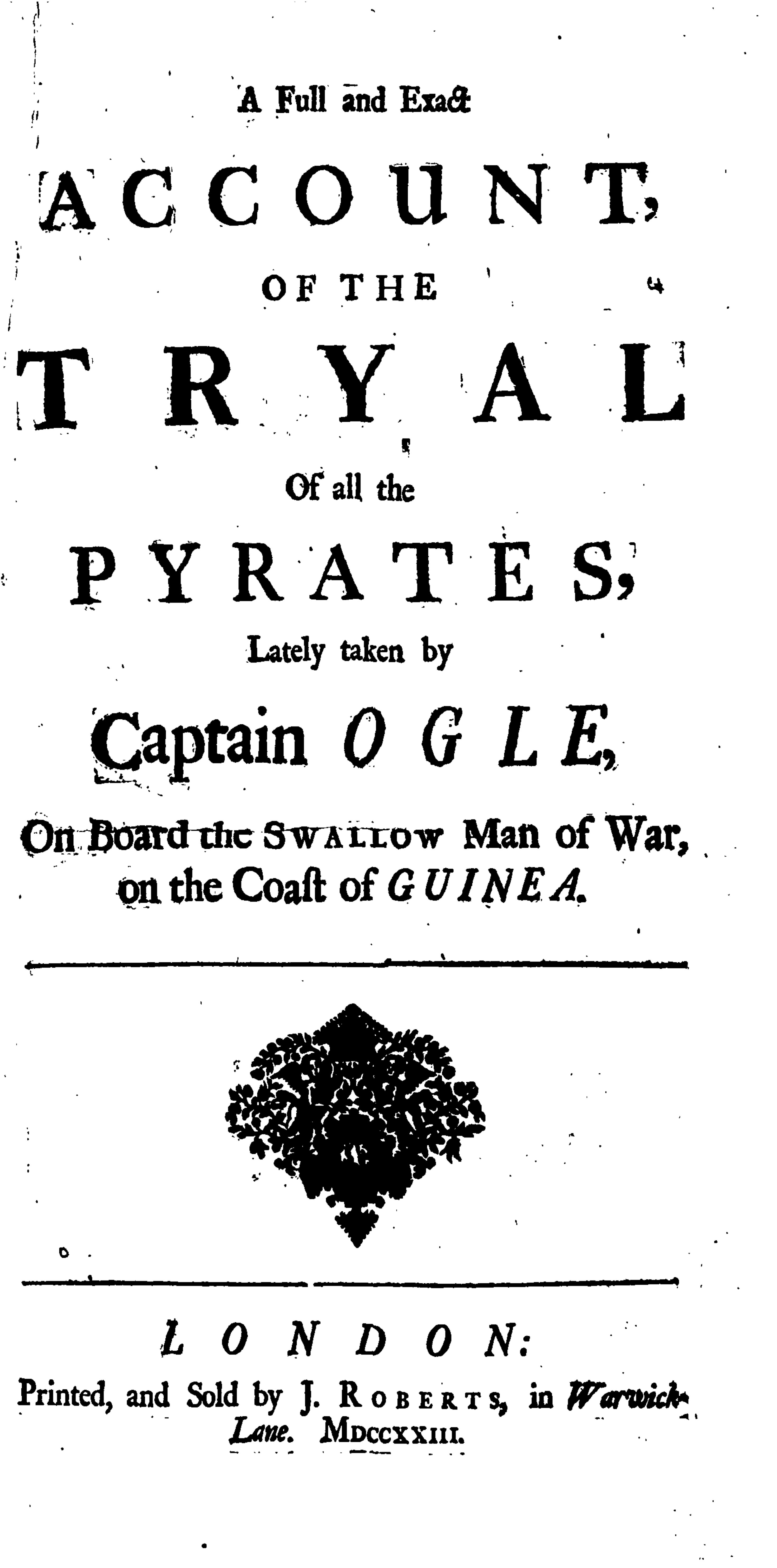
The numbers are the hard part of this room, and they are confirmed, because the printed record prints them. A Full and Exact Account of the Tryal of All the Pyrates Lately Taken by Captain Ogle, published in London in 1723, gives the outcome in its own summary tables: seventy-four acquitted, fifty-two executed, twenty sentenced to servitude, with smaller groups respited or held. These are not reconstructions. They are the tallies the court's own printer set in type.
The court's own words are the object of this room. The indictment read to the prisoners opens by naming what Sailing the Black Flag: The Archives has spent three rooms establishing. These were men "wickedly united, and Articled together, for the Annoyance and Destruction of his Majesty's Trading Subjects". The state, prosecuting for its life, described the pirate company as a thing that united and articled itself. The government at sea and the government that destroyed it agreed on that much. The articling was real; the quarrel was only over whether it was lawful.
The printed pamphlet stands in for a manuscript. The original proceedings survive at The National Archives as HCA 1/99, a composite Vice-Admiralty piece whose catalogue entry does not even name Roberts or Cape Coast Castle. The 1723 print is the record on which these pages rest. The trial's own page sets out the proceedings; the 1723 pamphlet is where the tables and the testimony can be read.
Records in this room
- Event The Cape Coast Trial and Executions, 1722 The Vice-Admiralty court held at Cape Coast Castle (Cabo Corso) on the Guinea coast that tried the surviving crew taken from Roberts's ships. Of those brought before it, 74 were acquitted, 52 hanged, and 20 sentenced to seven years' servitude to the Royal African Company; 17 were referred to the Marshalsea in London. It was the largest mass execution of pirates of the Golden Age, a superlative carried at Probable.
- Document A Full and Exact Account of the Tryal of all the Pyrates (1723) The printed record of the Cape Coast Castle trial of Roberts's crew, London 1723. It reprints Ogle's dispatch, the indictment, the sworn depositions (including the Porcupine burning), the servitude indentures and the summary tables of verdicts.