Gallery · Bartholomew Roberts and the Pirate War · Room 1 of 8
The Elected Captain
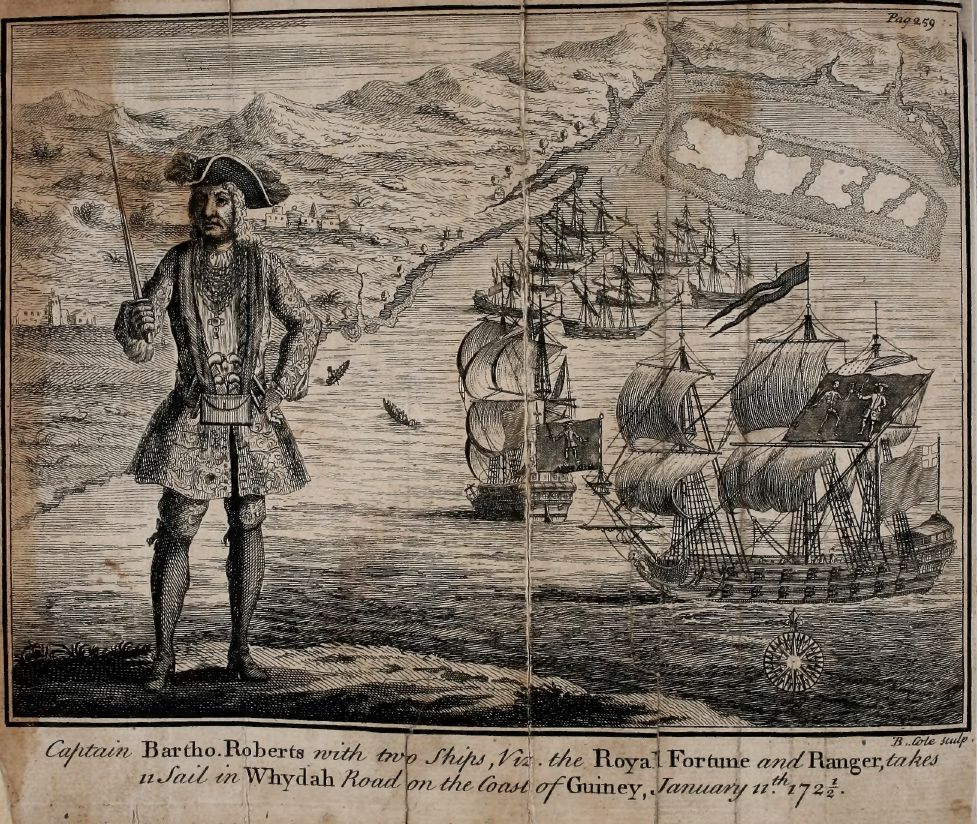
Roberts did not choose piracy. He was taken into it.
In June 1719 he was aboard the London slave ship Princess, off Anomabu on the Gold Coast, when the Welsh pirate Howell Davis captured her and forced some of her men into his company. Roberts was one of them. That much the record will bear, though it reaches us mainly through Johnson and the Dictionary of Welsh Biography, so Sailing the Black Flag: The Archives holds it at probable and no higher. His rank on the Princess is worse than that: second mate in one telling, master in another, and nothing that settles it.
Weeks later Davis was dead, killed in an ambush at Principe, and the company had to replace him. What they did next is the reason this Collection opens here rather than with a birth or a flag. They did not fall to the strongest man or the loudest. They held an election, and they elected Roberts, who had been a pirate for about six weeks.
If you read that plainly, it is the cleanest succession-by-vote the whole period hands us: a company that had just lost its captain choosing his replacement by a show of the company's own will, and choosing a near-stranger over its own veterans. It is the anchor for the site's argument about how pirates governed themselves, and the theme page on crew voting sets it beside the votes of other crews.
Here is the honest limit, and it matters for everything that follows. The election is accepted. The famous trimmings are not documented. The six-weeks interval is Johnson's phrasing, not a dated interval, and the election speech Johnson gives Roberts, the one about a short life and a merry one, is a set piece from a printed book, not a deposition. So the Archives caps the interval and the speech at possible and never quotes the speech as though a witness heard it. What is firm is the fact of the vote. What is soft is nearly every word attached to it.
The page for Roberts himself sets out what can and cannot be said about the man before June 1719. It is a short list. The documented Roberts begins with a vote.
Records in this room
- Person Bartholomew Roberts Welsh pirate captain of the Royal Fortune, elected to command after Howell Davis was killed at Principe in 1719; cruised Brazil, the Caribbean, Newfoundland and West Africa; killed in action against HMS Swallow off Cape Lopez in 1722, after which fifty-two of his crew were hanged at Cape Coast Castle.
- Document A Full and Exact Account of the Tryal of all the Pyrates (1723) The printed record of the Cape Coast Castle trial of Roberts's crew, London 1723. It reprints Ogle's dispatch, the indictment, the sworn depositions (including the Porcupine burning), the servitude indentures and the summary tables of verdicts.