Gallery · Theme · THM-003
Crew Voting and Councils
Also recorded as: the council of the whole company; pirate democracy (modern); shipboard democracy (modern)
Golden Age pirate companies elected and deposed their captains and settled major questions by a vote or council of the whole company. The election speeches and the mock 'House of Lords' are Johnson's; the institution is carried by depositions from four courts across four years.
Curator's note
The practice survives in testimony, and the exhibit is a page of it, the official Jamaica trial print of 1721, below. I've quoted the depositions of four courts through the gallery.
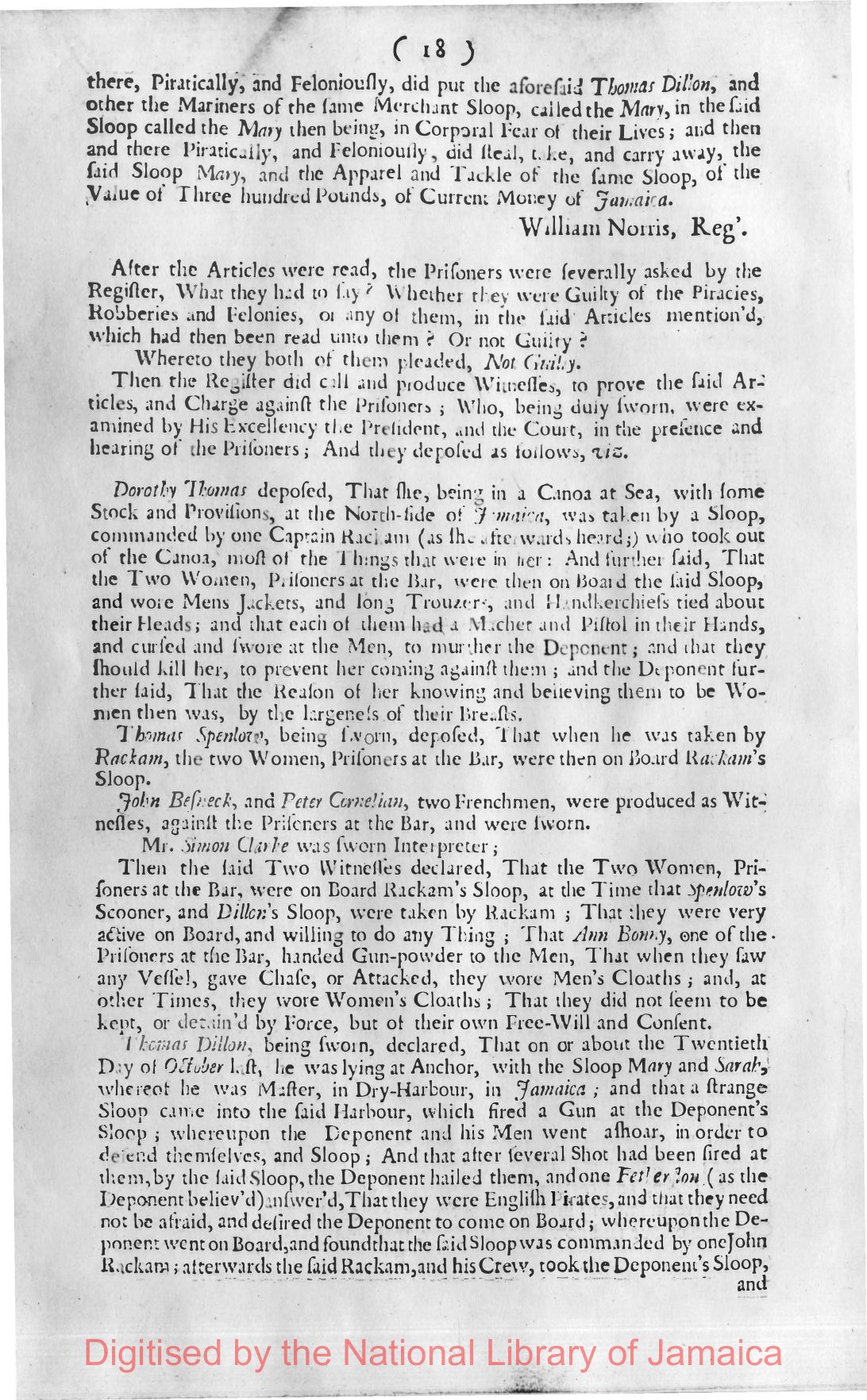
The third of the Pirate Government pages carries the argument's heart, and the same rule governs it. The election speeches and the mock House of Lords are Johnson's literary reconstructions. The institution of the whole-company vote is confirmed by sworn depositions from four courts across four years. The house rule for this page is blunt: assert the institution on the depositions, attribute the theatre to Johnson.
What the practice was
Crew voting and councils were the standing collective decisions of a pirate company. Three linked things made up the practice. The company chose its captain by a majority of the whole company and could turn him out again, so that command was conditional and revocable. Major questions, where to cruise, whom to attack, whether to spare or burn a prize, how to punish a man, went to the assembled company and were settled by consent or majority. And the whole arrangement sat inside a written constitution, the articles each man signed, with an elected quartermaster as the executive counterweight to the captain between councils.
The captain's near-absolute authority was kept for chase and battle. Outside of fighting, sovereignty rested with the company. That reservation is what makes the practice governance and not simply a mob, and it is attested, not assumed.
The four courts: the spine of the page
The strongest thing this page can say is that four separate courts, in four different trial years, recorded pirate companies choosing, deposing and voting. None of these depositions was written to prove a theory of pirate democracy. Each was sworn to convict or acquit a particular man, which is exactly why they carry weight.
Bellamy chosen captain, 1716
John Brown's examination, taken 6 May 1717 and printed at Boston in 1718, records the sloop "Commanded formerly by Hornygold, at that time by one Bellamy, who upon a difference arising amongst the English Pirates because Hornygold refused to take and plunder English Vessels, was chosen by a great Majority their Captain & Hornygold departed with 26 hands in a prize Sloop." The sentence gives both the mechanism, a great majority, and the trigger, a policy quarrel over attacking English shipping. It is graded Highly Probable rather than Confirmed: a deposition reading "chosen by a great Majority ... Hornygold departed with 26 hands" fits a factional split as well as a formal ballot, and the month is disputed. This page holds the claim at that level.
Vane turned out, 1718
The 1721 Jamaica trial of Robert Deal preserves a deposing. After Vane's brigantine attacked a French man-of-war about 23 November 1718 and was beaten off, "the Pirates quarrelled among themselves, and divided their Company ... That the Quarter-Master, being made Captain of their Brigantine, they turned out Charles Vane, Robert Deal ... and Fifteen Men more, and put them on Board a small Sloop." This is a company removing its captain and raising the quartermaster, carried in a deposition. It is Confirmed as a quarrel and an elevation. What it does not describe is a counted vote, and it names neither Rackham nor the cowardice that Johnson supplies. The vote, the cowardice and Rackham's succession are Johnson's overlay, capped at Possible.
Every's company calls a council, 1695
The 1696 trial of Henry Every's crew gives the word itself. Learning that the Moco fleet had passed, the company, "calling a Council they agreed to follow them; and accordingly went after them, and came up with one of them." A council of the whole company, deciding a target, in a period trial print. The same trial shows the company as the body that allocated the plunder: "some had a thousand Pound, some had eight hundred ... every Man in the Ship his Share, as they thought they deserved."
Roberts's company votes a prize, c.1721
At Cape Coast in 1723, John Wingfield deposed that a brigantine, the one "he was taken in, was voted by the Pyrates to be burn'd", and that "he really believes he was the Instrument of saving her." The verb is bare and unmistakable: the company voted on the fate of a captured ship. The same pamphlet is thick with the articles as the frame of membership, forced men pleading they were "dragged along to the Signing of their Articles", and one deposition that a captured surgeon was a man on whom "they would have imposed their Articles." Signing made a man a voting, sharing member; refusing was the forced man's defence.
Theatre versus institution: the house rule
What the depositions give is the fact of collective choice. What they almost never give is the procedure: no show of hands, no count, no franchise rule, no quorum. The colour that everyone remembers comes from elsewhere. Roberts's election speech, Bellamy's "I am a free prince" oration, the mock "House of Lords" that supposedly tried prisoners, all of these are Johnson's reconstructions, and all cap at Possible. The mock court in particular is absent from the 1723 Cape Coast print, which holds only "Lords Commissioners" and "Lords of the Admiralty", the crown's own institutions. Roberts's own election as captain after Davis's death in 1719 sits at Possible for the same reason: the event is plausible and consistent with the evidence, but the speech that carries it is Johnson's.
Guards against romanticising
Three over-claims are easy to slide into, and the page refuses all three. The one-off seizure of a ship from her lawful captain, Every's men running away with the Charles the Second at Corunna in 1694, is a founding act, not the standing constitution; it belongs to the origin of a company, not to proof of its routine democracy. A naval or privateer council of war was an officers-only body under commission, the opposite of the whole-company franchise that defines the pirate council; the two must not be elided. And the picture of the pirate ship as a floating commonwealth flatters the evidence. The same prints that carry the votes carry the forced men and the pistol on the table. Collective choice on specific questions is documented. It ran inside a coercive, violent trade, and the page shows both in the same frame.
The record is good on the fact of the vote and poor on its machinery. We can prove a company chose, deposed and voted. We cannot, from these sources, say who exactly held the franchise, how the count was taken, or what majority was needed. A fuller reading of Snelgrave's 1734 narrative on the Sierra Leone elections of 1719 would add a fourth independent witness; this page does not yet draw on it.
Evidence behind this record
- Pirate companies settled major questions (targets, the fate of prizes, punishment) by a vote or council of the whole company; the institution is carried by depositions from four separate courts. Trial records: 1696 Every trial ('calling a Council'), 1721 Jamaica trials (deposing), 1723 Cape Coast trial ('voted by the Pyrates to be burn'd'), Boston 1718 examination ('chosen by a great Majority')
- Golden Age pirate companies elected their captains by a majority of the whole company: Bellamy 'was chosen by a great Majority their Captain' after Hornigold refused to plunder English vessels. Highly Probable Sworn examination: John Brown's examination, 6 May 1717 (The Trials of Eight Persons, Boston 1718; OTA transcription of TCP N01688). Held Highly Probable: the vote-versus-mutiny mechanism and the month are disputed
- A pirate captain could be deposed by the company: after Vane's brigantine was beaten off by a French man-of-war (about 23 November 1718), the company divided, made the quartermaster captain and turned Vane and Deal out. Trial deposition: 1721 Jamaica trial of Robert Deal: 'they turned out Charles Vane, Robert Deal ... and put them on Board a small Sloop'. Confirmed as a quarrel and elevation, not a counted vote; the 'vote', 'cowardice' and Rackham's succession are Johnson's overlay (Possible)
- Pirate companies decided major questions in a council of the whole company: the Every company, learning the Moco fleet had passed, 'calling a Council they agreed to follow them'. Court record: 1696 trial of Henry Every's crew, narrative of facts
- The company voted on the fate of prizes: at the 1723 Cape Coast trial John Wingfield deposed that a brigantine 'was voted by the Pyrates to be burn'd'. Trial deposition: 1723 Cape Coast trial, deposition of John Wingfield
- The romanticised set-pieces of pirate democracy (the mock 'House of Lords' court, the captains' election and defiance speeches, Roberts's election speech of 1719) are Johnson's literary reconstructions and are capped at Possible; the mock court is absent from the 1723 Cape Coast print. Possible Printed history (Johnson): Johnson, General History Vols 1 (1724) and 2 (1728); the 1723 Cape Coast print holds only 'Lords Commissioners'/'Lords of the Admiralty'
Open research
Franchise and procedure (who exactly voted, how the count was taken, what majority was needed) are not established by the sources in evidence. The Bellamy election is held at Highly Probable, the vote-versus-mutiny mechanism and month disputed. A fuller reading of Snelgrave 1734 on the Sierra Leone elections of 1719 would add a fourth independent witness; it is not yet drawn on here.