Gallery · Theme · THM-002
Quartermasters and Divided Authority
Also recorded as: Quarter-Master; Quarter-Mafter; the pirate quartermaster
The pirate quartermaster was an elected officer holding the civil and economic authority of the company and standing as the crew's counterweight to the captain. The office is attested well beyond Johnson, in trial depositions and Snelgrave's firsthand narrative.
Curator's note
The office survives in testimony, in the sworn depositions and Snelgrave's firsthand narrative quoted below. The book that describes it most fully is Johnson's General History, and that's the exhibit on display.
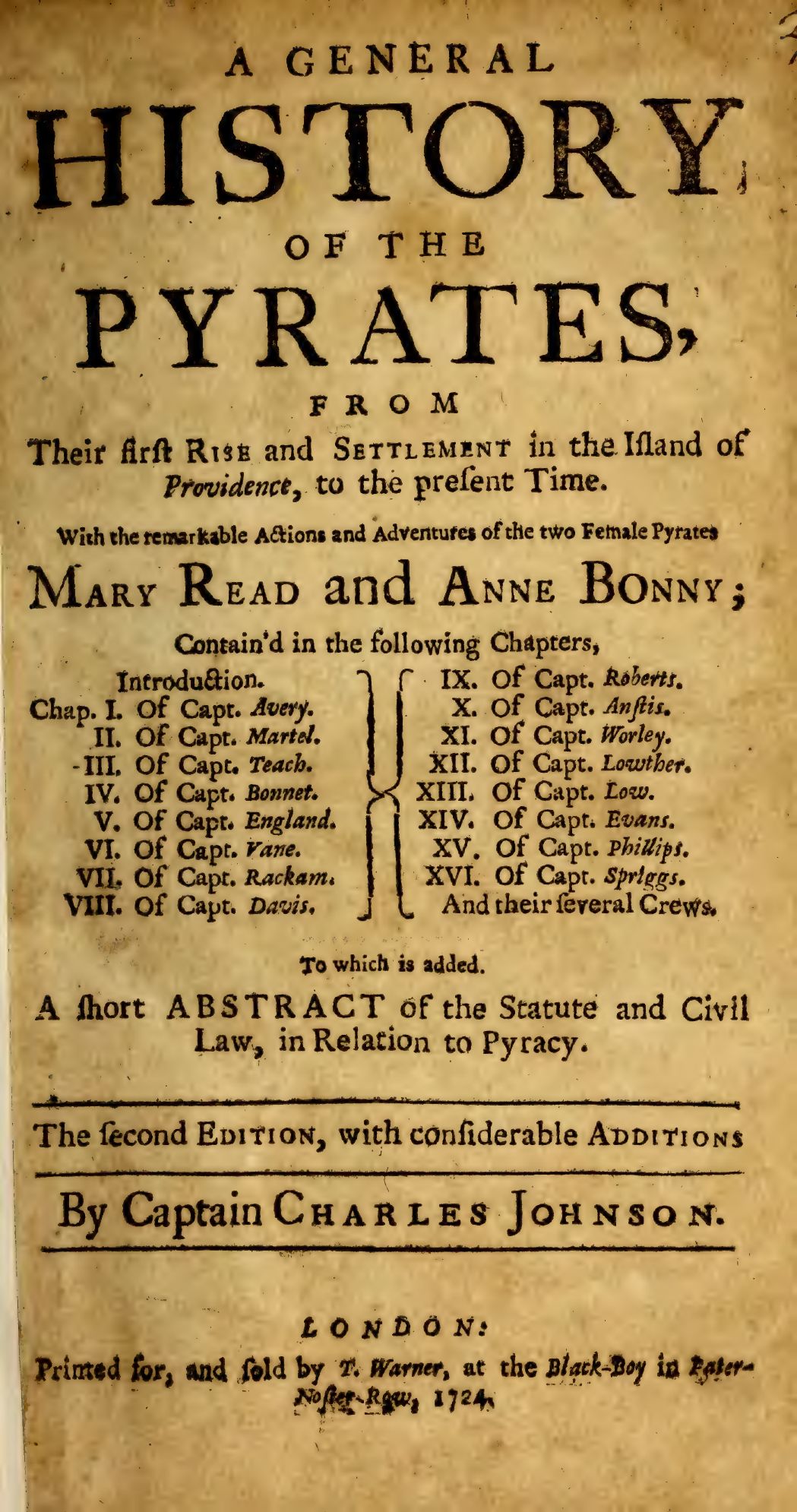
The house rule for the Pirate Government pages holds here too. The literary set-piece of the quartermaster, the "civil Magistrate" with his mock House of Lords, is Johnson-only. The office itself, elected, revocable, holding the company's money and much of its discipline, is confirmed by sworn depositions from four courts across four years, and by one firsthand narrative outside the trials.
What the office was
Aboard Anglo-American pirate ships of roughly 1690 to 1726, the quartermaster was an elected officer who held the civil and economic authority of the company. He was the crew's man and the captain's counterweight. Where a naval captain's word ran the whole ship, the pirate captain's near-absolute power was reserved to chase and battle; the rest of the time authority sat with the quartermaster and, above him, with the company that had chosen them both. This is the divided-authority core of the Pirate Government argument, and it does not rest on Johnson alone. Two trial records, one firsthand captivity narrative, and an earlier trial carry it independently.
His attested functions were concrete. He was custodian and distributor of plunder and provisions, first aboard a prize, separating what he judged fit for the company and allotting each man his share. He was a magistrate for the small offences the articles did not cover, punishing by drubbing or whipping and restraining ill usage of prisoners. He led the boarding party. He was the standard successor when a captain was deposed or killed. And he held his place by the votes of the company, which could turn him out.
The naval homonym: a scope trap
There are two offices that share the name, and the reader who imports the wrong one loses the whole point. In the Royal Navy and in merchantmen the quartermaster was a petty officer: he attended the helm and the conning of the ship, the binnacle and the steering, the stowage of the hold, and the issue of provisions and the spirit ration. He had no power over shares, no judicial standing, no political place, and he was appointed from above rather than elected. The pirate quartermaster absorbed the provisioning core of that role and built an elected magistracy on top of it. Snelgrave, taken by pirates off Sierra Leone in 1719, saw the two layers side by side: his captors kept "all other Officers as is usual on board Men of War" in addition to captain and quartermaster. The word was the same. The office was enlarged.
The powers, as the depositions give them
The office was elected and revocable. At Cape Coast in 1723 the court treated it as a matter of course, asking a prisoner "why they voted for such a Quarter-master, since what he did, being chose by their Votes, was their Action." The crew answered for the man they had elected. The bench's phrasing does the work: election by votes, and collective responsibility for the officer's acts.
He controlled the plunder. Benjamin Krest, master of the Gertruyt, deposed that William Magnes "came on Board as Quarter-Master of the Pyrates, and order'd his Provisions out." Another witness described the custom exactly: "after the Quarter-master has done with taking what he thinks fit for the Company's use, those that go with him do then serve themselves", and a prisoner "accepted of nothing on board a Prize, but the Shares the Quarter-master allotted him." First pick for the company, then the allotment of every man's portion.
He was the successor. Hosea Tisdell, a Kingston tavern-keeper, swore that after Charles Vane's company met a French man-of-war in November 1718 and was beaten off, "the Pirates quarrelled among themselves, and divided their Company. That the Quarter-Master, being made Captain of their Brigantine, they turn'd out Charles Vane, Robert Deal ... and Fifteen Men more." When the company removed the captain, it raised the quartermaster in his place. Tisdell leaves the man unnamed; the identification with John Rackham is Johnson's, not the deposition's.
And one witness outside the trials describes the whole division of authority in a single breath. William Snelgrave, writing from his own captivity in 1734:
the Captain of a Pirate Ship, is chiefly chosen to fight the Vessels they may meet with. Besides him, they chuse another principal Officer whom they call Quarter-master, who has the general Inspection of all Affairs, and often controuls the Captain's Orders: This Person is also to be the first Man in boarding any Ship they shall attack; or go in the Boat on any desperate Enterprize.
Snelgrave also watched the office act as a court. When a boatswain meant cruelty to him after quarter had been given, a passenger complained "to the Quarter-master and Company", urged the maxim against ill usage of prisoners, and "many of them voted for his being whipp'd." The quartermaster and the company together were the bench.
Named quartermasters, at their grades
Two are confirmed from the primary trial print. William Magnes (spelled Magnes, Magnefs or Mugnes, never "Maynes") was a named quartermaster of Roberts's company: a witness swore he "came on Board as Quarter-Master of the Pyrates." David Simpson, called "the old Quarter-master", was his predecessor in the same company, named when a prisoner protested he had voted "for David Simpson the old Quarter-master ... for that this Successor Magnes was too honest a Man for the Business."
Three more are carried at Possible, on Johnson's word alone. John Rackham as Vane's quartermaster rests on Johnson; the Tisdell deposition that records the succession leaves the man unnamed, and Rackham surfaces in no record before August 1720. Richard Hardy is a convicted senior pirate in the 1723 print but is not titled quartermaster there; the title is Johnson's. Richard Corner appears as quartermaster of Rackham's own later company on the 1721 Jamaica roll, again on Johnson's authority. And one name in wide modern circulation gets no support at all: Paul Williams as Bellamy's quartermaster is carried by no source cited for this theme. It would need the 1717 Boston trial of the Whydah crew, and without that record Sailing the Black Flag: The Archives does not assert it.
The "Lords" are Johnson's
Johnson gives the office its most quotable form: the quartermaster "claims all Authority this Way (excepting in Time of Battle)", "punishes at his own Arbitrement, with drubbing or whipping", "is Trustee for the whole, is the first on Board any Prize", and "acts as a sort of a civil Magistrate on Board a Pyrate Ship." He also styles the senior men of Davis's and Roberts's companies "Lords" and their body a "House of Lords". That last flourish is charming and it is uncorroborated. It appears in no period trial print cited here. The Cape Coast pamphlet holds only "Lords Commissioners" and "Lords of the Admiralty", the crown's institutions. The civil-magistrate summary, the two-shares figure and the House of Lords all cap at Possible and travel under Johnson's name.
What the sources will not give is the inside of the office in any one named company: how a quartermaster was nominated, how a vote to remove him ran, where his authority stopped and the captain's resumed. The depositions prove the office existed and did these things. They are thin on the procedure.
Evidence behind this record
- Aboard Anglo-American pirate ships of c.1690-1726 executive power was divided between an elected captain (command in chase and battle) and an elected quartermaster (civil, economic and disciplinary authority the rest of the time), with revocable sovereignty in the company. Highly Probable Trial records and firsthand narrative: Divided-authority core carried by the 1723 Cape Coast and 1721 Jamaica trials, Snelgrave 1734 and the 1696 Every trial; rises above the Johnson ceiling
- The pirate quartermaster was elected by the company and could be turned out; the 1723 court treated him as 'chose by their Votes'. Court record: 1723 Cape Coast trial, William Fernon: the court asks 'why they voted for such a Quarter-master, since what he did, being chose by their Votes, was their Action'
- The quartermaster was custodian and distributor of plunder and provisions: first aboard a prize, he separated what he judged fit for the company and allotted each man his share. Trial depositions: 1723 Cape Coast trial: Benjamin Krest on Magnes ordering provisions out; John Parker on the quartermaster taking 'what he thinks fit for the Company's use' first and allotting shares
- When a captain was deposed, the quartermaster was the standard successor: on turning Charles Vane out in November 1718 the company made the quartermaster captain. Trial deposition: 1721 Jamaica trials, Hosea Tisdell's deposition: 'the Quarter-Master, being made Captain of their Brigantine, they turn'd out Charles Vane, Robert Deal ... and Fifteen Men more'; the deponent leaves the quartermaster unnamed
- A firsthand captive describes the divided authority directly: the quartermaster has 'the general Inspection of all Affairs, and often controuls the Captain's Orders', and is first to board. Highly Probable Firsthand narrative: William Snelgrave, A New Account of Some Parts of Guinea (1734), captivity narrative; non-Johnson, held Highly Probable
- William Magnes was a named quartermaster in Bartholomew Roberts's company, and David Simpson ('the old Quarter-master') preceded him in the same office. Trial depositions: 1723 Cape Coast trial: 'he came on Board as Quarter-Master of the Pyrates' (Magnes); a prisoner voted 'for David Simpson the old Quarter-master'. Print spellings Magnes/Magnefs/Mugnes; never 'Maynes'
- The articulate set-piece of the quartermaster as a 'civil Magistrate', the two-shares figure, and the mock 'House of Lords' are Johnson-only and uncorroborated in the cached trial prints. Possible Printed history (Johnson): Johnson, General History Vol. 1 (1724), Roberts chapter (Gutenberg 40580); 'House of Lords' absent from the 1723 Cape Coast print, which has only 'Lords Commissioners'/'Lords of the Admiralty'. Capped Possible
Open research
The 'civil Magistrate' summary, the two-shares figure and the mock 'House of Lords' are Johnson-only (Possible). Rackham's, Hardy's and Corner's quartermaster titles rest on Johnson. Paul Williams as Bellamy's quartermaster is carried by no source cited here and would need the 1717 Boston trial of the Whydah crew. The internal procedure of the office in any named company is undocumented.